Let's roll some dice, watch some movies, or generally just geek out. New posts at 6:30 pm ET but only if I have something to say. Menu at the top. gsllc@chirp.enworld.org on Mastodon and @gsllc on Twitter.
I’ve been itching to watch the movie, Venom, for quite some time and finally watched it. It didn’t disappoint. Make no mistake about it: This isn’t something like the MCU that hides superb acting and writing within a fantasy-action film. It is what it is, but what it is is a lot of fun. Why else do you go to the movies except to have fun? Sometimes action is all you need.
Professional movie reviewers (the pre-internet world’s “influencers”) disagree. According to Rotten Tomatoes, Venom’s approval ratings are 80% for real people and only 29% for movie reviewers. Even politicians aren’t that out-of-touch with the people they serve. Seriously, how do these people have jobs? Who’s paying them?
From a purely artistic (not financial) standpoint, you can’t say a movie shouldn’t have been made unless absolutely no one likes it. Otherwise, it has artistic value. Movie reviewers shouldn’t be writing their reviews from the perspective of their own subjective point of view. They should put their egos and snark aside and focus on to whom the movie might appeal based on its themes and genre. Then the reader can predict whether or not it will appeal to them. That would be useful. That’s what I try to do with my writing, but I’m not a talented creative writer, so the professionals should do that.
I saw a play at Arena Stage decades ago, and one of the lines that always stuck with me was, “I don’t want to see one of those foreign films you like. If I wanted to read, I’d have stayed home with a book.” The speaker was talking to someone who should have become a movie reviewer. There’s nothing wrong with enjoying a book, and there’s nothing wrong with seeing a film with subtitles, but sometimes you don’t want either.
If a critic wants to assign a rating to a movie (i.e., one star, two star, etc.), that’s fine; we can all ignore it. But to do their job correctly, their review must disclose the genre and themes of the movie so that each of us can make an informed decision as to whether the movie will likely interest us (or our children, if applicable). Those are the only opinions that matter to each of us.
Sometimes you just want to see someone get his head bitten off. Venom delivered. It was fun.
There’s only one thing about the movie that stood out that I didn’t like: The typical comic book trope of a villain having the same powers as the hero. But hell; it’s an origin story. I’m looking forward to the next one.
If you enjoy this post, please retweet it. Other posts in this series can be accessed by clicking here.
Last night was another quarantine watch party hosted by Brandon Davis of ComicBook.com. This time it was Spiderman: Far from Home, and the small part I want to highlight is William Ginter Riva. There were several characters that helped Beck in his master plan. William was one of those characters. He had a small part . . . twice. He first appeared in Iron Man.
Jump to 0:10. Or just wait for it. It’s only 10 seconds.
Then he appeared again in Far from Home.
Jump to 2:10.
Unlike the other No Small Parts entries, he probably got a bit over 2 minutes of screen time, but the added value of this part is the connection it draws between the first modern MCU film, Iron Man, and the first one after which Tony Stark had died (representing a coda to the Tony Stark legacy). The thing that amazes me the most about the MCU is that I can’t think of any cinematic universe that tied together so many independent stories that collectively told a bigger one. Star Trek came close, and Star Wars came closer, but the MCU is the new standard for such a thing. Every movie stands 100% on its own yet tells a common story across 23 films. The fact that William appeared only at the very beginning and then at the very end makes the MCU feel a little bit more real, and thus relatable.
William was a small but significant way to remind us of that larger story, so I can’t help but appreciate this role.
Side note: What some may not know is that William was played by Peter Billingsley, who played Ralphie in 1983’s A Christmas Story. The best part, of course, is that they made a (not so?) subtle reference to “You’ll shoot your eye out.”
Jump to 2:33 for the reference.
Other posts in this series can be accessed by clicking here.
If you enjoy this post, please retweet it. Other posts in this series can be accessed by clicking here.
Unlike the other MCU films, the overarching storyline in Captain America: Civil War wasn’t the Avengers finding a way to come together, but rather the Avengers being torn apart. Behind the scenes, the Sokovia Accords were being written, and Secretary Ross was getting ready to confront the Avengers, but for the disassembly of the Avengers to occur, it had to come from within. The two factions were led by Steve Rogers and Tony Stark. Steve needed no outside help to make his stand; it’s what he does. Likewise, Tony is prone towards sacrificing liberty in favor of security, but in prior films, he insisted on being the one in control of that security. Something had to push him over the edge to where he’d be willing to surrender that control to the government that he so routinely dismissed.
Enter Miriam, played by acting veteran Alfre Woodard.
Jump to 0:55 for the scene in question.
Miriam tells the story of her son, Charlie Spencer, who had the city of Novi Grad, Sokovia dropped on him during the events of Age of Ultron. She blamed the Avengers for his death and laid a huge guilt trip on Tony Stark in that scene.
One of my pet peeves about superhero movies is the after saving the world, the unappreciative human race vilifies the heroes because of the collateral damage that occurs, ignoring that, in some cases, without the heroes the entire human race would be killed. That’s certainly a theme in Civil War, and it’s annoying as hell, but in Civil War those arguments were no more than a means to advance a more reasonable position. The United Nations truthfully understood that what the Avengers were doing was right, and that the consequences of those actions were often not the Avengers’ fault. They simply wanted international oversight to minimize those consequences.
But logic isn’t always the best motivator. Even the most stoic among us are emotional creatures. You can’t blame the Avengers for feeling bad about what happened. If a criminal held a gun to a loved-one’s head, and you felt you had to kill the criminal in order to save that person’s life, the world wouldn’t blame you, but you might still find it difficult to deal with having killed another human being. Maybe you could have disarmed the criminal, and if so overpowered him. Tony was facing the same emotional dilemma, and to make matters worse was the creator of the threat, Ultron. Even more, maybe Tony could have zigged when he zagged and saved some more lives.
Miriam appealed to that emotion, and in less than 2 minutes of screen time, set in motion the civil war between the Avengers.
Other posts in this series can be accessed by clicking here.
If you enjoy this post, please retweet it. Other posts in this series can be accessed by clicking here.
The DCEU is dark. In Man of Steel, Superman lost his mother and father before he knew them, and then lost his adoptive father just after reminding him he wasn’t his real father. Bruce Wayne famously lost both his parents, and that loss created the Batman. Wonder Woman couldn’t move forward without turning her back on her family, and by the end of the movie, she lost her one true love. The DCEU likes to kill heroes’ families.
The DCEU has taken some heat for how dark its tone is. The argument I’ve heard the most is that Marvel has always been upbeat, and Marvel is a success, so that must be the path to success. I think that’s a strange line of thought. First, there can be more than one path to success, and plenty of dark movies have enjoyed success. Second, the DCEU had to take its own path. If it had mimicked Marvel, it would have inspired just as many detractors who would have criticized a lack of originality. (My suspicion is that many of those detractors would have been the same people, but we’ll never know.) Whether you agree or disagree, my bottom line is that I’m glad it forged its own path, and I’ve enjoyed all the DCEU movies.
The Light in the Darkness
Moving to Aquaman, Jason Momoa played a brooding, reluctant hero who avoided connection at all costs due to his half-breed status and the loss of his mother. This is right in line with the darkness that I’ve enjoyed. That said, too much of even a good thing can be bad. We needed a break, and not just a scene or two. We needed hope, and not just an alien letter on a shirt. We needed to see Aquaman connect in a big way, and reuniting with his long, lost mother was just that. But that could have felt forced if not for the hints we had that deep down inside he sought that connection. Besides his scenes with his father, that started with the bar scene.
Go to 2:02 for the bar scene.
Granted, the build up within that scene was a bit overacted (which appears to be solely the script’s fault), but it redeemed itself by quickly shifting to comedy and lightheartedness. The actor portraying “Biker” is Luke Owen. Finding his information has proven difficult, so I can’t point to anything else he’s done or even copy him on this post. But as I’ve stated in my first and second “No Small Parts” posts, the scene and Mr. Owen’s part were important. They started the build up to the much-needed light in the darkness of the DCEU.
I leave you with a great song from the soundtrack.
Other posts in this series can be accessed by clicking here.
If you enjoy this post, please retweet it. Other posts in this series can be accessed by clicking here.
After participating in the Guardians of the Galaxy quarantine watch party, I published a post referencing the show business adage that there are no small parts. In doing so, I used Bereet as evidence supporting that adage. Today, I’m going to use the sympathetic physical therapist, played well by Kobna Holdbrook-Smith.
Character Growth
Like Tony Stark, Stephen Strange (slowly) grew from a self-absorbed jackhole to someone serving others, but unlike most others in the MCU did so by changing his methods. When the arms-dealing Tony Stark’s focus shifted from himself to others, his methods didn’t change. He still accomplished his tasks through weaponry. Thor still ran into battle headfirst relying on brawn more than strategy. Nebula’s plan for saving half the universe still involved murder, and her target was a family member. The Guardians in general were still scavengers looking for a payday to finance their universe-saving efforts. They worked with what they knew.
Strange was different. Off the top of my head, he was unique among the major MCU characters in that it wasn’t just his attitude that changed, but also his methods. Strange had to open his mind to other means to accomplish his goals. Strange’s circumstances largely removed his medical skills from his playbook, but he wasn’t being told to abandon them; in fact, he used them to help Dr. Palmer operate on him. The Ancient One’s point was that he had to add new skills. Experts “can often see in part but not the whole.” While I don’t believe in magic, as a general principle, this is certainly true. The more complex our base of knowledge becomes, the harder it is to understand everything necessary to solve large problems. But this is a superhero movie, so let’s stick with the magic. Strange needed to add magic to his repertoire, and while he could have used that magic to return to his old life, his new-founded altruism forced him to focus on a new skill set in favor of the old.
Bachelor’s Degree
In the prior post, I asked, “[H]ow can you appreciate that growth if you don’t experience its full progression?” That is, to appreciate the growth, you must first clearly establish the character’s starting point, which leads us to Holdbrook-Smith’s part.
Unfortunately, these videos get taken down from time to time. Here’s only the latter part of the scene with annoying 3D red and blue tint.
The physical therapist represents an important part of Strange’s own field, yet Strange responds to him with condescension (“Bachelor’s Degree”). Granted, Strange is emotionally compromised by his injuries, but Strange exhibited this same behavior earlier when discussing being a part of the emergency room team, and when criticizing the other surgeon, Dr. Nicodemus West (who could easily have been the subject of this post). The physical therapist was there to remind us of this specific character flaw at a time when we may have forgotten it. He also helped make it clear that even someone doing his job competently and exhibiting remarkable patience in the face of Strange’s insults, isn’t protected from them.
No doubt, this is a subtle point, but as I said before, actors with quick appearances, even if they have no lines and are relegated to the background, provide necessary color to scenes. Holdbrook-Smith did that for us, whether we were paying attention or not.
Other posts in this series can be accessed by clicking here.
If you like this post, please retweet it. Or comment. Seriously, more than any others, I’d like to know if anyone actually likes this post. That’d be weird.
Better late than never?
I wrote this in 2012 but never published it. I wanted to finish Part II before doing so, but I never really learned how to create artifacts in 4th Edition D&D, so that never happened. It’s been sitting in my Drafts folder for 8 years and 9 days. Just in case anyone is playing 4th edition and can make use of these high-paragon to epic level NPC stat blocks, and/or my take on their history, here they are. I’m not optimistic, but this “quarantine life” finds me posting a lot of material. Warning: I haven’t proofread this other than to delete a dead link. 🙂
In 2010, Wizards of the Coast published Dragon 178, and in it was an article that provided 4th Edition material for the creatures that appeared in the remake of Clash of the Titans. With the release of the sequel, Wrath of the Titans, it’s time for a sequel to the article. This article contains the stat blocks for the creatures that appeared in the movie. Part II will provide the artifacts that appeared in the movie: Zeus’s Thunderbolt, Hades’ Pitchfork, Poseidon’s Trident, and the Spear of Triam, as well as the stat block for Kronos himself.
These creatures are built based in large part on how they were portrayed in Wrath of the Titans. Obviously, the movie took (far too many) liberties with the legends, and at times the legends themselves contradict, so don’t expect a perfect congruence between the creatures as presented here and your personal understanding of their legendary counterparts. FYI, a third movie is planned. May Tharizdum have mercy on our souls.
The Chthonic Cyclopes of Hephaestus
My depth perception may be lacking, but that doesn’t matter when I swing for the fences.
Hephaestus guarded himself with three Cyclopes, a father and his two sons. These giants aren’t by any means evil, but as brutes, they tend to fire, ready, and aim in that order. They represent a good test of character for PCs that might take the same approach. Sometimes tact is the best weapon you have. If that fails, they’ll never attack someone wielding Poseidon’s Trident.
Lore
Arcana 37: Chthonic Cyclopes are master blacksmiths that aid Hephaestus in his work. Though not inherently evil, they’re territorial and fiercely protective of their master. They will attack first and ask questions later, but they will certainly
Encounters
The Chthonic Cyclops is the epitome of a brute, charging into battle against any sentient creature daring to intrude upon Hephaestus’s island sanctuary. It will use Hurl Foliage to toss tree trunks at its opponents until it has entered melee range, then switching to Sweeping Club to lay waste to its enemies. For lower-level characters, they represent an opportunity to negotiate a truce in the heat of battle by way of a skill challenge. For higher-level characters, they represent a good test of character for PCs that might be inclined to immediately attack. Sometimes tact is the best weapon you have. If that fails, they’ll never attack someone wielding Poseidon’s Trident.
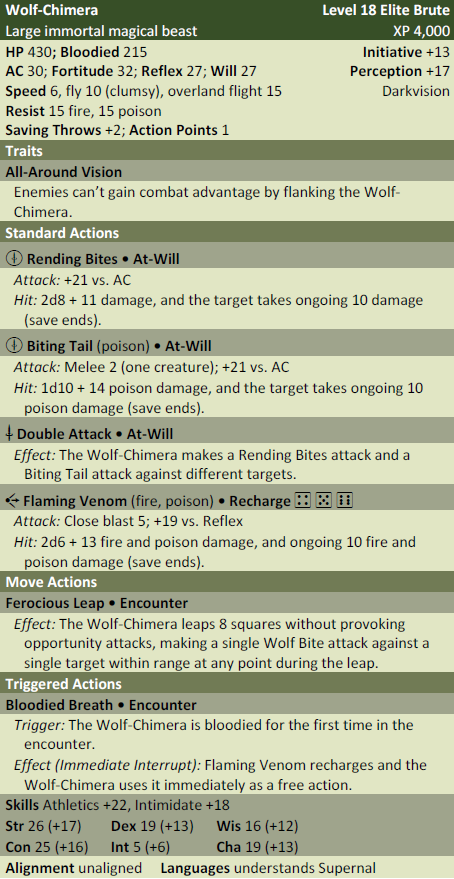
Wolf-Chimeras
Look, people. Special effects difficulty goes up exponentially by the number of heads you put on these things. Three heads of different animal types is just too much to ask of the filmmaker.
Unlike their better-known, worldly cousins, these creatures have only two heads, both of which are that of wolves that can spew ignited venom. Additionally, their tails end in serpent’s head that packs a poisonous bite.
Lore
Religion 32: Residents of the underworld, these immortal beasts serve Hades as a reminder of the order of things. Their master, god of the Underworld, Hades, relies upon the fear of mortals to feed his divinity, and uses Wolf-Chimeras as a source of that fear. Hades occasionally sends these creatures to the World to random places at random times, leaving its residents in constant state of fear. The resultant carnage can weaken a city’s resources, or forever wipe remote villages from the World.
Encounters
Wolf-Chimeras are used by gods of the underworld to strike the occasional chord of fear. However, they occasionally serve as an initial wave of attack in a war against humanity, serving as a harbinger of much worse things to come.
Tactics
A Wolf-Chimera begins combat by closing the gap with Ferocious Leap. The Wolf-Chimera will use Flaming Venom whenever available, but will otherwise use double attack to do as much damage as possible.
The Tartaran Minotaur
The ancient Greeks had no concept of dentistry. Even the gods couldn’t fix my teeth.
The greatest of minotaurs guards the greatest of mazes. With a spirit-filled maze, Tarterus, as its domain, this already fearsome creature knows exactly how to strike fear into the hearts of its enemies, then tears them to pieces with his natural weapons.
Lore
Religion 35: When Zeus, Hades, and Poseidon commissioned Hephaestus to create the prison-maze of Tartarus, the architect knew that a guardian was needed. Knowing of the affinity minotaurs have for mazes, Hephaestus chose from among their greatest warriors the honor of immortality, all for the small price of eternal damnation. It took very little time for the guardian’s rage to cross into the realm of insanity, but his insanity didn’t stand in the way of complete mastery of his domain. He uses its effects to full advantage.
If we have to be miserable, we’re taking you down with us!
Encounters
The great maze of Tartarus houses the souls of those who lived treacherous lives. These souls find little solace in their eternal existence and savor the rare opportunity to feed off the fear of the living that pass through their prison. They accomplish this feat by uncovering the greatest fear from within the minds of their targets and enhancing it. The Tartaran Minotaur takes full advantage of the crippling effect this causes.
Tactics
The Tartaran Minotaur attacks with its bare hands and horns. It attempts to gain surprise — a feat made relatively easy by its surroundings and at-will invisibility — and attack an unsuspecting target with its Teleporting Slam. Once isolated with its prey, the Tartaran Minotaur stays hidden the shadows, slipping in and out of invisibility, and doing extra damage from the resulting combat advantage.
Soldier of Kronos
When not waging war, we make great Vegomatics(TM)
When Kronos formally launches his war against humanity, he will be preceded into battle by the damned souls of long-dead soldiers, some of whom are fused into a single being.
Lore
Religion 31: When a great soldier dies, he becomes a leader in Hades’ army. When a mediocre soldier dies, his life force is joined to another in the hopes that together they will serve competently as foot soldiers in that army. Accordingly, these dual-torso soldiers serve as the first line of attack in the war waged upon residents of the World by the god of the underworld.
Encounters
Soldiers of Kronos protect Kronos from harm while he remains imprisoned. As Kronos emerges from the underworld to begin his war against humanity, he hurls Soldiers of Kronos onto the battlefield before him, where they weaken his enemy’s forces by literally slicing through their ranks.
Tactics
The Soldier of Kronos is thrown onto the battlefield by Kronos. Upon landing, it uses Cinder Strike to burn all in its range, then immediately hurls itself into battle using Rain of Steel. It constantly moves across the battlefield, attacking a different target each round. It focuses on a single target only if no other targets remain.
Follow me on Twitter @gsllc Follow Wizards of the Coast @wizards
On April 3, 2020, I posted my observations made during the quarantine watch party of Shazam. During a resultant discussion on Facebook, I referenced haters of the film, to which my friend, Erik, responded, “I’m sure they’re out there, but I can’t think of anyone in my real life who saw it and didn’t like Shazam.” My impression is that people hated the film, but Rotten Tomatoes says otherwise: critics at 90%, and audience at 82%. This reminded me of a nearly identical conversation with Erik about District 9, and Rotten Tomatoes tells the exact same story: critics at 90%, and audience at 82%. (I’m going to try not to get distracted by how weird of a coincidence all of this is.)
Sometimes when I post about a movie, all I get are negative reactions. Sometimes all I get are positive reactions. In either case, I don’t really know whether I should view the movie in question as a guilty pleasure or myself as one of the sheeple. (Reign of Fire remains a guilty pleasure at 42%/49%.) Our Facebook and Twitter streams provide relatively small amounts of data and aren’t random sources. There’s too much commonality in our respective audiences, especially considering that, even if you feel you’re open-minded, you probably live in a bubble. I’m not just talking about political bubbles, but also social bubbles defined by hobbies and such.
Don’t let the squeaky wheel dictate your worldview. Take it for what it is: sometimes thought-provoking but rarely dispositive of anything important. You may make a mistake far greater than this one.
The quarantine has me doing a bit of blogging lately, which means I’m also looking at my stats. With respect to my posts regarding copyright and RPGs:
The posts are broken into two separate issues. Part 1 and part 2 are about the copyrightability of RPG stat blocks, and part 3 (not relevant here) is about the OGL. As to the first issue, to date, part 1 represents ~30% of text by page count and has 17,037 hits (edit 10/20/2020: 17,667 hits), whereas part 2 (70%) has only 704 hits (edit 10/20/2020: 802 hits). Moreover, part 1 spends much of its text on going over basic copyright principles that don’t represent the actual argument. It’s clear by the stats and the basis of the criticism itself (often peppered with personal insults) that the vast majority of (non-lawyer) criticism I’ve received is from people that have read only 30% (at most) of that argument. I know it’s long, convoluted, and at times poorly written (mostly because it targets two very different audiences); and you’re under no obligation to read it (or even care about it). However, it’s all connected, and if you’re going to criticize it, you should probably understand it first.
Or not. Free speech and all that.
Endnotes:
1/27/2023: In the continuing mess of the OGL 2.0, I have since written focused posts on certain critical topics, expanding on them and, I hope, making them clearer.
Part 3 has only 703 hits (edit 10/20/2020: 849 hits), which is surprising. I thought it would be the most read post.
Part 3.5 provides necessary clarification and correction to Part 3.
Part 4 answers frequently ask questions and addresses frequently raised issues.
Over on a lawyers-only subreddit, the attorneys seemed to want to discuss only my side note on patentability of the Shadow of the Demon Lord initiative system. I guess it’s great that they all agree that my argument is trivially correct, but Rob Schwalb has seriously hijacked my glory. I let him have it when I saw him last February.
If you enjoy this post, please retweet it. Other posts in this series can be accessed by clicking here.
I recently binged the entire series, Community, via Hulu. I started on Netflix and then was informed that the Netflix version was based on a syndication license, meaning it had a little bit cut out of each episode. If you’ve never seen the show, go with Hulu over Netflix.
Going into it, all I knew was that it took place at a community college, it starred Joel McHale and Chevy Chase, and there was a Dungeons & Dragons episode (the first one with “Fat Neil”). I didn’t realize that the Russo brothers were involved in it, and having finished the series, I now appreciate the relevant cameos in the MCU. The best part about the show was how it often parodied other shows. For example, there was an episode based on Law and Order, another animated as a GI Joe cartoon, and another mimicking a civil war documentary (brilliantly casting Keith David as the narrator).
The series followed along the same life-cycle as most good TV comedies. It started a little slow in order to establish the characters, was largely funny throughout, but by season five, the scripts got stale, some key actors moved on to other projects, and the replacement/rearranged characters felt forced and/or substandard to me.
Nellie and Francesca: Occupying the Same Space
The series finale showed that the writers were self-aware in this regard, but another paintball episode in season 6? That could work if you weren’t binging, but binging is the new normal. I wonder if the shift to binge-watching series will discourage creators from allowing their shows to recycle tropes and, in general, overstay their welcome. Time will tell.
Has this reference jumped the shark yet? c/o Gfycat
Verdict: If you’re not a completionist like me, then I wouldn’t bother with season six unless someone with your tastes strongly suggests a specific episode. (Episode 12: Wedding Videography had me laughing out loud, and the series finale was also very good.) Enough of the core group was there to keep it funny, but the magic was clearly gone by then. It was then just a decent show. However, while never as good as the Office or Parks and Recreation, Community seasons one through five were certainly worth my time.
Other posts in this series can be accessed by clicking here.
Disclaimer: Dungeons and Dragons is a registered trademark of Wizards of the Coast, LLC, whose attorneys are overzealous in their enforcement efforts and did not contribute, endorse, or request any of the content in this post or references to their work appearing herein.
Someone posted a question to Facebook recently: Are we getting baseball soon? This instantly made me think of the scene in Endgame where director Joe Russo played a member of Steve Rogers’ support group. He was recalling a recent date. During the date, one of the topics of conversation was, “How much we miss the Mets.”
My first thought was to write a lighthearted, very short post – a stub, really – about how many of us feel that way. However, the connections between the aftermath of Thanos’s snap and our quarantine have quite a few more similarities. (Don’t worry. This will still be short.) While the reasoning for our predicament, and some of its effects, are very different, there are some effects where I find strong similarities. With 50% of the population suddenly and unexpectedly wiped out, storefronts were emptied and services like professional sports ground to a halt. Everyone missed their friends and family, but for some that loss would be tragically permanent (e.g., whoever was riding in the helicopter that crashed when its pilot was dusted). Does any of this sound familiar?
When the Hulk’s snap was an attempt to return everything to normal, it took only one movie, Spiderman: Far from Home, before we realized that wasn’t entirely so. Then attorneys like me started pointing out all sorts of legal issues that would arise. (My observations, including sports contracts, are buried in my Facebook stream, so enjoy this example article instead.) My understanding is that a serious legal issue will be addressed in Black Panther 2: Is T’Challa still king?
In the real world, what are the long-term effects of COVID-19 besides, obviously, the permanent loss of life? What will we be facing when the stay-at-home orders are lifted? It won’t be that simple. The practice of hand-shaking is under assault. Some long-standing, extremely popular restaurants just won’t be able to reopen. They’ll be replaced eventually. In fact, for many aspiring entrepreneurs, this will be the opportunity of a lifetime – demand will be high – but it still sucks.
When journalist Joni Balter suggested that, when the state’s stay-at-home order is lifted, many may welcome him and other restaurants back in the Downtown area, Douglas pushed back. “I’m not sure you really get it, Joni,” he said. “You don’t just come back from this. This cost $3 million just to close my businesses down. We are broke … the reality is that it’s going to be tough for 50 percent of our restaurants to come back.”
Staying in the real world, we’re already contemplating (if not seeing) the legal battles that will ensue over missed payments and such. Some of it is being held off by, for example, government moratoriums on foreclosures and evictions, but without forgiveness of debt, we’re just delaying the inevitable.
The streets are empty, friends and family are missing, and things will never quite be the same despite eventually getting our own version of the Hulk Snap. Some of that may be good in ways that don’t synchronize with the Thanos Snap. For example, some people have learned that they can work from their homes, and their bosses will realize how much money that will save them in overhead. Less traffic and lower fuel costs will make the world more efficient and less costly. I’ll have more time to write blog posts. 🙂 But humans are social creatures, and we’re going to lose some of that permanently.





 Play What You Want