Deny It All You Want, But . . .

In fact, these guys probably play World of Warcraft too.

Actually, I’d call these guys “wannabe jocks,” but the point remains the same. Kudos go to the guy wearing the Redskins’ apparel. Hail to the Redskins!

Follow me on Twitter @GSLLC

Hit Point Charts for Council of Spiders

For those of you running the Council of Spiders adventure for the latest season of D&D Encounters, I’d like to provide you with a game aid I like to use when DMing: D&D Encounters Council of Spiders HP Charts. These charts provide an easy-to-use format for tracking hit points and recording whether encounter powers have been used without requiring you to mark up your adventure book. If you’ve seen my 4th edition stat blocks for the gods of the Egyptian and Central American pantheons, this will be familiar to you.  Each creature has an entry that provides the creature name; the creature’s defenses; the mini being used to represent the creature; check boxes to record whether they’ve used their recharge, encounter, or daily powers; and their hit points, accompanied by columns to track damage.

First, I have some general comments for you. If the number of players varies at your table, you’ll  likely be adding or removing certain NPCs from the encounter. Those characters have their hit points provided in bold, italicized fonts to indicate they’re optional characters. Also, a recharge power is indicated by the American trademark symbol followed by a number (if applicable). Thus, the power Ricochet Shot, recharge  , appears as Ricochet Shot®5.

I generally use charts for minions only when the creatures have encounter or recharge powers; however, I’ve included them for all encounters in case you wanted them.

I’ve also included the DC charts that I stole from Sly Flourish. (Click that link. He has a lot to offer the D&D gamer.) I use them often enough that it’s useful to have them on hand on the same sheet of paper as the encounter charts. They’re in the footer of every page.

Finally, you’ll note the copyright notice at the bottom. I can’t help it. I’m an attorney focusing my practice on intellectual property law (and real estate law). I have to include it. Note that there’s also permission to use this for personal use. Basically, all that concerns me is the idea that someone might sell my work product. I doubt that’s a problem, and unless it’s your intent to do so, you won’t have any complaints from me. Don’t make money off of my work, and we have no issues between us.

As a final note, I’ll mention that, as I become more familiar with the adventure, I might add some notes to the pages that help remind me of key elements of the encounter that are easily forgotten or hard to reference quickly when buried in the adventure booklet’s write up. (For an example from last season, I had an italicized, underlined sentence that spelled out the schedule by which teams of skeletons animated as the combat progressed.) Feel free to come back here to see if I’ve updated the document or if you have any such suggestions.

In any case, I hope you find these useful. I’ve provided specific notes for each encounter. Mild spoilers follow.

Encounter 1

As mentioned above, the minion chart might not be useful here. If not, just ignore it.

Encounter 2

It seems strange to eliminate the Ambusher from this encounter if only 4 players are present, but technically he’s the appropriate one to eliminate. Again, the minion chart might not be useful here.

Encounters 3, 4, and 5

No notes.

Encounter 6

This is not likely to break out into combat, so stat blocks aren’t provided in the adventure package. I created stat blocks and placed them here so you wouldn’t have to bounce back and forth between encounters.

Encounter 7

The encounter is level 4, so but there’s only 1 level 4 character on the board: the Drow Acolyte. If you have 6 players, add another Drow Acolyte. Simple enough. Because of the importance of that character, though, removing her isn’t the best option if you have only 4 players. You’re obviously free to do so, but I chose to design the encounter blocks to eliminate 2 of the Drow Templars. YMMV.

Again, the minion chart might not be useful here.

Encounter 8

It makes absolutely no sense to eliminate Valan Jaelre from this encounter, though I guess it makes sense to add another character of his type. Nevertheless, to keep it simple, and to keep the spotlight on Valan as unique, I treated the Hex Knights as the NPCs that should be added or removed from the encounter to adjust for the number of players. They are also of level 4.

You’ll note that the recharge symbol for Valan’s Webbed Miasma power doesn’t have a number after it. That’s because it doesn’t recharge on a die roll. You’ll just have to reference the stat block or remember that it recharges when he’s first bloodied.

Again, the minion chart might not be useful here, especially considering there could easily be no Bone Spiders appearing during the encounter, and even if they do appear, there could easily be no more than one on the board at any one time.

Follow me on Twitter @GSLLC
Follow Mike “Sly Flourish” Shea on Twitter @SlyFlourish

Internet Scam Alert: Most “Kickstarter” Projects Just Useless Crap (via @theOnion)

Sadly, at times, this is the truth. Kickstarter has a tendency to remove risk from the process of business, and that encourages people to do projects half-assed.

In the end, I suspect Kickstarter will implode. After getting burned enough times, people will contribute only to projects put forth by well-established companies. This might turn out to be just as tragic. First, I’d like to see Kickstarter be used as a way for the new guy with no funds to be given his shot. Unfortunately, there’s no way to distinguish those guys from the people who just don’t want to spend their own money and aren’t really in need of that break, so that’s a pipe dream. Second, it’s unethical for large, well-established companies to take start-up capital from people who aren’t given an ownership interest in the company, and it’s just as unethical for small, well-established companies to do the same unless the backers are given very good value for their contributions. (I won’t call them investments unless an ownership interest is attached.) Unless Kickstarter starts enforcing these rules, this is also a pipe dream.

Kickstarter should start scrutinizing which projects it allows. Until they start, I won’t give them another look.

Follow me on Twitter @GSLLC

Fantasy Flight Games Beta for Star Wars: Edge of the Empire

Last Friday, Fantasy Flight Games announced the availability of the beta test document for their new role-playing game, Star Wars: Edge of the Empire. It costs $29.95. Paying to play-test someone’s else materials isn’t my thing — in fact, I find it insulting to ask considering it’s more appropriate that I get paid to do so* — but if you’re willing to do so, go for it. It’s always good to see that what the player base wants is factored into what’s being delivered, and any game published by Fantasy Flight Games is a good candidate for your gaming group.

*Please note that I know it’s not practical for companies to pay the general public to play-test their games. I’m simply saying that play-testing is work, so either handle public play-tests as WotC is doing it (i.e., free PDFs) or keep the play-testing in house.

Follow me on Twitter @GSLLC
Follow Fantasy Flight Games on Twitter @FFGames

Three Thoughts from Last Week’s Game

I’m currently running my 4th edition D&D conversion of the classic AD&D adventure G3: Hall of the Fire Giant King. My players have run through G1: Steading of the Hill Giant Chief and G2: Glacial Rift of the Frost Giant Jarl, and assuming everyone’s interested, G3 will lead to conversions of the D1-2-3 and Q1 modules as well. The conversions have been performed using  my Dungeon Crawl system, which makes high paragon and epic level play much faster, but most importantly, the system allows for a more realistic approach to dungeon crawls, wilderness treks, or other DM stories that make the 15-minute adventuring day seem ridiculous in both 3rd edition D&D and 4th edition D&D (and probably others).

There were three things that came up in that game that I thought were worth noting here.

Surprise!

Here’s the set up: The PCs are opening a door. The door makes noise. There’s no way to stealthily enter without the NPCs being aware of their presence. However, there’s no reason for the NPCs to be on guard. They’re busy working in the armory, so the door opening won’t necessarily be alarming. They might not even look over, meaning the PCs could still get the drop on them (i.e., gain surprise).

Under those facts, whether the PCs gain surprise is really a matter of luck, which is always handled with a die roll. So, I reached back into my (fuzzy) memory and recalled that surprise in AD&D was handled with the roll of a d6. I told the players that I wanted a d6 roll, and on a 1 or a 2, they’d gain surprise. Knowing my tendency to roll low, they asked me to roll the d6, so I said, “Fine, but you gain surprise on a 5 or 6, then.” They said they’d accept that, because they knew my rolling curse wasn’t a matter of always rolling low, but rather always rolling poorly. I rolled a 5. The PCs gained surprise.

My memory was indeed flawed. AD&D surprise was determined by rolling opposed d6s. From the DMG,

Surprise is determined by rolling a six-sided die for each party concerned, modifying the result by using the most favorable member of the party concerned, i.e., a ranger, surprised only on a roll of 1, will represent the whole of a group of other character types. Note, however, the effect of dexterity as detailed below. The same holds for mixed types of monsters. Of surprise is indicated for both parties concerned, the party which has lesser surprise subtracts its result from the result of the greater to find the number of segments the latter are inactive. Nonetheless, it is possible for both parties to be surprised equally — with surprise having no effect.

Surprise is usually expressed as a 2 in 6 chance for all parties concerned . . . . Each 1 of surprise equals 1 segment (6 seconds) of time lost to the surprised party, and during the lost time the surprising party can freely act to escape or attack or whatever . . . .

There’s more, including a table, but that’s the gist of it. Refer to the AD&D DMG for more.

DM Screen

At DDXP a couple of years ago, I was in an official WotC seminar. DDXP is great because the seminars are small but give you access directly to WotC personnel. (Whether this will change now that WotC has pulled out of the Ft. Wayne convention in January remains to be seen.) I mentioned to Chris Perkins that, despite the 4e DM screen being printed in landscape orientation, it’s still too tall. I like having certain information at my finger tips, but even an 8-1/2″ tall screen blocks too much of the battle map. If I can’t see what’s going on, I’d rather ditch the screen and just rely on a player to look up a rule if necessary. The one thing I can’t live without (for 4e D&D) is the DC chart, but as I provided in one of my Protection from Chaos articles, Protection from Chaos, Part IX: For My Conversion of an Adventure, What May I Publish?, I include that in the footer of my adventures.

Bloodied? How Boring

I’ve always used different words to describe a character as bloodied. (For non-4e D&D players, this refers to a character who’s been reduced to half their normal hit points.) For example, mechanical constructs don’t have blood, so it doesn’t make sense to call them “bloodied.” Instead, I call them oily reflecting that oil, not blood, is spewing from their bodies upon taking a certain amount of damage. Not all constructs, however, are “mechanical.” A stone golem is nothing by stone animated by a spirit of some sort, so stone golems get “gravelly.” Here are some of my favorites (YMMV):

Flame creatures steamy (as if doused with water to put out the flames)
Ice creatures watery, wet
Incorporeal creatures (e.g., ghosts) misty
Insects, demons, and devils ichory
Oozes, water creatures low viscosity

As you should always do, I’m just making the game my own. In my case, that means making the game a smart-ass.

Follow me on Twitter @GSLLC

FASA Star Trek RPG: Yet Another Adventure

A friend had a birthday party yesterday, and although it was a board-game friendly event, I prepared a short, self-authored adventure for a game of FASA Star Trek RPG just in case anyone was interested in playing. The issue never even came up. Instead, I played 7 Wonders (came in a close 2nd my first time playing the game) and Circvs Maximus (my character was killed in a chariot race), but I digress . . . .

A Doomsday Like Any Other

By now any reader of this blog or my Loremaster blog should know that I’ve been revisiting the FASA Star Trek RPG recently, having run it once at TerpCon in College Park, MD. The adventure I ran, Anything but Routine, took place in the Outback area of the FASA Star Trek universe, which is where Federation space borders both Gorn and Romulan space. The Romulans were always my favorite Star Trek villain, and the Gorn were oddly underused. I remember once opining online that one of the later series or movies should revisit the Gorn as velociraptor-like enemies, perhaps representing a subspecies of Gorn. Again, I digress . . . .

For this adventure, I kept the same crew of the Chandley class Frigate, the USS Fife (lifted from the FASA adventure, A Doomsday Like Any Other). It was intended to be only two hours long in light of the fact that it was written for a board-game audience, but it can be fit rather nicely into the story I started with Anything but Routine, either before or after that adventure. In other words, I might have the start of an entire FASA Star Trek RPG campaign.

Now, if I can just find a table of players for it . . . .

Follow me on Twitter @GSLLC

Dungeon Crawl System: High Paragon Level

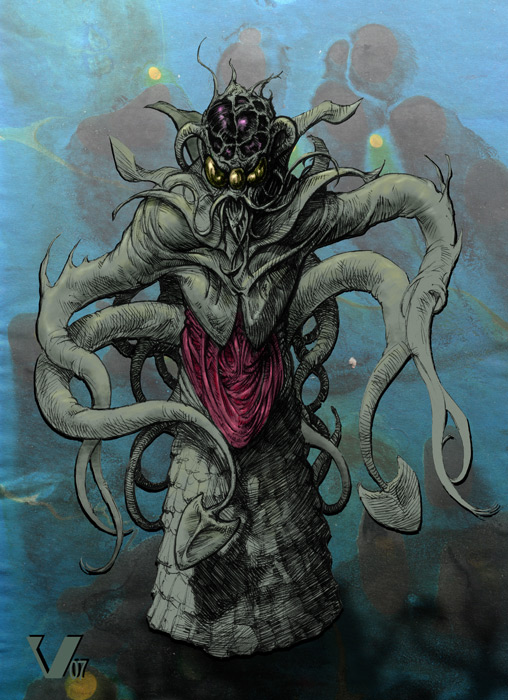
Image © 2008 Jesse Mohn. All rights reserved.

As some of you know, I published an article entitled, How to Build a 4th Edition Dungeon Crawl for Heroic and Paragon Tiers, which sprang from my conversion of Advanced Dungeons & Dragons adventure modules into 4th edition adventures. The “standard” system of encounter design (i.e., the one presented in the 4th Edition Dungeon Master’s Guide) didn’t work. As I pointed out in the article, I could suspend my disbelief in fighting dragons, devils, and slaadi, but the “15-minute” adventuring day was too much for me to accept as applicable to a dungeon crawl or a trek across the wilderness. That is, if the PCs were in an underground dungeon consisting of 100 rooms, it was unrealistic on so many levels to think the PCs could go through those rooms at a rate of 3-5 per day (i.e., the standard system assumes an extended rest every 3-5 encounters). Every 30 minutes, they should expect their rest interrupted unless the DM provided some ridiculous deus ex machina to justify 6-8 hours of peace and quiet. Obviously, another system of encounter design was needed. My conversions started with C1: The Hidden Shrine of Tomachan (before Wizards of the Coast announced they were doing one), C2: The Ghost Tower of Inverness (which I adapted as an LFR MyRealms adventure), L1: The Secret of Bone Hill, S2: White Plume Mountain (available here), and G1-2-3: Against the Giants (again, before WotC announced their conversion). Not being a professional game designer, I didn’t have the luxury of extensive playtests, instead relying on my Loremaster blog to supplement the article as I continued to refine it. As I progressed, I realized that what I had written was really appropriate only for levels 1-15. Once the PCs reach 16th level, some new math was required, which would eventually lead to the proper math at epic level (necessary for the next phase of the adventure, the conversion of the Drow series D1-2-3 and Q1). One of my home groups started G3: Hall of the Fire Giant King last night. It’s my first attempt at the new math. The results were remarkably good considering they were the result of my rough estimates as to what the new numbers should be.

What Am I Talking About?

Let’s start with some context. For those that haven’t read the article, read it dammit! Oops . . . . Sorry. For those that haven’t read it, the basic premise of the Dungeon Crawl system is that each individual encounter creates less of a drain on party resources while maintaining the threat level on the party. Moreover, through the use of “thematic encounter templates” (TETs), the system can be adjusted very easily on the fly for the varying number of players that shows up on any given night (much more accurately than, for example, the encounter adjustment rules provided by the Living Forgotten Realms campaign). The consequences are two-fold. First, for parties of 4-6 PCs, the party can address 10-15 encounters before having to take an extended rest. Second, for parties of only 3 PCs, the encounters create the same threat and resource drain as you find using the standard system, which means you don’t have to cancel your session because only three players show up on a given night.

How It Played out

So, now that everyone’s up to speed on what the system is, let’s talk about last night. I had only three players, so it was “game on,” but the encounters should feel like they would in the standard system. We had a ranger, a paladin, and a warlord, all level 17. There was a lot of role-play and a clever avoidance of combat by the PCs, which means there were only two combat encounters. For those encounters, looking at daily attack powers, daily powers associated with weapons, and healing surges, the PCs went through 30-40% of their resources. Considering they went through 40% of the number of encounters they should expect to face before an extended rest, and things will get harder, this seems to be about right. I have only two data points, but the numbers worked out ideally, and it felt right, so I’m very optimistic that, at the very least, I’m on the right track. Give me a few more weeks, and I’ll be writing the second edition of the article, which will include support all the way up to level 30, though not in the way you might expect. 🙂

Remembering FASA’s StarTrek RPG

This is a re-blog of my post on Loremaster.org, “Remembering FASA’s StarTrek RPG.” For my thoughts on adopting the composite skill system for your Dungeons & Dragons game, see my last article, Composite Skill Bonuses in the d20 System.


I played D&D Sunday night [10/23/2011], and something came up that I thought I’d share with everyone. I was fondly remembering FASA’s Star Trek game from my high school years. I left [Dungeons & Dragons] in 1981 (not returning until 2005), but for a brief time in high school (1982 or 1983), I bought up materials from the FASA Star Trek game and played it a couple of times. I really miss that game and would like to do a 1-shot or 2-shot game. In 2007, I played the Demand of Honor adventure, which involved the Gorn, but online play was very “unsocial” and lacked the feel of true RPGing.

Can I Cook or What?

I’ve been very lucky to have founded a group that’s open to trying other systems. We’re currently in the midst of a Savage Worlds: Weird Wars campaign because we tried out that system one night (in the Deadlands setting). We’ve also played some Dragon Age RPG but have done nothing more than create some characters and run through a single sample encounter. Tonight, Hal Mangold of Green Ronin Publishing gave me two sourcebooks for DC Adventuresthe Hero’s Handbook and Heroes and Villains Vol. I, and although I’ve never been a comic book fan, I played a demo at GenCon run by its creator, Steve Kenson, and so it remains a candidate for our next experiment.

Still, FASA’s Star Trek would be my first choice for doing something different. As the one who’d be pushing the system, I probably wouldn’t get to be a player, but I love GMing as much as I do playing, so I can live with that.

What’s the Big Deal?

Of all the systems I’ve played (admittedly, not many), none immersed me as much into the setting as the bridge combat system. The hand-to-hand combat system was good, but when dealing with inter-ship battles, I felt like I was on the bridge of a starship. It was so good that they sold the system as a separate product. It could stand on its own.

Visualize the bridge of an Original Series starship. You have the science officer at one workstation, the helmsman at another, the communications officer at yet another, and so on for navigation, engineering, weapons control (for the Original Series movies), and of course the captain’s chair. Other than the captain, this is what the gaming table looks like. Everyone has their spot around a common center. The only difference is that, in a game, everyone always looks towards the center rather than occasionally.

Each of these work stations would necessarily have a different control panel on it. The science officer had a goofy sensor viewing thingy, the helm had it’s own in the Original Series, navigation had a star chart, weapons control had targeting systems and what amounted to “triggers” for the weapons, and so on. For the game, each of the players had their own control panel on paper tailor-made for their handling their responsibilities and tracking the resources for which they were responsible, roughly simulating a bridge workstation. The captain would make decisions on how to proceed, then ask the relevant character to carry out the order. This would usually necessitate a skill roll on the d100 system, and not surprisingly the character was built to contribute in ways appropriate for his position on a star ship.

In other words, there was a chain of command, but it was still a cooperative game, just like 4e [Dungeons & Dragons]. Although it’s certainly possible to play a 4e game without a leader, it helps if you have a healer. The same was true of Star Trek. Yeah, the captain’s in charge but can’t do it all. The time for the captain’s hands to get dirty was when it was time to make contact with others, and captains certainly were built to be good at that.

The game also addressed technology thoroughly, from starship weaponry, to sidearms, to medical and science equipment. All of the major races were addressed, including the Caitian from the animated series. In fact, at DDXP last year, I got to play one. My Gamma World GM created pre-gens for his game, and one of them was a Catian lieutenant from the Star Trek universe who had been stranded here by the Big Mistake. (At the time, he was playing in a FASA Star Trek home game.)

The game even had an ingenious explanation for why Original Series Klingons looked so different from the movie Klingons: The ones from the Original Series were “human fusion” Klingons, genetically combined with humans to make a Klingon better suited to deal with humans. The game took this to the next logical step, introducing Romulan-fusion Klingons as well. The Imperial Klingons (from the movies) existed, but they weren’t the first choice for dealing with humans, so you never saw them on the TV screen. Taking this level of detail even one step further, the game provided a ton of words from the Romulan language. This attention to detail is exactly the sort of thing a fan of the Original Series, like me, would love.

Finally, because everything was handled via the skill system, it wasn’t a burden to have a long list of skills for each character. This allowed each player to customize their character. Kirk liked to ride horses, Picard had a strong background in archaeology, and Riker played the trombone. Your character had plenty of skill points to spend. If you were an optimizer, you could certainly max out your engineering, but you didn’t have to do so. In fact, the game was basically built assuming some characters would be optimizers and others actors (i.e., role-players). Any character could be played by any player type, but because there was always a need for both role-playing and roll-playing, both player types could find a home somewhere on the bridge. Making sure everyone at the table is happy is a goal I’ve set for myself with organized play, but FASA Star Trek makes it easier.

Oh, and FASA Star Trek called them opportunity actions long before D&D had them. 🙂

What If This Isn’t for Me?

Obviously, feeling immersed in the setting isn’t important if the setting doesn’t matter to you. I’ll ask my group if they’re interested, but I won’t beg them to do it. “Play what you like,” implies, “Don’t play what you don’t like.” This might prevent me from every playing the game again, as I might have to find a table of players willing to do so and the time to play outside my group, but there’s always hope.

So Much to Do, So Little Time

Of course, there just isn’t enough time to do all the things I want to do. I’m currently having trouble focusing on a few projects for the Gamers’ Syndicate, and I’m essentially in a job hunt. Once successful in my job hunt, my time might become even more precious. We can’t have everything we want, and I can accept that, but there’s so much out there to do, I don’t see how I could ever get bored.

Either way, consider (re)visiting this game if you enjoyed watching Star Trek. You shouldn’t be disappointed.

Follow me on Twitter @GSLLC