Balancing the Negatives #RPG #DnD #ADnD

If you enjoy this post, please retweet it.

That’s a weird title, I know, but it relates to something that’s bugged me about what appears to be a universal approach to game design. It manifests in two general ways.

“Damage Type” Magic Items

What could be cooler than a flaming sword, right? It’s a sword made of metal but is on fire. That’s great. It’s also an appropriate item for a weapon-using character advancing to an appropriate level. Except that it isn’t. It’s actually a curse. If you have a +1 longsword that does 1d8+1 damage, and I have a +1 flaming weapon that does 1d8+1 fire damage, in most cases, we have the same chance of doing the same damage. However, when we face a fire giant, you’re still doing 1d8+1 damage, and I’m doing 0 damage unless I pull out my non-magical dagger. All my fire damage is negated by the fire giant’s resistance. But hey, that’s okay. When we face a frost giant, you’ll still be doing 1d8+1 damage, but I’ll be doing double damage (2d8+2) damage, right? Right? Well, no. Against the frost giant, we’ll both be doing 1d8+1 damage because frost giants inexplicably aren’t vulnerable to fire damage. From a logical perspective (i.e., flavor), it makes sense that they would be, and from a gaming perspective (i.e., having fun), it would be an appropriate trade off considering that fire giants nerf me. However, I rarely see vulnerabilities in monsters when in fact every single resistance a monster has should always be countered by a meaningful vulnerability. That would appeal to both logic (flavor) and game theory (fun).

The pretentious among us (no judgments; that’s me too) may respond that it doesn’t necessarily make you weaker; it just holds you in place. But that’s the same thing for all intents and purposes. In 4e, a +x magic weapon would do an extra xd6 damage, but for a fire weapon, that extra damage would be fire damage. So, the fire weapon wouldn’t make you weaker than you already are, but it would make you weaker than what you should be. At a given level, if you’re expected to have a +2 weapon, then eliminating your extra 2d6 of damage against fire giants is effectively the same thing as weakening you when facing those monsters. You’re weaker than your contemporaries, which means you’re far better off selling the flaming sword than keeping it. In any event, it’s no reward to find one.

I know that curses can be fun, at least for old-school D&D players, but the flaming sword isn’t meant to be a curse, so it shouldn’t be. Yet it is. Consistently. Why? Even in 4e where vulnerabilities were more common than any other game I played, they were still relatively rare, and when they existed, they didn’t balance. That is, a fire giant with resistance to fire of 10 was (of course) vulnerable to cold, but his vulnerability was only 5. Maybe the game was balanced around this discrepancy (not as far as I can tell), but even if so, all this accomplishes is to make the game more frustrating. If you adjust the math so that they could both be 10, people would feel like their found items were actual rewards for a job well done. As I’ve previously discussed, mathematical advantages and disadvantages are illusory. The real money is in doing cool things and telling a good story (the latter not being relevant here). Making yourself useless against fire giants is uncool. Making yourself insignificantly more useful against frost giants is almost as uncool (though it might mathematically come close to balance considering that you can still do a small amount of damage against the fire giant with your non-magical dagger). The boring magic items became better than a lot of the ones that would otherwise be cool.

I should know. I’m the arbiter of what’s cool.

Why do seemingly all game designers do this? It’s maddening.

The 4th Edition Invoker

Here’s another way this manifests itself, though it’s probably far less common. For those of you that never played 4e, the Invoker was a flavorful class. It was the divine equivalent of the sorcerer (c.f., Divine Soul from 3.5). That is, Invokers channeled divine energy not through research or training but through instinct. As a result, they lacked control over those energies, often resulting in self-harming feedback. This meant that, in addition to damaging the enemy, the Invoker’s attacks (usually) dazed the Invoker. Here’s a hypothetical example that demonstrates the problem. Let’s say the Rogue (a.k.a., Thief) has a 3rd-level power (that’s an “attack” in 4e) that does XdY+Z damage and on a hit immobilizes the opponent. The Invoker would also have a 3rd-level power that does XdY+Z damage and on a hit immobilizes the opponent, but then dazes the Invoker. That makes the 3rd-level Invoker weaker than the Rogue. Not just different (which is cool), but weaker (which is not). The class was always behind the curve, but there’s an easy fix for this. Change the Invoker’s power such that it also dazes the enemy in addition to the immobilization. That’s not a perfect solution – PCs are far more sensitive to conditions than NPCs – but it comes close enough for government work. It makes the flavorful self-harm worth it, and thus the class is viable. My experience is anecdotal, but I knew only one person other than myself that played an Invoker. I wouldn’t be surprised if it were among the least popular classes in 4e, and that’s probably a large part as to why.

EDIT: After discussing this on Facebook with a friend, I want to add that the 5e sorcerer’s Wild Magic in 5e technically has a chance of creating negative feedback, but the chances of that are quite rare, and the bonuses it gives in the vast majority of cases (4d10 lightning damage to up to 3 creatures within 30′!!!) is amazingly beneficial. Clearly, Wild Magic is meant to be a boon, not a bust, and it absolutely is one. No balancing feature is needed, but technically Wild Magic by itself is a balancing act, and it certainly is an exception to the problem I’m addressing. Hence, I’m not surprised that the class remains relatively popular.

I think both of these things come from the same place. Again, I ask, why do game designers seem to take this approach? It seems obvious to me that this is a flaw in game design, but I’ve never seen a game even try to get it right, let alone succeed.

Any ideas as to what they’re (you’re) thinking?

Follow me on Twitter @gsllc

Dungeons & Dragons is a trademark of Wizards of the Coast, LLC, who neither contributed to nor endorsed the contents of this post. (Okay, jackasses?)

Finding a Better Mix #MythologyMonday #MythologyMonandæg

If you enjoy this post, please retweet it.

I’m loading all mechanical data for 1st Edition AD&D (“1e”) into a database. Having finished data entry for all the spells appearing in the Player’s Handbook and Unearthed Arcana, I spent this weekend creating the tables, queries, and forms for 1e monsters. I’ve entered all the data for everything up to and including the Chimera. This is going to be similarly tedious but 100% worth it when all is said and done.

I’ve gotten through the As, Bs, and Cs, and as of this writing Sunday night, I’ve entered Demogorgon as well (that was a real pain in the ass, with Juiblex — note the spelling — and other demon lords to come). Most of the monsters I’ve entered so far (29 out of 49, or 59.2%) are disappointingly ordinary, representing real world creatures or simply giant or prehistoric versions of them. Grabbing the 3.5 Monster Manual, I see there are 44 creatures (including variations) that begin with the letter A, B, or C. Of those, the closest ones to ordinary are animated objects, arrowhawks, and assassin vines (10 total, or 22.7%). Everything else is made up nonsense, which is the way it should be. Lions, tigers, and bears have their place, but we all come to D&D to fight lycanthropes, trolls, and balors. Of course, you can do that, so this isn’t a major criticism of 1e. There’s plenty of good stuff in there. I just found it surprising how boring the book started. Whether that holds up remains to be seen.

Aside: Kobolds

The bugbear entry mentioned kobolds, and that got me thinking about another design decision my friend and I discussed when creating our own game. I’ll spare you the details of that conversation but instead simply point out that kobolds of legend aren’t anthropomorphic reptiles. I went through YouTube and found a video explaining their true, historical origin. Game designers have plenty of kobold-like fey that fill the space of a kobold, but Lord Gygax apparently didn’t want to throw away the legendary term, so he coopted it for another creature. There’s nothing wrong with that, of course, but considering that the term, kobold, generally means something different now, it suggests that going back to an older definition is an occasionally useful (if not lazy) means to be original from the perspective of a modern audience.

Okay, I didn’t spare you the details of that conversation.

Follow me on Twitter @gsllc

Dungeons & Dragons is a trademark of Wizards of the Coast, LLC, who neither contributed to nor endorsed the contents of this post. (Okay, jackasses?)


A Couple of D&D Memes #ADnD #DnD #RPG

If you enjoy this post, please retweet it.

Sundays now are lazy days for me. I either post something silly or other people’s work. Usually both. Today, once again my current old-school kick has 1e taking over.

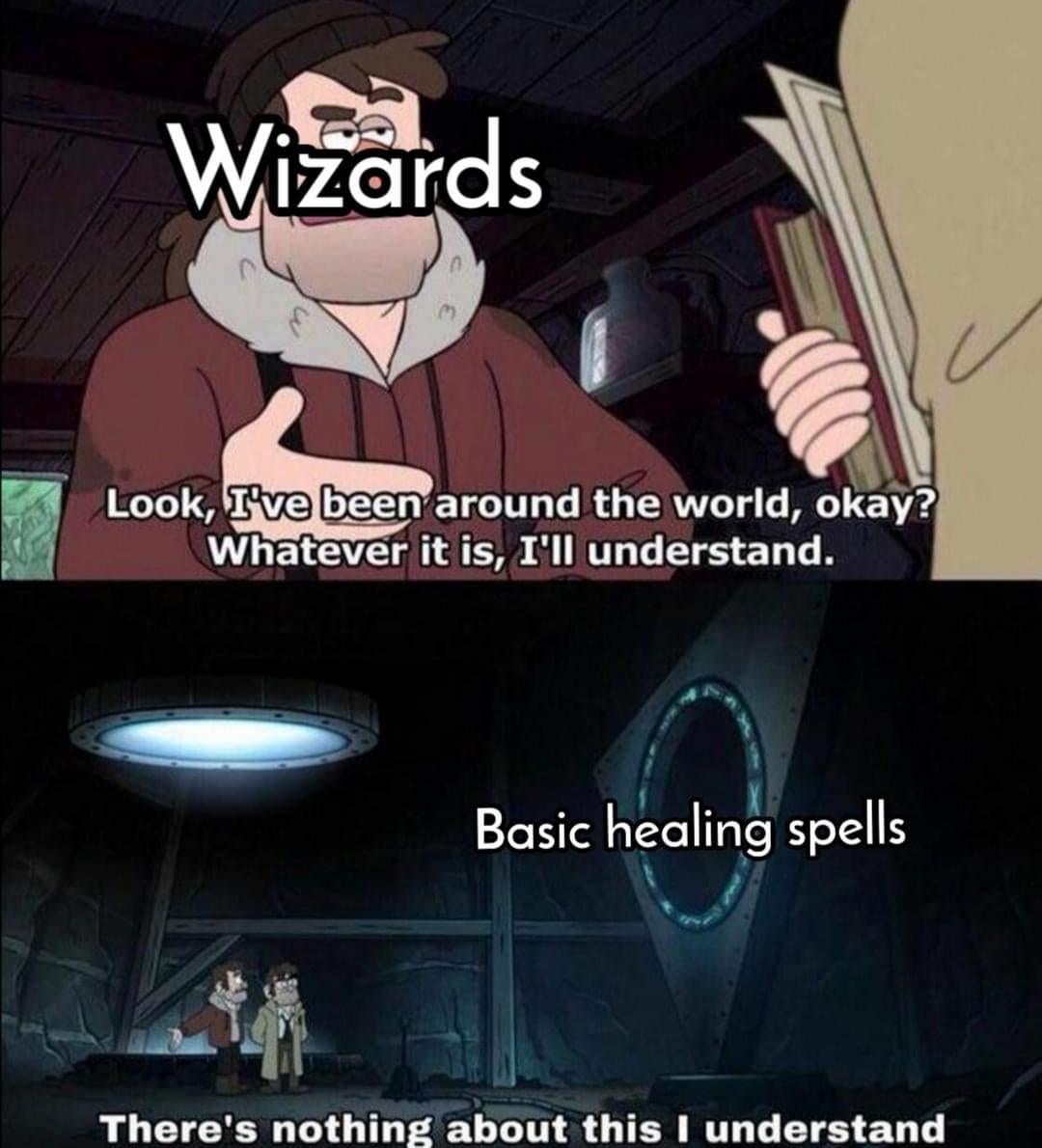
In 1e, this is 100% true. I don’t think a magic user sees healing capability until Limited Wish.

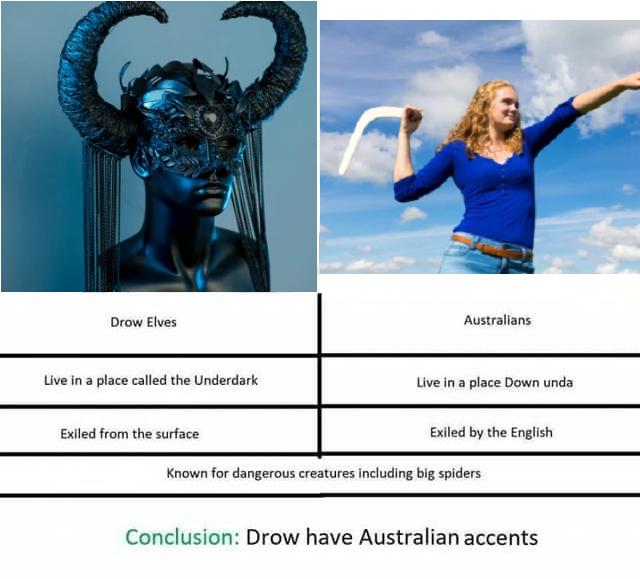
I had to replace the original photos with these wonderful, stock photos to avoid copyright concerns. That’s sad, but there is some good news. No Aussies were harmed in the editing of this meme. This does remind me, though, of something I once read (lost to the passage of time) that Lord Gygax always said that the Olman of Greyhawk weren’t just culturally similar to the Aztecs. They were the Aztecs. There was a portal in their lands that connected Oerth to Earth, so they sometimes passed between the two worlds. I’ve heard a lot of things attributed to Lord Gygax over the years. I know better than to assume they’re accurate.

Like I said; Sundays are lazy.

Follow me on Twitter @gsllc


Dungeons & Dragons is a trademark of Wizards of the Coast, LLC, who neither contributed to nor endorsed the contents of this post. (Okay, jackasses?)

The Spells of Unearthed Arcana #RPG #DnD #ADnD

If you enjoy this post, please retweet it.

I played 1e Advanced Dungeons & Dragons (“1e“) from 1977 to 1982. I received the “blue box” for Christmas 1977, but by 1982, the Satanic Panic pulled me away. I came back in 2005 (completely missing 2e and 3.0e), but by then I was wrapped up in the current edition, 3.5. Last week (when I wrote this post), the 1e Unearthed Arcana had been generating a lot of chatter over on MeWe, but because it wasn’t published until 1985, I was never aware of its existence until long after I left 1e. With my impending return to 1e, I’m creating a database of all the 1e information I can gather and have just finished the slow process of data entry on 1e Unearthed Arcana spells. Having played the 3rd, 4th, and 5th editions, it’s amazing how much iconic material is in the 1e Unearthed Arcana.

Alarm, Evard’s Black Tentacles, Heroes’ Feast, Melf’s Acid Arrow, Mordenkainen’s Magnificent Mansion, Otiluke’s Resilient Sphere, Stoneskin, and Tasha’s Uncontrollable Hideous Laughter (or their equivalents) are among many spells that are in most (or all) of the first Player’s Handbooks for later editions, but that didn’t enter 1e until Unearthed Arcana. I took those spells for granted as part of the game even though I never used them when I played 1e. So, if for no other reason, there’s no doubt that I’m going to allow Unearthed Arcana in my game.

I’ve said it before, and I’ll say it again: 1e has its problems, but there’s a ton of good in there.

Follow me on Twitter @gsllc

Dungeons & Dragons is a trademark of Wizards of the Coast, LLC, who neither contributed to nor endorsed the contents of this post. (Okay, jackasses?)

Cover Art on 1e Adventure Modules #RPG #DnD #ADnD

If you enjoy this post, please retweet it.

Last weekend, someone on Facebook (Dino) shared an anecdote accompanying this image.

May be a cartoon of text
I2: Tomb of the Lizard

Funny story. Was running this late 80s/ high school. I describe the bridge encounter shown on the front of the module. Players say heyyy… isn’t that pic on the cover? They were careful. Oops….

That’s interesting. After all these years I never realized why cover encounters usually aren’t in any of the adventures I played. If a player was in a gaming store and saw the adventure, the cover art would give away a couple of the encounters. When the art is there, it’s often misleading or too vague to give the players a warning (e.g., S1: Tomb of Horrors). I feel kind of dumb because that never occurred to me. Even as a kid I’d never take advantage of that, so false consensus effect, I guess. When I converted the adventures to 3.5e, 4e, and 5e, I almost always included the cover page encounter, so if you ever want to face a toothpaste demon, I’m your DM.

I’m a dope.

Follow me on Twitter @gsllc

Dungeons & Dragons is a trademark of Wizards of the Coast, LLC, who neither contributed to nor endorsed the contents of this post. (Okay, jackasses?)

Character Names, Copyright, and RPGs #RPG #DnD #ADnD #copyright

If you enjoy this post, please retweet it.

Blog posts cannot substitute for legal advice. If the topics discussed in this post are relevant to a real case you have, please consult an attorney.

I’m designing a database for 1st Edition Dungeons & Dragons and am close to finishing the data entry on spells. This brought a copyright issue to the forefront. Characters can be copyrighted. This isn’t a controversial position. However, the name of a character is not copyrightable, and unless a name is used as a brand for your line of products, it doesn’t even receive the (much weaker) protection of trademark. So why does everyone remove proper names from spell names when referencing D&D spells?

Copyrighting a Single Word or Short Phrase

While there is no “bright line” rule stating a minimum number of words necessary to secure a copyright, it’s well settled that a short phrase is not copyrightable. Either they lack tiny amount of creativity necessary for copyright (thus likely representing independent creation) or the merger doctrine applies. A simple Google search will uncover a multitude of articles supporting this notion.

Only nothing at all is more minimal than a single word, so there’s no doubt (outside of Poland) that a single word can’t be copyrighted. But even a short phrase, such as the name of a spell, can’t be copyrighted, especially where it’s descriptive of the mechanics of the spell (mostly the case).

The Nichols Case and Copyrighting Characters

The standard for copyrighting characters comes from Nichols v. Universal Pictures Corp., 45 F.2d 119 (2d Cir. 1930), in which the Court stated:

If Twelfth Night were copyrighted, it is quite possible that a second comer might so closely imitate Sir Toby Belch or Malvolio as to infringe, but it would not be enough that for one of his characters he cast a riotous knight who kept wassail to the discomfort of the household, or a vain and foppish steward who became amorous of his mistress. These would be no more than Shakespeare’s “ideas” in the play. . . . It follows that the less developed the characters, the less they can be copyrighted; that is the penalty an author must bear for marking them too indistinctly.

45 F.2d 119, 121 (2d Cir. 1930). This has since become known as the “well delineated character” test.

Can a spy be protected? Of course not. What if that spy uses sex as a tool of the trade? Don’t all spies (at least in fiction) do that? How about if he’s a martini drinker? Hmm, that sounds familiar. “Shaken not stirred”? Well. . . . Eventually, we get to the specific character of James Bond, and he’s certainly a copyrighted character, but it took a bit of detail beyond his name to get there. If I created a fictional character of James Bond who was an accountant, I’d be just fine. In fact, I could even have him joke, “I’m not that James Bond.” I’m not using Ian Fleming’s James Bond, just referencing him, and to the extent James Bond is trademarked, readers will understand from context that I don’t have the endorsement of whoever currently owns the character.

The less common, “story being told” test isn’t relevant here, but in case you’re interested, see Warner Bros. Pictures v. Columbia Broadcasting Sys., 216 F.2d 945 (9th Cir. 1954), cert. denied, 348 U.S. 971 (1955) (“It is conceivable that the character really constitutes the story being told, but if the character is only the chessman in the game of telling the story he is not within the area of the protection afforded by the copyright.”).

Elsewhere when discussing the precise boundaries of copyright as it related to plays, the Nichols Court went on to add that, “[n]obody has ever been able to fix that boundary, and nobody ever can.” Nichols at 121. That makes copyright hard, but it’s not impossible, and sometimes it’s even easy. A name cannot be protected by copyright, even within the context of a spell name of a few words.

Tenser’s Floating Disc

So why do so many of you seem to think that you’re avoiding copyright infringement by avoiding writing, “Tenser’s Floating Disc,” “Mordenkainen’s Magnificent Mansion,” and “Tasha’s Hideous Laughter”? Based solely on the text of the spell as written, can you tell who Mordenkainen is? Is Mordenkainen the wizard that wrote the spell? The wizard’s significant other, child, or pet? The name of the Wizard’s favorite watering hole anthropomorphized into the owner of a mansion? Even if the original spell as written by TSR contained the answers to such questions in sufficient detail to flesh out the character (it didn’t even try), a reproduction of the spell not including such information, but rather limited to the spell’s mechanical effects, wouldn’t infringe on the character of Mordenkainen just by using the name. The name isn’t what’s copyrighted; the combination of several traits defining the character are, but they’ve been left out.

Seriously? You think WotC can restrict use of the name, Tasha?

This is as ridiculous as, for example, using the word “Forgeborn” for “Warforged” as if WotC owns the word, “Warforged,” and that use of “Forgeborn” relieves the writer of any infringement of WotC’s text describing the species. Such a writer is focusing on the wrong thing. Think of it this way: If you think that dropping the name off of the spell cures your text of copyright infringement, then you concede my point that spell text describing the mechanical effect of a spell within the context of an RPG isn’t usually copyrightable. Great! However, you then must be thinking** that the name itself is where the copyright lies. That can’t possibly be true. It flies in the face of every knowledgeable commentator (again, outside of Poland) that’s ever addressed the issue.

** Unless, of course, you’re still under the mistaken impression that the OGL is somehow a valid contract, and that its terms, if taken seriously, wouldn’t constitute copyright misuse. But if you really want to know why that’s silly, you’ll have to read that long post.

There’s absolutely no legal reason not to use those names in spells, and it doesn’t hurt WotC at all to use them (other than perhaps robbing their arrogant legal department of their hubris). Why is this important? Because there are too many misconceptions about copyright law that have had far reaching consequences to the gaming industry and the gaming community in general. The text of the Open Gaming License and System Reference Document collectively foster this misinterpretation, and I suspect (can’t prove) that’s an intentional scam. If WotC legal gets you to focus on the word, “Tasha,” but does nothing to stop you from copying the text of the spell, then you still may be infringing whatever copyright they arguably have. If you do something that’s 100% legal later down the road, but it’s something they don’t like, they can go after you for that infringement. As I’ve discussed elsewhere, this can often lead to copyright misuse, but most gamers aren’t sophisticated or wealthy enough to hit back on those grounds. More importantly to the community as a whole, while using these names in spells is not creative on your part, your misconceptions eventually lead down the road of stifling your own creativity. The purpose of copyright is to promote creativity. When copyright law stifles creativity, its entire purpose vanishes, in which case we may as well not even have copyright.

You can’t know what you can’t do unless you also know what you can do.

Follow me on Twitter @gsllc

Dungeons & Dragons is a trademark of Wizards of the Coast, LLC, who neither contributed to nor endorsed the contents of this post. (Okay, jackasses?)

Character Aging in First Edition AD&D #ADnD #DnD #RPG #biology

If you enjoy this post, please retweet it.

I’m going to take you down the same rabbit hole my mind entered while gradually waking up one recent morning. Most (if not all) gamers have encountered those online quizzes that tell you what D&D class you are in real life. I’ve always been of the mindset that I’m probably best characterized as a monk. I’ve trained a lot in the martial arts, starting when I was 14 (almost four decades ago), and every online alignment test has pegged me as lawful good or lawful neutral (very heavy on law). All of that checks out, which is unsurprising considering I’m answering the questions about myself (which means my biases must creep in). I feel like I might be a bad monk because I wouldn’t consider my Wisdom score my maximum, but that’s my skill set. Of course, you have to suspend some disbelief here either way. We’re translating classes into a real world that doesn’t enjoy the effects of magic.

But even considering that translation, what concerned me the most is that, while my knowledge of that hobby continues to improve, my body can’t keep up. I’m old, and that’s no small matter. Everything is always injured. Usually, it’s just a strain or something like that, but at times I’ve had to take weeks off to recover, even having had my first surgery ever at age 51 a couple years ago.

Aging in 1e

All of that got me thinking about how much I like the aging rules from page 13 of the 1e DMG, but not the aging rules from page 12. On the one hand, I like the idea that characters’ ability scores change as they age. It’s yet another tool that promotes immersion in the game world, and anyone who’s read this blog knows how much I prefer that play style. On the other hand, I don’t like that age is determined randomly. These two positions create a tension. Players can game the system, setting, for example, a cleric as age, mature, to boost Strength and Wisdom by 1 with no downside. In fact, other than a magic user or illusionist who’d likely go with middle aged, what character wouldn’t benefit from that?

If the DM has draconian character creation guidelines (e.g., 3d6 assigned in order, or even slightly better ones), the characters are sometimes going to have some terrible scores, and if the scores can’t be assigned out of order, perhaps scores that prohibit playing the class the player wants to play. In such a situation, gaming the system may make an unplayable character playable, so it’s not a bad thing after all. However, in my game world, the characters will roll 4d6 dropping the lowest, and assigning in whatever order they want, so the danger of overpowered characters is greater.

Because I don’t want their ages rolled randomly, I’ll probably require that the scores as rolled stay as they are, but perhaps create my own schedule of ability score changes due to aging. I’ve noticed that imbalance in minor things like this often go unnoticed by game designers, resulting in design elements with either a benefit or a drawback, but not both (c.f., the 4e Invoker’s own powers always harming itself without any extra harm delivered to its target). No matter what I do, I’ll keep this 1e DMG rule on page 13: “The only ability which may exceed 18 due to age effects (unless age restricts this) is wisdom.”

A few days after writing this post, MerricB tweeted something relevant:

Which I’m only now publishing. I’m way ahead of schedule.

I don’t have any problem with optimism, but this is a game system, so gains in Wisdom should be accompanied by losses elsewhere, even if they make just as little sense as a rule.

Who says I don’t have an 18 Constitution?

If you’ve had a different experience from what I suggest here, please share your thoughts.

Follow me on Twitter @gsllc

Dungeons & Dragons is a trademark of Wizards of the Coast, LLC, who neither contributed to nor endorsed the contents of this post. (Okay, jackasses?)


AD&D Monster Manual II: Even More Cats #DnD #RPG #ADnD #Caturday

If you enjoy this post, please retweet it.

I’ve gone through all of the cats from the 1e AD&D Fiend Folio here and here, and I pretty much covered the 1e AD&D Monster Manual cats here. Now it’s time for the 1e AD&D Monster Manual II (“MM2“), which is entirely new to me. I recently got it as part of my stash of 1e purchases, so it’s time to go through MM2 cats. There aren’t a lot.

Cat (p. 22)

Umm, okay. A cat. There are two varieties: domestic and wild. As a human living in the real world, I understand that wild cats can be a pain in the ass when they’re angry, but . . . what? Okay, let’s just move on.

Level I, not included on any of the encounter tables. No idea why. 🙂

Cat Lord (p. 22)

This is the master of all cats, but he looks like an ordinary dude. Despite the art, we’re told he has ferocious bite and claw attacks, and being a level X (10) monster, that’s backed up by the numbers. I should relate to the character, but I can’t see including him in any adventures except as a joke. A level X joke, but a joke nevertheless.

Astral Plane, 5.3% chance of encounter (3 on a 2d10).

Catfish, Giant (p. 23)

No, no, no, no, no. Doesn’t count. Move on.

Level VI, 5.3% chance of encounter in tropical and subtropical freshwater.

Cheetah (p. 25)

I have to say that I’m not particularly impressed with the MM2 cats so far. It’s an ordinary cheetah. What else do you need to know?

Level III, not found in any of the random encounter tables. For creating your own random encounter tables, cheetahs are “rare” in both tropical wilderness plains and tropical wilderness deserts.

Hey, there’s a demilich on page 32!

Stop, Rob! Don’t get distracted.

Elfin Cat (p. 63)

We don’t get a picture of this cat, but it’s described as “usually mistaken for a wild cat or possibly a lynx, but this is because the creature does not wish to be recognized as out of the ordinary.” Yeah, this cat’s got some magic, including Enlarge, Reduce, Pass Without Trace, Tree, and Trip. They have limited ESP, magically resistant 20% of the time, are surprised only on 1 out of 20, and surprise 1-5 on a d6 (1-2 is normal). What the hell. They can also leap 20 feet “with ease.” So, throw a bunch of wild cats at the PCs, then have them stumble upon a pair and their kits.

Level IV, found in forests when rolling a 19 on a 2d10 (5.3% chance). For creating your own random encounter tables, elfin cats are “very rare” in temperate wilderness forests.

Wemic (p. 126)

These count. A wemic is a “lion centaur,” akin to the urmahlullu from Mesopotamian mythology. Wemic are intelligent, use armor and weapons (both melee and ranged), and may even have magic items. If they lose their weapons, they can use their claws instead, so they’re never truly unarmed. They are surprised only on a 1.

Level IV, not included on any of the encounter tables. For creating your own random encounter tables, wemics are “very rare” in both temperate wilderness plains and temperate wilderness deserts.

Well, that’s not a lot, but maybe you can make something of these in your game.

Elfin cats >> cooshees.

Follow me on Twitter @gsllc

Dungeons & Dragons is a trademark of Wizards of the Coast, LLC, who neither contributed to nor endorsed the contents of this post. (Okay, jackasses?)
Monster Taxonomy #DnD #RPG #biology

If you enjoy this post, please retweet it.

Okay, I know. I went to Vegas, and you don’t care. Fine. Back to 1e AD&D.

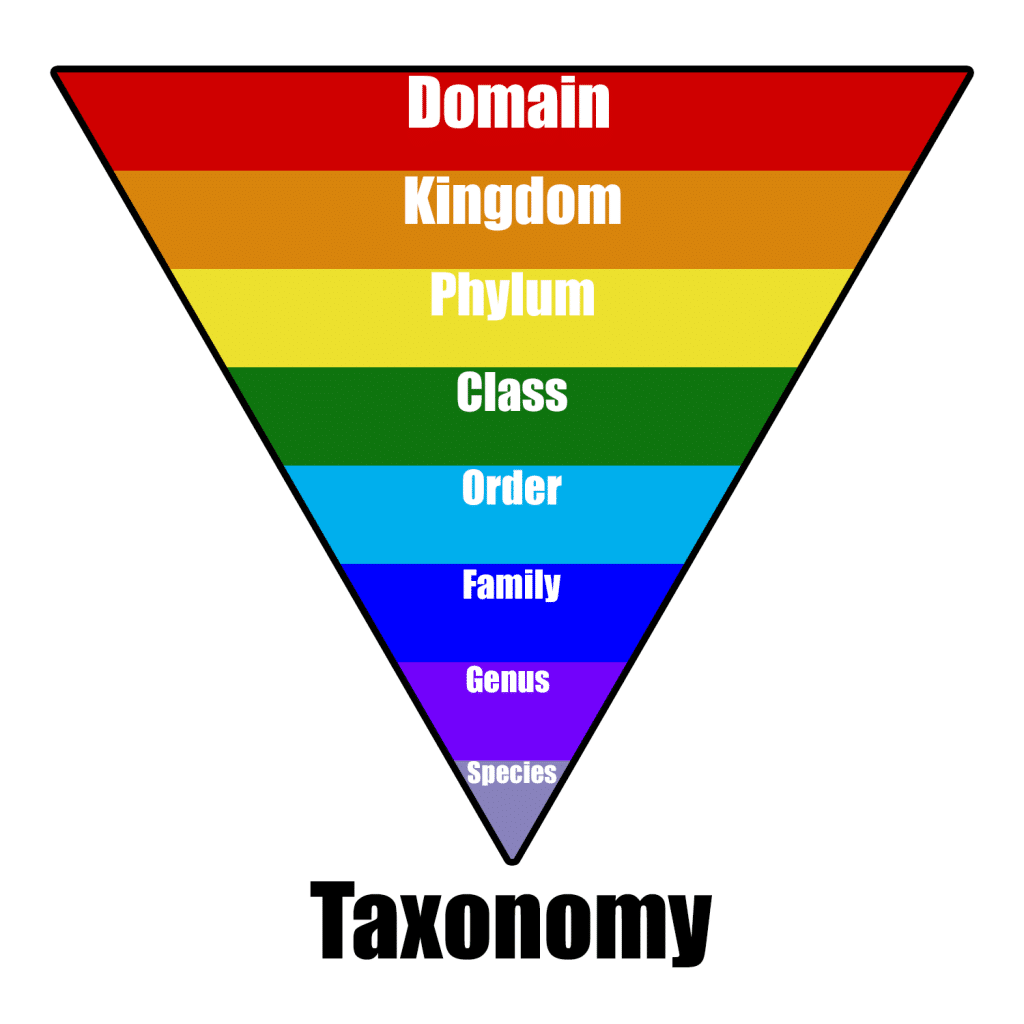
My friend and I are developing a game system. It’s unlikely it’ll ever see the commercial light of day, but it constantly keeps me thinking about what I like and dislike about game design. I had an idea that’s apparently not novel (I’ve never even read Shadowrun, let alone played it), and it was brought up a couple of weeks ago on Facebook: Monster taxonomy.

See the source image

Obviously, I think it’s a fun idea. Despite someone complaining that the mere discussion of monster taxonomy was stifling creativity and story, the only use for developing taxonomy is creative in nature, producing a story element with no real mechanical effect. All taxonomy would do (at least as I envision it) is tell the player how closely related two species are. Are elves homo sapiens dryadalis (a subspecies of human), or are they something like dryadalis sapiens (in an entirely different genus from humans)? This would depend on your origin story for each species. Matching the nomenclature with the origin story can be clever and fun, but as a story element, players and GMs that disagree could completely ignore it.

And that was today’s lesson on how to take something nerdy and make it even nerdier.

Follow me on Twitter @gsllc

Dungeons & Dragons is a trademark of Wizards of the Coast, LLC, who neither contributed to nor endorsed the contents of this post. (Okay, jackasses?)


More Thoughts on First Edition AD&D: Secret Rolls and Spells @slyflourish #ADnD #DnD #RPG

If you enjoy this post, please retweet it.

A couple weeks ago, I wrote about the Withdraw spell. This week, another spell from 1e Unearthed Arcana caught my eye: Meld to Stone. The spell allows a cleric (and gear) to meld into a large block of stone. It has a duration of 1d8+8 rounds, but the 1d8 is rolled by the DM so that the cleric doesn’t know exactly how long protection lasts. This spell isn’t unique in this regard. There are a few spells where the DM rolls secretly.

If you’re a regular reader of this blog, you know that the last thing I want is an overbearing DM that thinks, “This is my table!” No, dipshit; it’s our table. As Sly Flourish will tell you, the players do as much story writing as the DM does. But giving the DM this kind of control isn’t anything like that. The spell is simulating how capricious or uncaring gods can be to those pesky little gnats that call themselves “mortals.” To do that, the DM must seize control, but this control is baked into the rules, reducing the potential for conflict between players and DMs. I’ve seen too much conflict at tables, and this spell shows that you can avoid it even where the DM appears to exercise a great deal of control. I say, “appears,” because it’s really the dice, and therefore the gods of luck, that are in control.

Besides, if players don’t like the spell, they can take another instead. This effects players only if they’ve willingly bought into it.

You still have control over your character, but not the entire surrounding universe.

Follow me on Twitter @gsllc
Follow Sly Flourish @slyflourish

Dungeons & Dragons is a trademark of Wizards of the Coast, LLC, who neither contributed to nor endorsed the contents of this post. (Okay, jackasses?)