Let's roll some dice, watch some movies, or generally just geek out. New posts at 6:30 pm ET but only if I have something to say. Menu at the top. gsllc@chirp.enworld.org on Mastodon and @gsllc on Twitter.
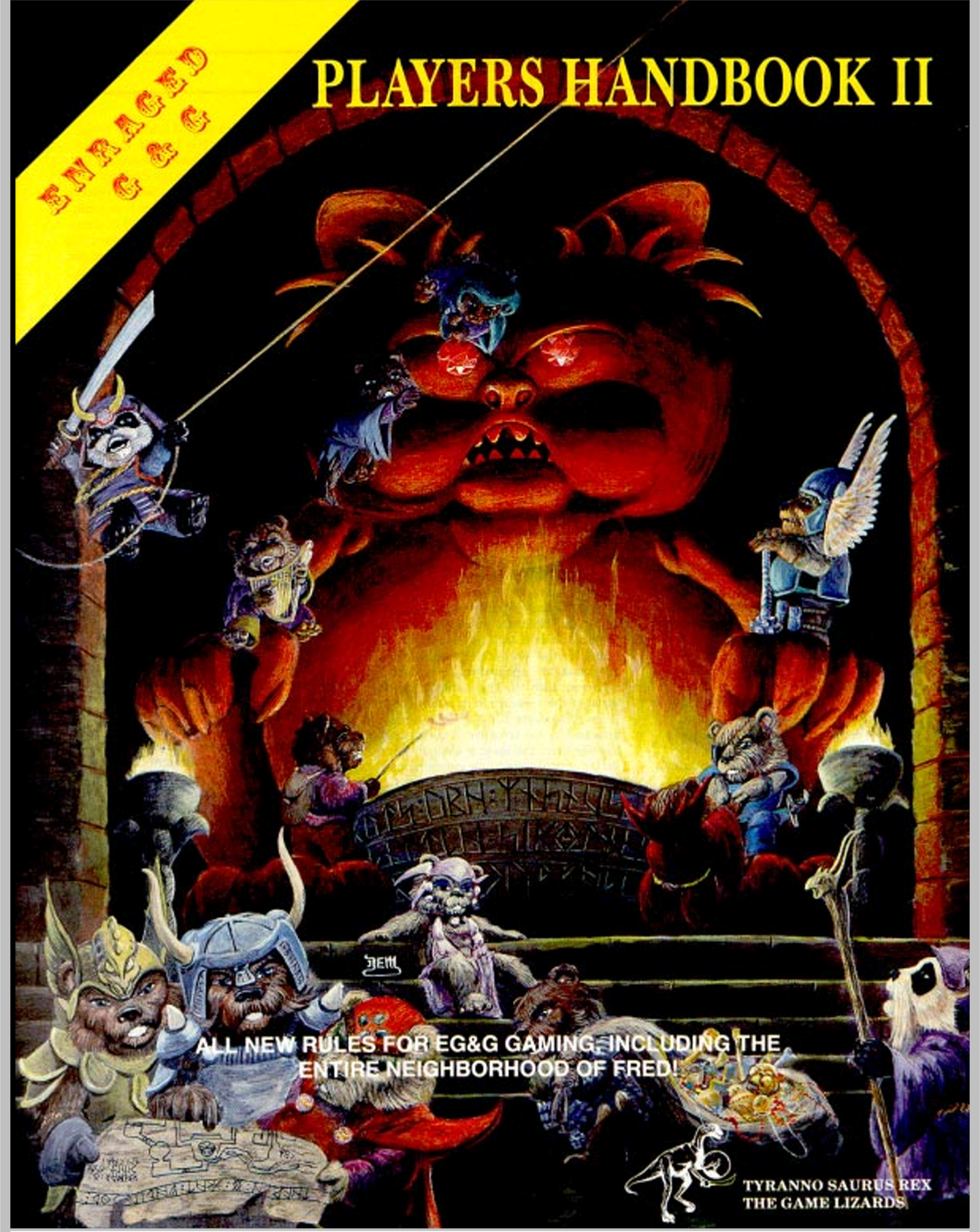
So in this image, cats are cast in the role of goblins (or at least baddies). I must admit there’s some sense to that.
Checks out.
Cats don’t give a shit, but at least they have my respect. Dogs would never make good adventurers. They’re all a bunch of followers all seeking the approval of their superiors. Maybe those bears are in charge.
Dungeons & Dragons is a trademark of Wizards of the Coast, LLC, who neither contributed to, nor endorsed, the contents of this post. (Okay, jackasses?)
I’m not sure I agree with Uhura as a Thief. She’s clearly charismatic and never used the mentioned skills. I also would have labeled Scotty an Artificer. If I’m not mistaken (I know very little about 2nd Edition), the Alchemist is a new class in 5th Edition. The artificer goes back to 3rd Edition. Duelist is a build but certainly fits Sulu based on one of his most iconic scenes.
Dungeons & Dragons is a trademark of Wizards of the Coast, LLC, who neither contributed to, nor endorsed, the contents of this post. (Okay, jackasses?)
Recently, I discussed the introduction of eastern folklore and mythology to the MCU, and specifically discussed the shishi in Shang-Chi. This inspired me to crack open my new PDF of 1st Edition AD&D‘s (“1e“) Oriental Adventures, which I’d never read before. So far, I’m impressed, though I’ve just scratched the surface. Three new races, 10 new classes (10!), a bunch of new spells, and 31 new monsters. I find myself wondering whether the typical 1e player considered this book bloat, but I digress. Today is Caturday, so here are the cats that appear in Oriental Adventures.
Hengeyokai (p. 12)
One of the PC races, the hengeyokai (I’m assuming that’s also plural) are shape changers. Though not lycanthropes, they have the same three forms: animal, human, and a hybrid of the two. One type of hengeyokai is a cat, which must be chaotic (of course), and while naturally dexterous, has a penalty to wisdom (exactly what you’d expect).
Not particularly wise.
Generals of the Animal Kings: Tiger King (p. 120, Level X)
Oriental Adventures states that
The oriental mind has organized the world into a unified whole. One particularly strong belief is that of the Celestial Emperor, a powerful being who heads the Celestial Bureaucracy, a type of government of the spirits. Like the bureaucrats of the real world, these spirit officials can be corrupt, disobedient, just, or incompetent.
Oriental Adventures, page 116
Yes, I know. The “oriental mind.” *sigh* Anyway, one part of the bureaucracy are the generals of the animal kings, and the most powerful (by XP) type of general is the Tiger General, who suppresses rebellions or doles out punishment. He appears as a giant, anthropomorphic tiger wielding magic, scaring the hell out of characters with his appearance, and regenerating 5 hps/round. The best part, however, is that he wields a +5 vorpal sword (+8 to hit, 3 attacks/round). There could be more than one of them, and each one is always accompanied by 100 tigers. Good luck with that.
Shirokinukatsukami (p. 128, Level IX)
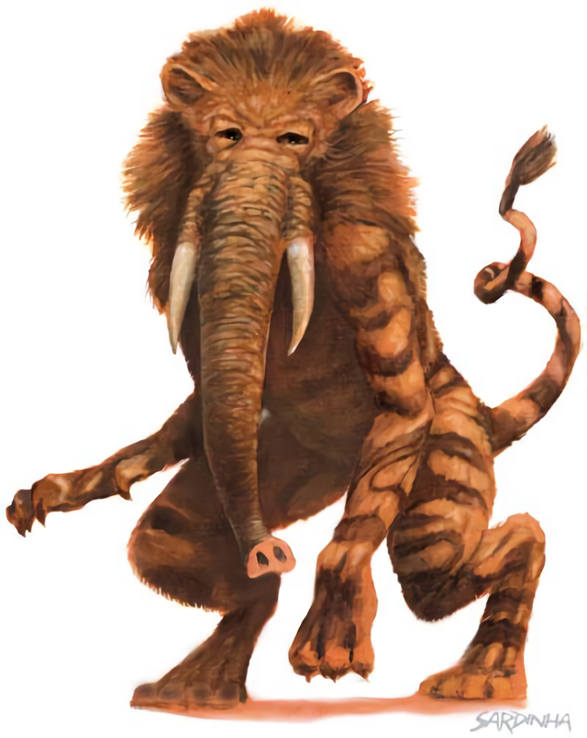
This one’s weird. Okay, it’s all weird, but this is really weird. The shirokinukatsukami has “the body of a horse, the face of a lion, the trunk and tusks of an elephant, the tail of a cow [intimidating!], and the feet of a tiger.” As far as I’m concerned, that’s enough to count as a cat. It’s a shame this book doesn’t provide a picture. Good luck visualizing that.
Google is your friend.
It can have up to 5 physical attacks per round, casts a lot of spells, regenerates, +3 or better weapon to hit. . . it’s a bad ass, which explains why there can be no more than four in existence at any point in time. This is also explained by how difficult it must be to build something like that. Fortunately, its lawful good, so your PCs should be okay even if it shows up.
Neither of the monsters appear on the random encounter table. They aren’t the kind of monster you’d want to randomly drop on a party. They deserve planning.
That’s it. Oriental Adventures has a ton of new material, but not a lot of cats.
My brain had to take a vacation for a couple weeks, but I’ve finally returned to my 1st Edition AD&D (“1e“) database. Having recently discussed the shishi, it was a nice coincidence that I finished Fiend Folio‘s oriental dragons last night. There were a couple of things that bothered me in the technical writing (e.g., is their lack of infravision a mistake?), but there was a creative choice that bugged me as well.
In my conversation with Tanya last Friday, she pointed out how eastern culture has far more good-aligned dragons than the western world. This was my understanding as well. Then why are all but one of the oriental dragons neutral along the moral axis? I get why Sobek, the crocodile-headed Egyptian god of the Nile, was made evil in most (every?) editions of D&D. He looked evil, and they needed a balance between good and evil gods for that pantheon. His evil fulfilled a narrative role, and there was plenty of material presented to accommodate some wiggle room. Besides, DMs are free to change it. No harm done.
That doesn’t seem to apply to neutrality, though. Sure, if the Fiend Folio had gone into depth as to the role their neutrality took, then there may be a narrative value to that change. Instead, it appears that they were made neutral simply because none of the chromatics or metallics were neutral. If you’re introducing a different culture into your game, it makes far more sense to remain loyal to it, at least until you’ve got a certain minimal level of material. That is, to start, it’s better to give DMs something authentic/faithful so that they have the right feel for that material before you or they make it their own. As with the Egyptian pantheon, oriental dragons should have been a balance of good and evil, and if one of them was made neutral, it wouldn’t have struck me the wrong way.
Note: I’ve never opened the 1e Oriental Adventures, though I recently bought the PDF from the DMs Guild. I say this to point out that I have no idea how an expansion of those cultures played out in the D&D world beyond what’s in the Fiend Folio and 1e Deities and Demigods.
My conclusion is that I’m going to have to do some personal research and, depending on what’s in the 1e Oriental Adventures, may modify these dragons. I definitely like oriental dragons and intend to use them.
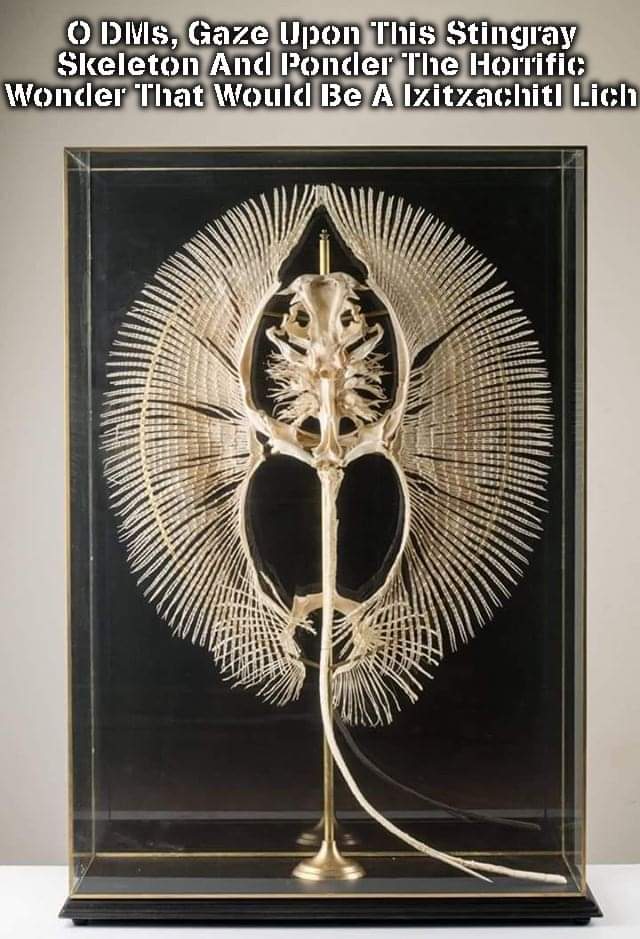
Sundays now are lazy days for me. I either post something silly or other people’s work. Usually both. Today, it’s (loosely) using science to imagine a D&D creature.
Funny story. I never thought I’d ever be able to spell ixitxachitl, and only recently did it stick in my brain. Now I can spell it at will. Small victories, huh?
Dungeons & Dragons is a trademark of Wizards of the Coast, LLC, who neither contributed to, nor endorsed, the contents of this post. (Okay, jackasses?)
Okay, that title is false. Dumb monsters are dumb, but that doesn’t mean they don’t serve a purpose. I’m currently entering Fiend Folio data into my 1st Edition AD&D database, so I’ve got dumb monsters on the brain. This reminds me of countless articles I’ve read listing the dumbest monsters in D&D. I don’t agree with all the entries, and I’d guess many of you don’t either. One list had a Beholder on it. That’s got to be a minority opinion. And Teos will have words with anyone who criticizes the flumph. This is, of course, because these lists are subjective, but most of these lists do involve the usual suspects.
For example, let’s look at the mauler. Just look at it. Try not to give it too much thought. You definitely shouldn’t consider how the thing reproduces. That won’t end well because you’ll likely have to consider what it looks like from behind, especially while it’s rolling around. Anyway, there aren’t many things dumber looking than that. However, such a monster can serve a purpose to an adventure writer.
D&D takes place in a world of magic, and that necessarily leads to things that don’t make logistic sense. In fact, maulers don’t need to breed through a natural process. Phew! So, let’s say that your BBEG is performing an apocalyptic ritual. You decide that the ritual’s end goal is to cause non-sentient animals to gain sentience and kill all humans. You don’t want to give that away, but you need an adventure seed that hints at what’s going on. You decide that the early stages of the ritual must manifest themselves with increasingly strange effects on the natural world. The early stages of the ritual may be working out the fine details of the process, causing grossly odd mutations to normal wildlife in the meantime. Such mutations would probably be painful, which would anger temperamental animals such as big cats. Sure, you could give them stronger bites and extra claws, but that’s not so much “odd” as mere exaggeration. We already have exaggerated animals, whether prehistoric or “dire.” You want something far weirder than a larger animal with an extra couple of claws. That plays out no differently than just giving your normal animal more attacks with the claws it already has. The mauler fits this scenario perfectly, so you should be glad that the mechanics of how such a creature would work are already written for you.
The mauler helps in another way. As I was writing this post, I chose the mauler. From there, I had to reverse engineer how the mauler would fit into the example I gave above. I decided that the nature of the ritual was to grant sentience and anger to ordinary animals; ergo, the mauler inspired my writing. Its odd nature gave me the idea I didn’t already have. One of these bizarre creatures could inspire an unexpected story element.
Let’s also look at the carbuncle. That freak always makes the lists of dumb or “unusual” monsters. It has a very specific goal. The actual problem with this creature is that everyone’s aware of it, so players aren’t going to fall for its tricks. However, the carbuncle teaches us that we can come up with a silly little story idea then build a creature around it. I’m sure that’s how the thing came into existence in the first place.
Dumb monsters can fit nicely within your adventure and even help you write it. Once you’ve chosen to use one, you already have a shortcut on how such oddly structured creatures would play out in combat.
Now go insert a duckbunny in your adventure.
Note: I’ve exhausted all the posts I’ve written and don’t plan to write any more for a while. Sorry, but I’m not in the mood and won’t be for some time. I guess the current streak ends at 194 days in a row with a post.
Last week, I discussed some issues with the calculations for experience points (“XP”) in 1st Edition AD&D (“1e“). When I finally play 1e again, my intent is to play the game as written (as weird and impossible as that is), and every statement I make below will be in the context of the rules as written (unless expressly stated otherwise). I’m fully aware of the fact that a dungeon master can do what they want, but what I want to do is run the game as written. With that in mind, I intend to use XP, though I’m not a fan of it.
It makes far more sense to use a milestone method for leveling up. In 1e, you can’t level up within the course of an adventure because leveling up requires an expenditure of both time and money. You must spend between 1 to 4 weeks training, spending 1,500 gold pieces per level per week just to advance to the next level. (There may be even greater money and time spent on other matters, but those are outside the scope of this post.) In this regard, 1e is a perfect system for milestone leveling. There’ll never be a need for a calculation at the game table to see if it’s time to level up.
My reacquaintance with 1e does give me new appreciation for XP. The source of this appreciation is baked into why it would be difficult to run 1e without XP. (None of this will be new to any of you.) I like that you can earn XP based on treasure, which encourages playing characters intelligently (i.e., don’t have unnecessary fights). More importantly, level drain is some scary shit, and it gives you a sense of danger. That in turn immerses you in the game world. That said, I pointed out on Facebook that level drain more excessive than it needs to be, and someone suggested XP drain instead: each energy drain effect drains 500 XP per level. To that, I add the possibility that 1) in no event does XP drain take you below your current level; and 2) the XP (or level) drain is temporary. XP facilitates fine tuning energy drain to meet the DM’s specific needs, especially if you’re a modern gamer giving 1e a try.
I can live with XP, but I don’t look forward to tracking it. 🙂
Last Monday, I shared a bit of Chinese folklore. Today, I’m continuing with the eastern theme, moving northeast a bit. Here’s a video on the Japanese Oni. 1st Edition AD&D called them “Ogre Magi.” It’s no coincidence that the speaker points out how much they looked like ogres.
It isn’t all about Europe, or at least it shouldn’t be.
As I said yesterday, I’m not going to spend nearly as much effort on this blog for the time being, but I’m happy to say that I finished data entry for the 1st Edition AD&D Monster Manual yesterday and started entering Fiend Folio information. I think I may have written that I finished that entry a couple of days ago. I did but had to go back through the data and fix some issues. I’m not taking a particularly professional approach to this database — for software engineers, my requirements analysis phase has been shit — so after I reach a certain point, I realize I have to go back and change a few things. Getting to the very end of the Monster Manual lit yet another lightbulb, so I had to do a little more work.
Something important I learned in making those final changes: The XP calculations in Appendix E of the Dungeon Masters Guide sometimes make no sense at all. That not only includes some strange calculations that don’t seem to be supported by the stat block — green slimes don’t have as many special abilities (10) and exceptional ones (11) as Asmodeus — but it also includes impossible calculations not supported by the table, Experience Points Value of Monster (DMG, p. 85).
As to the former, I did what I was told. I assumed (probably naively) that the creatures were play-tested and played out more powerfully than the numbers otherwise dictated. I’m not going to rock that boat, though there were a couple of times I know I did, but don’t remember exactly which monsters those were. Sometimes the numbers were just so ridiculous that I changed them.
As to the latter, it forced me to make some calls that I really didn’t want to have to make. When you create a specific instance of a monster, you roll its hit points, which affects the final XP calculation. Because I want that calculation to be automated (less math for you!), for every given monster, I entered integers for the number of “special” and “exceptional” abilities. Therefore, the software will combine your die roll with certain data that calculate the XP for you. If that doesn’t make sense, just understand that you’ll push a button, and you’ll have a monster complete with an XP calculation. However, as I said, the calculations were impossible in a few cases, representing odd exceptions to the rules. I sometimes had to choose between a calculation that would give a creature an extra 10 XP or shortchange it by 5 XP. In such cases, I chose to give an extra 10 XP (larger numbers apply for higher level monsters, but the percentage of error is about the same). This doesn’t seem like much, and XP is often, being generous, an inexact science, so I won’t lose sleep over it. What bugs me about it is 1) it happened enough that it appears to be intentional; and 2) if these minor differences are nothing to lose sleep over, why have them? Why not have these monsters conform to the standard formula? If they did, that difference would also be nothing to lose sleep over. It just seems weird to make such specific, small exceptions to such an inexact equation, but knowing some of the AD&D crowd, I know I’m going to take some heat anyway for what I produce.
I’m so selfish for forgetting that I owe these people all my hard work.
In addition, there were times that no formulae were given, so I made them, and that also had me going my own way at times. For example, I broke out the dragons by those that cast spells and those that don’t, and considered 1st- and 2nd-level casting as “special” and higher level casting as “exceptional.” I also thought that the dragon’s fear aura was pretty damn powerful, so I called it “exceptional” even though it’s not in either list of abilities. Some will agree, and some won’t. Just try to keep in mind that all of these numbers will be subject to your own modifications within the database itself.
As someone who’s quite pretentious, I’m amazed how much competition some in the AD&D crowd give me in that regard. You realize it’s a game, right?





 Play What You Want