A Follow up on Spell Components #DnD #RPG #4e #1e #5e #ADnD #TTRPG

If you enjoy this post, please retweet it.

Yesterday, I discussed spell components. The conversations I had across Facebook and MeWe encouraged me to provide a quick epilogue to the spell components post.

The point I was making applies to games yet to be designed, not to current editions, and the argument is a rather trivial one: The more valuable a thing is, the higher it’s cost should be. We can all get behind that notion, right?

A problem I have with 5th Edition D&D (“5e“), and I think most editions, is that there are a list of go-to spells (or class abilities) that everyone feels they have to take, limiting the diversity of builds at the table. I have no intention of trying to “fix” existing editions to balance material spell component cost and availability with the power of spells. It turns out that for 5e (the subject of that post), that would be a lot of work. Here’s a sample of those spells (and their spell components) that I’ve mathematically proven to be preferred by WotC themselves in creating NPCs, and I suspect players favor as well.

  • Feather Fall: a piece of down or small feather.
  • Fireball: bit of guano and sulfur.
  • Fly: a feather from a bird’s wing.
  • Hold Person: a small straight piece of iron.
  • Invisibility: an eyelash encased in gum arabic.
  • Lightning Bolt: a bit of fur and a rod of amber/crystal/glass.

As you can see, all of these spells have cheap material components that are easily obtained without the DM creating an illogical scarcity. Some popular spells (Counterspell, Dimension Door, and Misty Step) don’t even require material components. So, in 5e, even if you “enforced” components, it wouldn’t change a damn thing. That, to me, is a design flaw, and one I don’t have the desire to fix. However, where there’s a high cost for a spell (e.g., Heroes Feast), I’m going to enforce it.

That said, increasing the cost or scarcity of material components is just one way to increase the cost of spells. In 1st Edition D&D (“1e“), spell cost was assessed using casting times. Combat consisted of 1-minute rounds divided into 6-second segments (i.e., 10 segments per round). Initiative determined the segment in which a character was able to act (with some caveats not relevant here). Because spells had casting times measured in segments, a caster would start casting a spell in one segment, but the casting wouldn’t complete until a later segment. If a caster took a single point of damage during this time, the spell would fail, and the caster would lose the spell slot. Therefore, casters had a choice to make: either cast a weaker spell quickly, assuring it would be of (limited) value, or cast a more powerful spell accepting the risk that it could wind up to be worthless.

In other words, 1e used casting times to increase the cost of spells, and it appears to have done so quite well. Of course, without dividing your rounds into segments, casting times may not be a viable solution.

The moral of this story is that game designers really need to pay better attention to whether their systems lead a majority of players to make the same choices. Sure, some things should be better than others, but like in the real world with food, cars, houses, and everything else, the better things should have a higher cost, regardless of how that cost is assessed. That way, different players will create widely diverse builds, and we’d (or at least I’d) see more dynamic combats.

In 5e, material spell components seem to be the intended way to do that.

Follow me on Twitter at @gsllc

Dungeons & Dragons is a trademark of Wizards of the Coast, LLC, who neither contributed to nor endorsed the contents of this post. (Okay, jackasses?)

Paleozoic Monsters #DnD #ADnD #gaming #science #biology #paleozoic

If you enjoy this post, please retweet it.

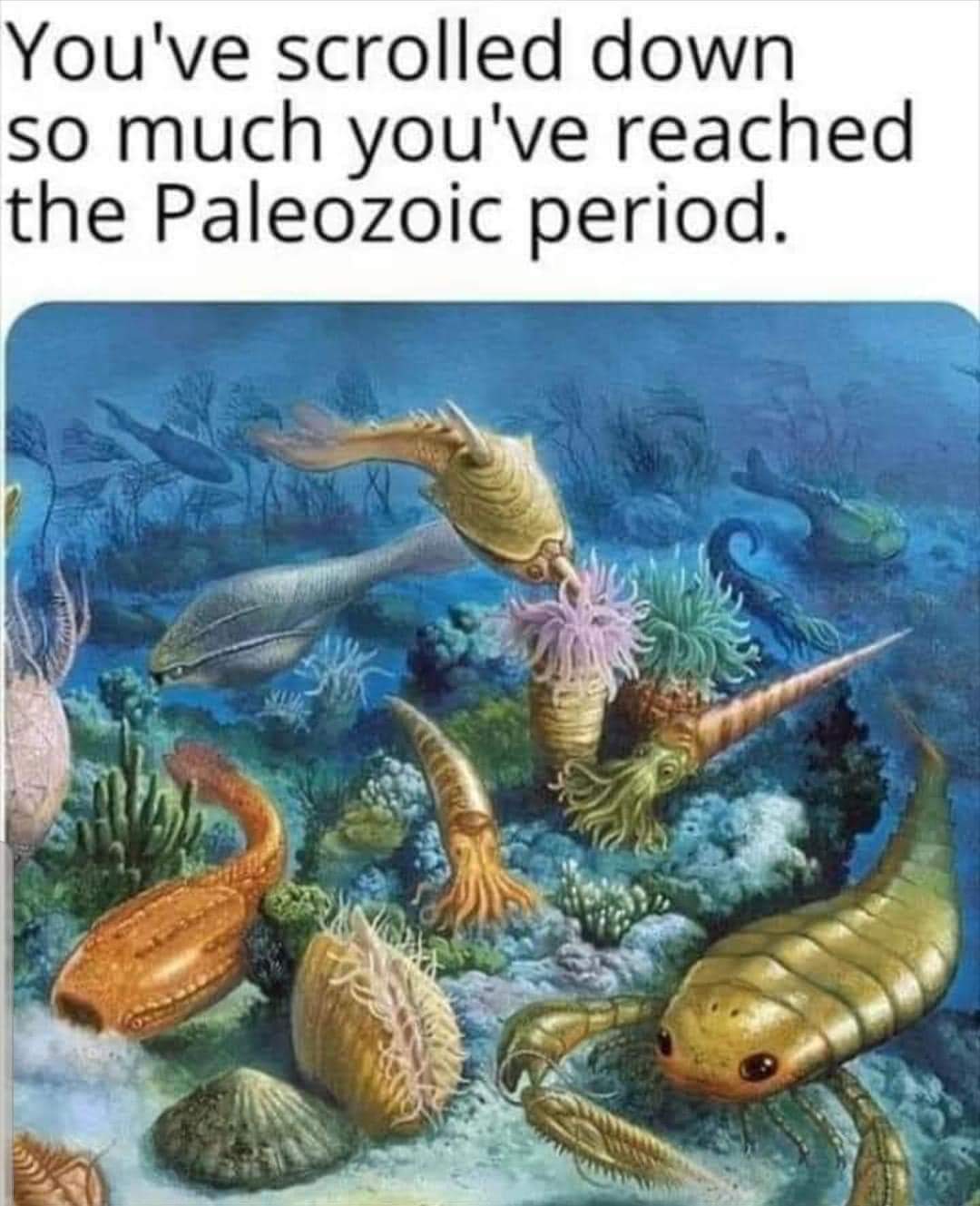
Sundays now are lazy days for me. I either post something silly or other people’s work. Usually both. Today, it’s a continuation of my obsession with how to deal with aquatic encounters.

I discussed how there are plenty of viable aquatic PC races in 1st Edition D&D (“1e“). This image contains more threats, much of which don’t appear (as far as I can tell) among official 1e bestiaries, and I’m sure there are plenty of options from other eras to add to what we have. If 1e weren’t so human-centric, the writers may have done a better job contemplating aquatic campaigns, and then we’d have more of these. Perhaps some reskinning is in order.

Oh, and happy Super Bowl Sunday! Go Sean McVay! Remind Daniel Snyder how much of a dipshit he is!

Someone stat that shit!

Follow me on Twitter @gsllc

Dungeons & Dragons is a trademark of Wizards of the Coast, LLC, who neither contributed to, nor endorsed, the contents of this post. (Okay, jackasses?)

The Acaeum @theacaeum #ADnD #2e #3e #4e #DnD #RPG

If you enjoy this post, please retweet it.

Before you purchase any used materials for Advanced, Basic, or Original D&D, please visit the Acaeum at https://www.acaeum.com/ddindexes/rulebooks.html. Their main homepage is here, and their methodology is here. Someone posted a list of D&D materials to the Facebook 1st Edition D&D group earlier this week. The prices were generally double what the Acaeum lists.

Scam Artist Luring Buyers Posing as Franchised Distributors - AERI
Last printing of 1st Edition D&D PHB in fair condition only $300!

The guy wasn’t trying to be an asshole. He seemed like a reasonably nice guy, but his claimed success, if true, is relying on gullibility and desperation to make his sales. He may not realize that.

As rare as it is, I know there are some gamers that have a decent amount of disposable income. I, myself, have made several 1st Edition D&D purchases recently (though most were new). It doesn’t matter. If anyone is selling materials for higher prices than what’s listed at the Acaeum, don’t freaking buy them. Things cost whatever people will pay for them, but that’s exactly why you should rely on a neutral third party to assess the fair price. Otherwise, you encourage overpricing, and buyers suffer. Be patient. If everyone plays it cool, prices will lower.

I wish there was a resource for 3rd Edition D&D material. There are a couple of items I’d like, but they’re way too expensive at the moment.

Follow me on Twitter @gsllc
Follow the Acaeum @theacaeum

Dungeons & Dragons is a trademark of Wizards of the Coast, LLC, who neither contributed to nor endorsed the contents of this post. (Okay, jackasses?)


Another Blast from the Past: Print Issues of Dragon and Dungeon Magazines #ADnD #DnD #3e #4e #RPG 

If you enjoy this post, please retweet it.

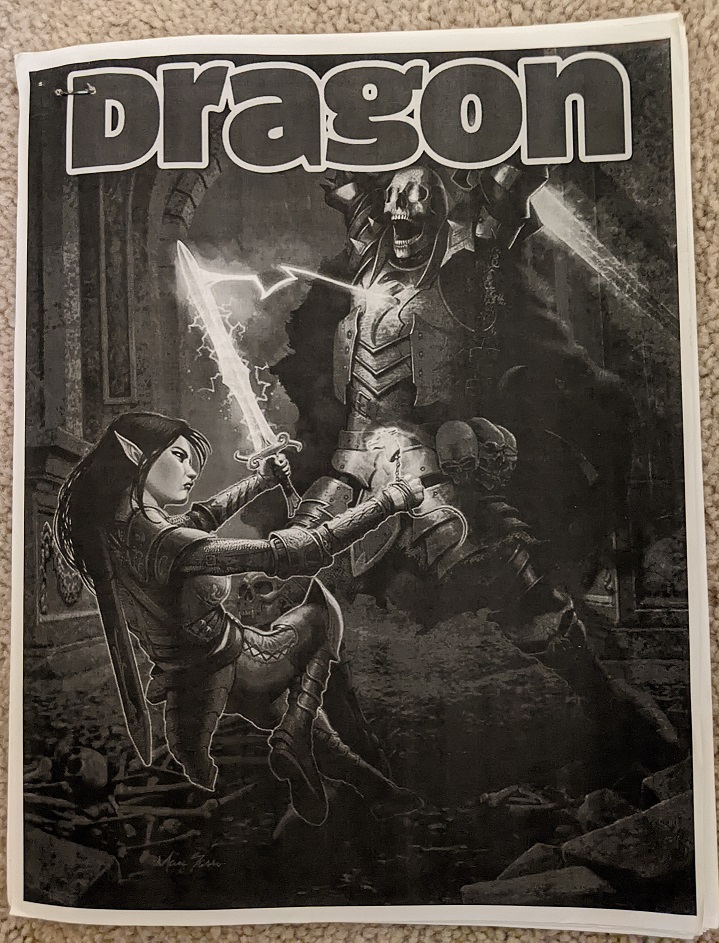
Last week, I mentioned that, during my move, I found the hard copies of my Dungeon Delves from synDCon. Well, I also found some print issues of Dragon and Dungeon magazines. Any mechanics or setting-based discussed in the magazines is for 3rd Edition D&D (“3e“), which I no longer enjoy playing, but much of the material is system agnostic. It’s still good stuff.

As I’ve said in many other contexts, I left D&D in 1982 due to the Satanic Panic, dabbled a bit in the Star Trek RPG in high school and college, then finally returned to D&D and a small amount of other RPGs in 2005. Because of my age, my awareness, my family’s restrictions, and logistics, I didn’t subscribe to Dragon and Dungeon until 2005 or 2006. It was fantastic. As someone still trying to get a feel for writing and running my own gaming material, I loved the advice and rules explanations that magazine offered. Unfortunately, shortly after I started subscribing, the rug was pulled out. They announced that they were moving the magazines online, and shortly thereafter, 4th Edition D&D (“4e“) was announced at GenCon 2007. The last issues of each were dated for September, 2007.

I wasn’t a fan of the online magazines. I wanted to find a color magazine in my Delaware post office box twice a month, but the reality of our world took over, and I eventually started receiving them online with my DDO subscription. How much did I prefer print? I printed out several of the PDFs, but in black and white. It wasn’t the same, and the ink costs were too high despite not being in color, so that practice didn’t last.

I think this was the first online issue.

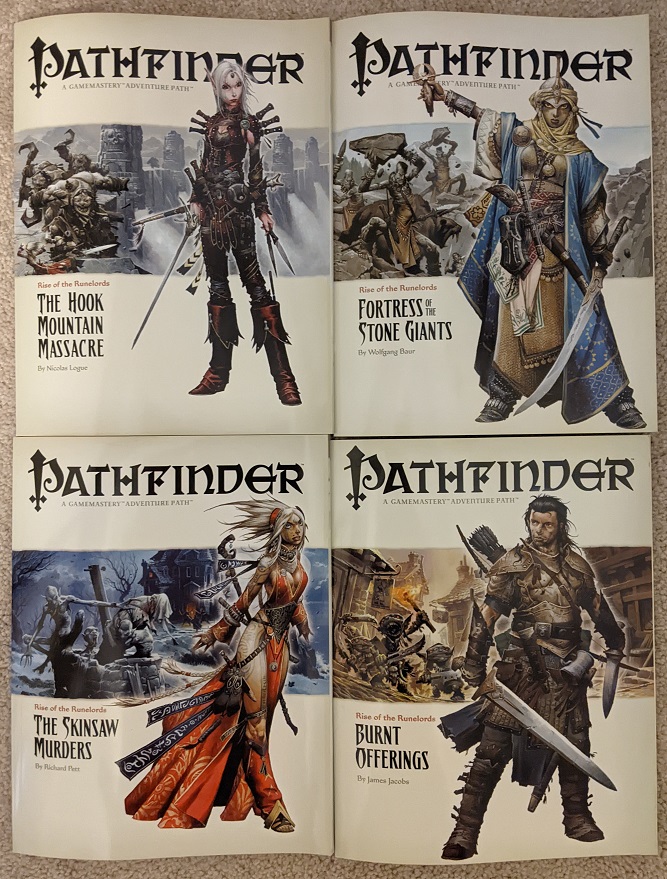
Because I appreciated Paizo for publishing them, I gave them a chance by continuing to subscribe to their Pathfinder adventure path books. I recall telling them that in response to their sales pitch they delivered via email.

You can buy these here, but they seem to have new covers.

Sadly (for Paizo), they weren’t for me, so I never used the material. Honestly, I always found their style of artwork better suited for children (especially the goblin), and, as I said above, I also knew that I wouldn’t be staying behind for 3e due to my participation in organized play. In hindsight, that wouldn’t have been a barrier due to the introduction of Pathfinder Society, but I would have abandoned Pathfinder anyway. I greatly prefer 4e, so I’m happy with my decision. Still, I’m happy Paizo enjoyed success, even though that success created a misconception as to how 4e fared, and that people were able to continuing playing an improved system they enjoyed.

My recent revisiting of 1st Edition D&D has me asking questions, and many people have pointed me to old editions of Polyhedron, Dragon, and Dungeon magazines. Apparently, these were a valuable resource long before I subscribed.

I’m old school, so I want those magazines, but I completely understand why I can’t have them.

Follow me on Twitter @gsllc

Dungeons & Dragons is a trademark of Wizards of the Coast, LLC, who neither contributed to nor endorsed the contents of this post. (Okay, jackasses?)
The Other D&D: Deities and Demigods @SerpentineOwl @Luddite_Vic #ADnD #DnD #RPG #MythologyMonday #MythologyMonandæg #folklore

If you enjoy this post, please retweet it.

Every now and then, someone posts to a D&D group asking how everyone used Deities & Demigods in your games. The question almost always refers to 1st Edition D&D (“1e”). I suspect the reason for that is 1) many people that used it as kids so (like me) their answers will depend on how long ago they played; and 2) later editions of D&D overtly incorporated combat with divine creatures, or their avatars, for epic level adventurers. I’ve also played 3rd Edition D&D (“3e”), 4th Edition D&D (“4e”), and 5th Edition D&D (“5e”), so I’m going to address all of them.

Yes, there’s a clear pattern in my abbreviations, but this is how lawyers write.

1e

As a kid, I loved reading mythology before I had even heard of D&D. Mythology is what drew me in, so of course I was going to use Deities and Demigods anyway I could. I remember during my earliest days (1977 or 1978), I created a list of 100 (or so) magic items from that sourcebook (e.g., Thor’s hammer, Enlil’s helm), and each PC was permitted to roll a d100 to determine their starting magic weapon. Yes, a 7th-level level character could wield Zeus’s Aegis. As an adult, this sounds stupid, but there’s no wrong way to play D&D, right? We had fun with it.

Hiatus

I stopped playing D&D in 1982 due to the Satanic Panic, so no 2nd Edition or 3rd Edition D&D for me.

3.5e

I returned to the game of D&D in 2005, and 3.5e was the current edition. I never played or ran epic level for 3.5e, so that edition’s Deities and Demigods was nothing more than reading material. I sold off almost all my 3e materials when 4e came out, but when I repurchased some for posterity, I made sure to grab that one (actually, it was gifted to me by James). I love that book, but what stood out the most to me about it was the transition to Horus as the supreme leader of the Egyptian pantheon. Like the real world, leadership switched. But I never used it in game.

Side Note: I really wish I’d never sold Hordes of the Abyss or Tyrants of the Nine Hells. They’re great resources valuable in any edition, but buying them now would be a horrible waste of money.

4e

There was no 4e Deities and Demigods. Divine creatures, or their avatars (DM’s choice as to which), appeared throughout various monster manuals, and they were designed as encounters for epic level creatures. Basically, Wizards of the Coast (“WotC”) surrendered to the notion that a lot of us wanted to face the divine, and it became part of the game. How the monster was interpreted – the actual creature or just an avatar – was a matter for the DM to decide, but they were there. Well, a few of them. I don’t recall WotC publishing gods beyond their own proprietary pantheons. I believe you had to go to third parties for that material, and sometimes it wasn’t right on point (e.g., Soldiers of Fortune had a Thor equivalent, but he wasn’t called “Thor”).

Going Backwards

Now that I’m going backwards, I must decide how to deal with divine creatures. They aren’t baked into the scheme like they are with 4e. In fact, as some have pointed out, it really should be impossible for PCs to compete against the divine on their home plane, which is the only place where they can finally be defeated. Once you leave the Prime Material Plane, many spells don’t work or are severely weakened. The environment itself works against the PCs but is home sweet home for divine creatures. There’s no upper limit to class levels for PCs, so eventually PCs should be able to fight the divine within the rules, but who’s going to level up to level 1,000? No one, and isn’t advancement through adventuring the real fun of the game? I’m not just going to say, “Okay, you’re all 1,000th level. Let’s go fight some gods.” I’m also not going to rewrite the rules in some odd way to make divine encounters more practical. It’s assumed that DMs will tweak the rules a bit, but eventually that reaches a point where we aren’t playing D&D anymore. That doesn’t interest me.

Of course, I don’t have to make my decision anytime soon. In fact, I may never have to make it. Once I sit down at the table, I may lose interest in 1e quickly. We’ll see.

Shameless Plug

This isn’t much of a plug, but here it goes. Luddite Vic and I are designing our own RPG. It’ll never see the commercial light of day because we don’t meet frequently enough to get it done. However, the system so far is, unsurprisingly, exactly what I want from an RPG. One of our design schemes relevant here is to make sure that PCs can emulate characters from mythology, folklore, or literature even at first level. I’ve never seen that in an RPG.

For example, how might one emulate Thor in 5e? One less-than-ideal option would be a hammer-wielding human tempest cleric, but that cleric would barely be distinguishable from any other cleric build until 3rd level, and even then, it’s going to take a while before it’s obvious to other players what you’re trying to do. You could just tell them, but if you need to do that, you’re not really playing Thor yet. What about Tarzan? How long would a half-naked, dagger-wielding barbarian last in a game of 5e?

In our system, everyone would know from the get-go exactly what you were doing with your lightning/thunder-based, hammer-wielding, human tempest, or a half-naked, dagger-wielding barbarian, even though those characters wouldn’t be any more or less powerful than any other 1st-level characters. That’s the real solution, but I know of no other game that does that. One game was mentioned to me where the PCs are the gods, but from what I understand, they don’t start as anything resembling 1st-level for other RPGs. That’s not bad, but it’s not the same thing. I want to start as first level with that character concept and earn divinity.

That’s how I’d prefer to “use Deities and Demigods.” I shouldn’t need to. I should be able to make the PCs and NPCs exactly what I need them to be. But in 1e, they’re just avatars.

Maybe someday Vic and I will finish our game.

Follow me on Twitter @gsllc
Follow James @SerpentineOwl
Follow Luddite Vic @Luddite_Vic

Dungeons & Dragons is a trademark of Wizards of the Coast, LLC, who neither contributed to nor endorsed the contents of this post. (Okay, jackasses?)

My synDCon Dungeon Delves @Luddite_Vic @flashedarling #ADnD #DnD #4e #RPG 

If you enjoy this post, please retweet it.

I know you’re all sick of hearing about my new house, but hear me out. This is a D&D post. During my move, I found some things I had lost. Sort of. I have the original Word and PDF versions, but I found the bounded hard copies. First, some context.

Luddite Vic and I ran a gaming club called the Gamers’ Syndicate, and ran a convention about a decade ago called synDCon, playing off the association with the Syndicate. It took place in the DC area (Rockville, MD, to be precise); hence, the odd capitalization in the convention’s name.

I’m like a free agent: Unrestricted.

The current edition of D&D at the time was 4th, and one of the marketing efforts for that edition was the “dungeon delve.” These were 30-45 minute (if I recall correctly) collections of three or four combat-only scenarios. They were great at conventions for giving gamers something to do if their adventures ran over. In many cases, there were minor prizes for completing the delves, which wasn’t always easy.

Well, I took that idea and ran with it for synDCon II. It was my pet project because I was able to combine a couple of ideas to make it worth my trouble. I created delves based on iconic encounters in 1st Edition AD&D adventures, added in pregens created by Galen, and named the event synDClash (shut up). Here’s the rundown:

  1. Return to the Borderlands (easy): The Mad Hermit, the Owlbear, and the Minotaur, all based on Keep on the Borderlands.
  2. Giant Problems (easy): The kitchen encounter from Steading of the Hill Giant Chief, the frozen tomb from Glacial Rift of the Frost Giant Jarl, and the children’s barracks from Hall of the Fire Giant King (they were actually “Fire Giant Tweens”).
  3. The Ruins at Inverness (medium): The chessmen, the medusa and “strange apes,” and the fire giant from my favorite D&D adventure, Ghost Tower of Inverness, which I’ve converted to 4e and 5e (only characters were published).
  4. Erelhei-Cinlu Rises (difficult): A troglodyte, wyverns, and piercers in a cavern from Descent into the Depths of the Earth; the statute of Blibdoolpoolp and some kuo-toa from from Shrine of the Kuo-Toa, and the married couple Belgos and Silussa (the succubus) from Vault of the Drow.
  5. The Great Metal Dungeon (difficult): The mind flayer and vegepygmies, the combat-based robots, and the bulette from second favorite D&D adventure Expedition to the Barrier Peaks.
  6. The Pit of the Queen (very difficult, by which I meant impossible): The demonweb maze populated by various giant arachnids, the two drow clerics sitting on towers, and Lolth herself from Queen of the Demonweb Pits.

We also allowed DMs to run the Fool’s Grove Delve, which was published by WotC. For synDClash (shut up), it was medium difficulty.

As you might guess, the Pit of the Queen was completely unfair. For those of you that have knowledge of 4e, here are three features that stand out for the final encounter with Lolth. First, the encounter begins with a lot of space between the PCs and Lolth, but with spider swarms near the PCs. The swarms have a close blast 3 basic attack(!). That is, if one PC provoked, the spider would execute a blast that could affect multiple PCs, and considering the cramped space and the range of the attack, there were always multiple targets. Oh, and of course that attack went off the moment the swarm was destroyed. Second, she had some animated statutes that kept PCs prone. Third, Lolth had a power that made her appear as “artillery.” However, the moment more than one PC at a time was adjacent to her, it became clear she was a “soldier.” No one saw that coming. They thought that once they got nearby, they’d have her, but that didn’t happen. There’s no way PCs could win this encounter if the DM played it as written, but that didn’t stop PCs from trying.

Josie, if you’re reading this, you’re credited on one of these as a playtester under the name, Jamie Morgan. I have no idea how that happened. 🙂

I was happy to see how popular synDClash (shut up) was. There were some people playing multiple delves for an entire slot, and not because there weren’t seats available at regular games. They enjoyed the nostalgia as well. If we had run a third synDCon, my next plan was to make a bunch of delves based on fairy tales, but it wasn’t meant to be.

I also found this gem from 1986.

One of these days, I’d like to run these again, and having hard copies for the adventures and the pre-generated characters makes that easy.

Follow me on Twitter @gsllc
Follow Vic at @Luddite_Vic
Follow Galen @flashedarling

Dungeons & Dragons is a trademark of Wizards of the Coast, LLC, who neither contributed to nor endorsed the contents of this post. (Okay, jackasses?)

Tiamutt #science #biology #gaming #DnD #ADnD #Tiamat

If you enjoy this post, please retweet it.

Sundays now are lazy days for me. I either post something silly or other people’s work. Usually both. Today, it’s from a Facebook D&D group I frequent. Here’s what was shared (on this post if you can see it):

I know. This blog hasn’t been kind to canines (too many examples to count). But whether you’re a cat person or a dog person, everyone likes both kittens and puppies, and I’m no exception, so no backhanded compliments on this post.

Everyone’s reaction to this was some variation of “It’s a hydra!” Have they never heard of taxonomy? Reptiles aren’t even in the same class as canines. No, this is its own thing, and its name is Tiamutt, lord of all canines. Always check with me before classifying D&D monsters. I’m apparently much better at it than you guys.

Now someone stat that shit!

Follow me on Twitter @gsllc

Dungeons & Dragons is a trademark of Wizards of the Coast, LLC, who neither contributed to, nor endorsed, the contents of this post. (Okay, jackasses?)

I Must Admit . . . #Caturday #DnD #ADnD #RPG

If you enjoy this post, please retweet it.

So in this image, cats are cast in the role of goblins (or at least baddies). I must admit there’s some sense to that.

Checks out.

Cats don’t give a shit, but at least they have my respect. Dogs would never make good adventurers. They’re all a bunch of followers all seeking the approval of their superiors. Maybe those bears are in charge.

Cats >> dogs.

Follow me on Twitter @gsllc

Dungeons & Dragons is a trademark of Wizards of the Coast, LLC, who neither contributed to, nor endorsed, the contents of this post. (Okay, jackasses?)


Cats from 1st Edition AD&D Oriental Adventures #DnD #RPG #ADnD #Caturday

If you enjoy this post, please retweet it.

Recently, I discussed the introduction of eastern folklore and mythology to the MCU, and specifically discussed the shishi in Shang-Chi. This inspired me to crack open my new PDF of 1st Edition AD&D‘s (“1e“) Oriental Adventures, which I’d never read before. So far, I’m impressed, though I’ve just scratched the surface. Three new races, 10 new classes (10!), a bunch of new spells, and 31 new monsters. I find myself wondering whether the typical 1e player considered this book bloat, but I digress. Today is Caturday, so here are the cats that appear in Oriental Adventures.

Hengeyokai (p. 12)

One of the PC races, the hengeyokai (I’m assuming that’s also plural) are shape changers. Though not lycanthropes, they have the same three forms: animal, human, and a hybrid of the two. One type of hengeyokai is a cat, which must be chaotic (of course), and while naturally dexterous, has a penalty to wisdom (exactly what you’d expect).

Not particularly wise.

Generals of the Animal Kings: Tiger King (p. 120, Level X)

Oriental Adventures states that

The oriental mind has organized the world into a unified whole. One particularly strong belief is that of the Celestial Emperor, a powerful being who heads the Celestial Bureaucracy, a type of government of the spirits. Like the bureaucrats of the real world, these spirit officials can be corrupt, disobedient, just, or incompetent.

Oriental Adventures, page 116

Yes, I know. The “oriental mind.” *sigh* Anyway, one part of the bureaucracy are the generals of the animal kings, and the most powerful (by XP) type of general is the Tiger General, who suppresses rebellions or doles out punishment. He appears as a giant, anthropomorphic tiger wielding magic, scaring the hell out of characters with his appearance, and regenerating 5 hps/round. The best part, however, is that he wields a +5 vorpal sword (+8 to hit, 3 attacks/round). There could be more than one of them, and each one is always accompanied by 100 tigers. Good luck with that.

Shirokinukatsukami (p. 128, Level IX)

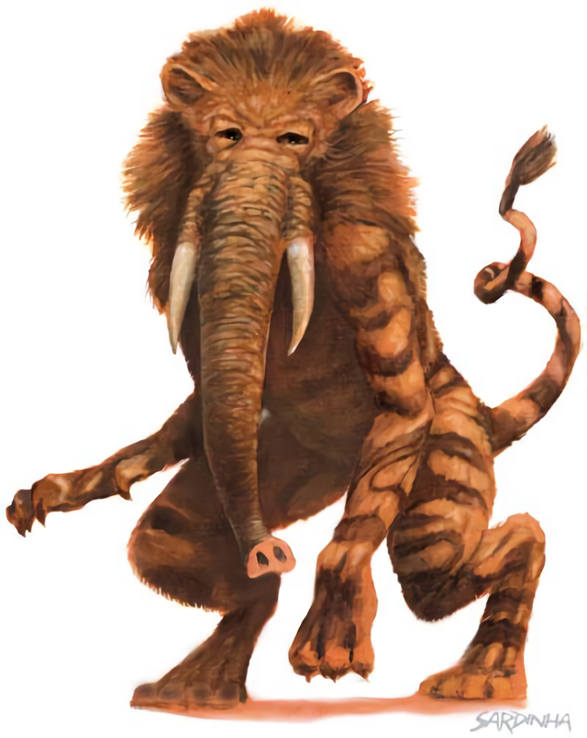
This one’s weird. Okay, it’s all weird, but this is really weird. The shirokinukatsukami has “the body of a horse, the face of a lion, the trunk and tusks of an elephant, the tail of a cow [intimidating!], and the feet of a tiger.” As far as I’m concerned, that’s enough to count as a cat. It’s a shame this book doesn’t provide a picture. Good luck visualizing that.

Google is your friend.

It can have up to 5 physical attacks per round, casts a lot of spells, regenerates, +3 or better weapon to hit. . . it’s a bad ass, which explains why there can be no more than four in existence at any point in time. This is also explained by how difficult it must be to build something like that. Fortunately, its lawful good, so your PCs should be okay even if it shows up.

Neither of the monsters appear on the random encounter table. They aren’t the kind of monster you’d want to randomly drop on a party. They deserve planning.

That’s it. Oriental Adventures has a ton of new material, but not a lot of cats.

Booooo!!!!!!!!!.

Follow me on Twitter @gsllc

Dungeons & Dragons is a trademark of Wizards of the Coast, LLC, who neither contributed to nor endorsed the contents of this post. (Okay, jackasses?)

Returning to My AD&D Database #ADnD #DnD #RPG 

If you enjoy this post, please retweet it.

My brain had to take a vacation for a couple weeks, but I’ve finally returned to my 1st Edition AD&D (“1e“) database. Having recently discussed the shishi, it was a nice coincidence that I finished Fiend Folio‘s oriental dragons last night. There were a couple of things that bothered me in the technical writing (e.g., is their lack of infravision a mistake?), but there was a creative choice that bugged me as well.

In my conversation with Tanya last Friday, she pointed out how eastern culture has far more good-aligned dragons than the western world. This was my understanding as well. Then why are all but one of the oriental dragons neutral along the moral axis? I get why Sobek, the crocodile-headed Egyptian god of the Nile, was made evil in most (every?) editions of D&D. He looked evil, and they needed a balance between good and evil gods for that pantheon. His evil fulfilled a narrative role, and there was plenty of material presented to accommodate some wiggle room. Besides, DMs are free to change it. No harm done.

That doesn’t seem to apply to neutrality, though. Sure, if the Fiend Folio had gone into depth as to the role their neutrality took, then there may be a narrative value to that change. Instead, it appears that they were made neutral simply because none of the chromatics or metallics were neutral. If you’re introducing a different culture into your game, it makes far more sense to remain loyal to it, at least until you’ve got a certain minimal level of material. That is, to start, it’s better to give DMs something authentic/faithful so that they have the right feel for that material before you or they make it their own. As with the Egyptian pantheon, oriental dragons should have been a balance of good and evil, and if one of them was made neutral, it wouldn’t have struck me the wrong way.

Note: I’ve never opened the 1e Oriental Adventures, though I recently bought the PDF from the DMs Guild. I say this to point out that I have no idea how an expansion of those cultures played out in the D&D world beyond what’s in the Fiend Folio and 1e Deities and Demigods.

My conclusion is that I’m going to have to do some personal research and, depending on what’s in the 1e Oriental Adventures, may modify these dragons. I definitely like oriental dragons and intend to use them.

No subdual for you!

Follow me on Twitter @gsllc

Dungeons & Dragons is a trademark of Wizards of the Coast, LLC, who neither contributed to nor endorsed the contents of this post. (Okay, jackasses?)