
The Other D&D: Deities and Demigods @SerpentineOwl @Luddite_Vic #ADnD #DnD #RPG #MythologyMonday #MythologyMonandæg #folklore

If you enjoy this post, please retweet it.

Every now and then, someone posts to a D&D group asking how everyone used Deities & Demigods in your games. The question almost always refers to 1st Edition D&D (“1e”). I suspect the reason for that is 1) many people that used it as kids so (like me) their answers will depend on how long ago they played; and 2) later editions of D&D overtly incorporated combat with divine creatures, or their avatars, for epic level adventurers. I’ve also played 3rd Edition D&D (“3e”), 4th Edition D&D (“4e”), and 5th Edition D&D (“5e”), so I’m going to address all of them.

Yes, there’s a clear pattern in my abbreviations, but this is how lawyers write.

1e

As a kid, I loved reading mythology before I had even heard of D&D. Mythology is what drew me in, so of course I was going to use Deities and Demigods anyway I could. I remember during my earliest days (1977 or 1978), I created a list of 100 (or so) magic items from that sourcebook (e.g., Thor’s hammer, Enlil’s helm), and each PC was permitted to roll a d100 to determine their starting magic weapon. Yes, a 7th-level level character could wield Zeus’s Aegis. As an adult, this sounds stupid, but there’s no wrong way to play D&D, right? We had fun with it.

Hiatus

I stopped playing D&D in 1982 due to the Satanic Panic, so no 2nd Edition or 3rd Edition D&D for me.

3.5e

I returned to the game of D&D in 2005, and 3.5e was the current edition. I never played or ran epic level for 3.5e, so that edition’s Deities and Demigods was nothing more than reading material. I sold off almost all my 3e materials when 4e came out, but when I repurchased some for posterity, I made sure to grab that one (actually, it was gifted to me by James). I love that book, but what stood out the most to me about it was the transition to Horus as the supreme leader of the Egyptian pantheon. Like the real world, leadership switched. But I never used it in game.

Side Note: I really wish I’d never sold Hordes of the Abyss or Tyrants of the Nine Hells. They’re great resources valuable in any edition, but buying them now would be a horrible waste of money.

4e

There was no 4e Deities and Demigods. Divine creatures, or their avatars (DM’s choice as to which), appeared throughout various monster manuals, and they were designed as encounters for epic level creatures. Basically, Wizards of the Coast (“WotC”) surrendered to the notion that a lot of us wanted to face the divine, and it became part of the game. How the monster was interpreted – the actual creature or just an avatar – was a matter for the DM to decide, but they were there. Well, a few of them. I don’t recall WotC publishing gods beyond their own proprietary pantheons. I believe you had to go to third parties for that material, and sometimes it wasn’t right on point (e.g., Soldiers of Fortune had a Thor equivalent, but he wasn’t called “Thor”).

Going Backwards

Now that I’m going backwards, I must decide how to deal with divine creatures. They aren’t baked into the scheme like they are with 4e. In fact, as some have pointed out, it really should be impossible for PCs to compete against the divine on their home plane, which is the only place where they can finally be defeated. Once you leave the Prime Material Plane, many spells don’t work or are severely weakened. The environment itself works against the PCs but is home sweet home for divine creatures. There’s no upper limit to class levels for PCs, so eventually PCs should be able to fight the divine within the rules, but who’s going to level up to level 1,000? No one, and isn’t advancement through adventuring the real fun of the game? I’m not just going to say, “Okay, you’re all 1,000th level. Let’s go fight some gods.” I’m also not going to rewrite the rules in some odd way to make divine encounters more practical. It’s assumed that DMs will tweak the rules a bit, but eventually that reaches a point where we aren’t playing D&D anymore. That doesn’t interest me.

Of course, I don’t have to make my decision anytime soon. In fact, I may never have to make it. Once I sit down at the table, I may lose interest in 1e quickly. We’ll see.

Shameless Plug

This isn’t much of a plug, but here it goes. Luddite Vic and I are designing our own RPG. It’ll never see the commercial light of day because we don’t meet frequently enough to get it done. However, the system so far is, unsurprisingly, exactly what I want from an RPG. One of our design schemes relevant here is to make sure that PCs can emulate characters from mythology, folklore, or literature even at first level. I’ve never seen that in an RPG.

For example, how might one emulate Thor in 5e? One less-than-ideal option would be a hammer-wielding human tempest cleric, but that cleric would barely be distinguishable from any other cleric build until 3rd level, and even then, it’s going to take a while before it’s obvious to other players what you’re trying to do. You could just tell them, but if you need to do that, you’re not really playing Thor yet. What about Tarzan? How long would a half-naked, dagger-wielding barbarian last in a game of 5e?

In our system, everyone would know from the get-go exactly what you were doing with your lightning/thunder-based, hammer-wielding, human tempest, or a half-naked, dagger-wielding barbarian, even though those characters wouldn’t be any more or less powerful than any other 1st-level characters. That’s the real solution, but I know of no other game that does that. One game was mentioned to me where the PCs are the gods, but from what I understand, they don’t start as anything resembling 1st-level for other RPGs. That’s not bad, but it’s not the same thing. I want to start as first level with that character concept and earn divinity.

That’s how I’d prefer to “use Deities and Demigods.” I shouldn’t need to. I should be able to make the PCs and NPCs exactly what I need them to be. But in 1e, they’re just avatars.

Maybe someday Vic and I will finish our game.

Follow me on Twitter @gsllc
Follow James @SerpentineOwl
Follow Luddite Vic @Luddite_Vic

Dungeons & Dragons is a trademark of Wizards of the Coast, LLC, who neither contributed to nor endorsed the contents of this post. (Okay, jackasses?)


My synDCon Dungeon Delves @Luddite_Vic @flashedarling #ADnD #DnD #4e #RPG 

If you enjoy this post, please retweet it.

I know you’re all sick of hearing about my new house, but hear me out. This is a D&D post. During my move, I found some things I had lost. Sort of. I have the original Word and PDF versions, but I found the bounded hard copies. First, some context.

Luddite Vic and I ran a gaming club called the Gamers’ Syndicate, and ran a convention about a decade ago called synDCon, playing off the association with the Syndicate. It took place in the DC area (Rockville, MD, to be precise); hence, the odd capitalization in the convention’s name.

I’m like a free agent: Unrestricted.

The current edition of D&D at the time was 4th, and one of the marketing efforts for that edition was the “dungeon delve.” These were 30-45 minute (if I recall correctly) collections of three or four combat-only scenarios. They were great at conventions for giving gamers something to do if their adventures ran over. In many cases, there were minor prizes for completing the delves, which wasn’t always easy.

Well, I took that idea and ran with it for synDCon II. It was my pet project because I was able to combine a couple of ideas to make it worth my trouble. I created delves based on iconic encounters in 1st Edition AD&D adventures, added in pregens created by Galen, and named the event synDClash (shut up). Here’s the rundown:

  1. Return to the Borderlands (easy): The Mad Hermit, the Owlbear, and the Minotaur, all based on Keep on the Borderlands.
  2. Giant Problems (easy): The kitchen encounter from Steading of the Hill Giant Chief, the frozen tomb from Glacial Rift of the Frost Giant Jarl, and the children’s barracks from Hall of the Fire Giant King (they were actually “Fire Giant Tweens”).
  3. The Ruins at Inverness (medium): The chessmen, the medusa and “strange apes,” and the fire giant from my favorite D&D adventure, Ghost Tower of Inverness, which I’ve converted to 4e and 5e (only characters were published).
  4. Erelhei-Cinlu Rises (difficult): A troglodyte, wyverns, and piercers in a cavern from Descent into the Depths of the Earth; the statute of Blibdoolpoolp and some kuo-toa from from Shrine of the Kuo-Toa, and the married couple Belgos and Silussa (the succubus) from Vault of the Drow.
  5. The Great Metal Dungeon (difficult): The mind flayer and vegepygmies, the combat-based robots, and the bulette from second favorite D&D adventure Expedition to the Barrier Peaks.
  6. The Pit of the Queen (very difficult, by which I meant impossible): The demonweb maze populated by various giant arachnids, the two drow clerics sitting on towers, and Lolth herself from Queen of the Demonweb Pits.

We also allowed DMs to run the Fool’s Grove Delve, which was published by WotC. For synDClash (shut up), it was medium difficulty.

As you might guess, the Pit of the Queen was completely unfair. For those of you that have knowledge of 4e, here are three features that stand out for the final encounter with Lolth. First, the encounter begins with a lot of space between the PCs and Lolth, but with spider swarms near the PCs. The swarms have a close blast 3 basic attack(!). That is, if one PC provoked, the spider would execute a blast that could affect multiple PCs, and considering the cramped space and the range of the attack, there were always multiple targets. Oh, and of course that attack went off the moment the swarm was destroyed. Second, she had some animated statutes that kept PCs prone. Third, Lolth had a power that made her appear as “artillery.” However, the moment more than one PC at a time was adjacent to her, it became clear she was a “soldier.” No one saw that coming. They thought that once they got nearby, they’d have her, but that didn’t happen. There’s no way PCs could win this encounter if the DM played it as written, but that didn’t stop PCs from trying.

Josie, if you’re reading this, you’re credited on one of these as a playtester under the name, Jamie Morgan. I have no idea how that happened. 🙂

I was happy to see how popular synDClash (shut up) was. There were some people playing multiple delves for an entire slot, and not because there weren’t seats available at regular games. They enjoyed the nostalgia as well. If we had run a third synDCon, my next plan was to make a bunch of delves based on fairy tales, but it wasn’t meant to be.

I also found this gem from 1986.

One of these days, I’d like to run these again, and having hard copies for the adventures and the pre-generated characters makes that easy.

Follow me on Twitter @gsllc
Follow Vic at @Luddite_Vic
Follow Galen @flashedarling

Dungeons & Dragons is a trademark of Wizards of the Coast, LLC, who neither contributed to nor endorsed the contents of this post. (Okay, jackasses?)

Tiamutt #science #biology #gaming #DnD #ADnD #Tiamat

If you enjoy this post, please retweet it.

Sundays now are lazy days for me. I either post something silly or other people’s work. Usually both. Today, it’s from a Facebook D&D group I frequent. Here’s what was shared (on this post if you can see it):

I know. This blog hasn’t been kind to canines (too many examples to count). But whether you’re a cat person or a dog person, everyone likes both kittens and puppies, and I’m no exception, so no backhanded compliments on this post.

Everyone’s reaction to this was some variation of “It’s a hydra!” Have they never heard of taxonomy? Reptiles aren’t even in the same class as canines. No, this is its own thing, and its name is Tiamutt, lord of all canines. Always check with me before classifying D&D monsters. I’m apparently much better at it than you guys.

Now someone stat that shit!

Follow me on Twitter @gsllc

Dungeons & Dragons is a trademark of Wizards of the Coast, LLC, who neither contributed to, nor endorsed, the contents of this post. (Okay, jackasses?)

Star Trek Characters as D&D Characters @StarTrek #DnD #RPG #StarTrek

If you enjoy this post, please retweet it.

I’m not sure I agree with Uhura as a Thief. She’s clearly charismatic and never used the mentioned skills. I also would have labeled Scotty an Artificer. If I’m not mistaken (I know very little about 2nd Edition), the Alchemist is a new class in 5th Edition. The artificer goes back to 3rd Edition. Duelist is a build but certainly fits Sulu based on one of his most iconic scenes.

May be an image of text

Why not?

Follow me on Twitter at @gsllc
Follow Star Trek @StarTrek

Dungeons & Dragons is a trademark of Wizards of the Coast, LLC, who neither contributed to, nor endorsed, the contents of this post. (Okay, jackasses?)

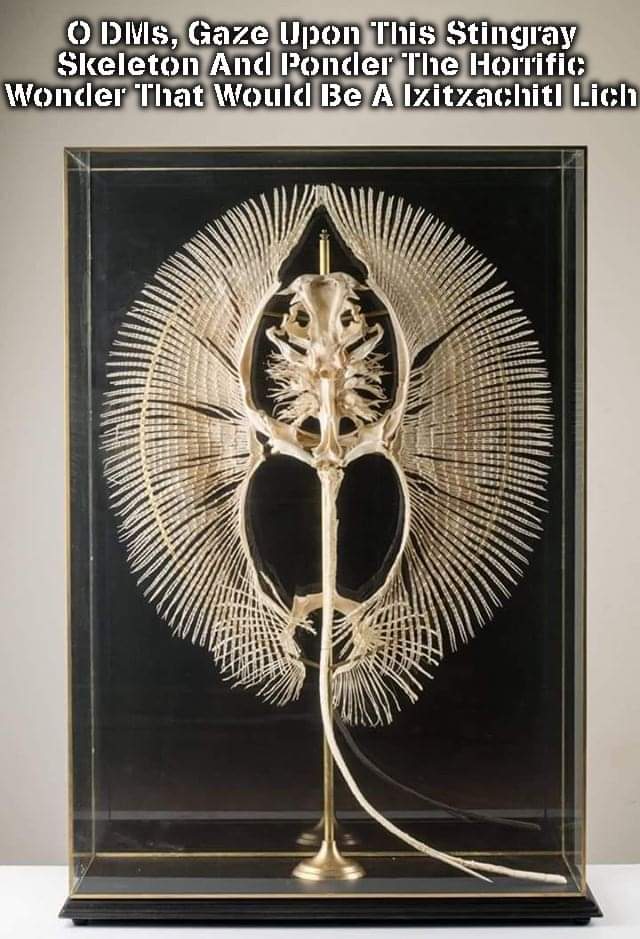
The Ixitxachitl Lich #science #biology #gaming #DnD #ADnD #ixitxachitl

If you enjoy this post, please retweet it.

Sundays now are lazy days for me. I either post something silly or other people’s work. Usually both. Today, it’s (loosely) using science to imagine a D&D creature.

Funny story. I never thought I’d ever be able to spell ixitxachitl, and only recently did it stick in my brain. Now I can spell it at will. Small victories, huh?

Now, someone stat this thing.

Follow me on Twitter @gsllc

Dungeons & Dragons is a trademark of Wizards of the Coast, LLC, who neither contributed to, nor endorsed, the contents of this post. (Okay, jackasses?)

Lord Gygax’s Writing Technique #ADnD #DnD #RPG 

If you enjoy this post, please retweet it.

Flogging A Dead Horse GIFs | Tenor

A while back, I observed that, despite Lord Gygax’s writing being rightly criticized at times, he sometimes made some funny observations that I loved, and you really can’t have one without the other. Rather than accept the compliment for our beloved leader, some of you took me for task, stating there is no way (Seriously? No way?) Lord Gygax’s writing could be rightfully criticized. I have some questions for those people.

Gary Gygax" T-shirt by SaintAgnost | Redbubble
I need this shirt.

1/day, an ogre mage can cast “a ray of cold the same dimensions as that of a cold wand.” Putting aside the missing preposition, what’s a “cold wand”? A wand of cold? No, because that’s not a thing either.

Okay, that one’s not so bad. It’s probably a wand of frost. I don’t like having to go to another book to figure out what the book I’m reading is saying, especially without a page cite, but it didn’t take much work to deduce, so let’s keep going. Locathahs are “very intelligent” (intelligence of 11-12), yet they don’t speak a language. If that doesn’t seem right, it’s because it isn’t. They have their own language. How do I know this? I read the write up on the merman. Half of mermen speak locathah. That’s where I had to go to learn about the locathahs. You could also go to the triton stat block to learn that, which is my suggestion because the triton stat block is also where you have to go to learn that aquatic elves have their own language. Well, it actually says “sea elves,” which we’re all assuming are aquatic elves. Worgs may also have a language because winter wolves (that do) can converse with them, but it’s unclear whether that’s because Worgs can speak the language of winter wolves. If troglodytes speak a language, I haven’t found it yet.

Bingpot GIFs - Get the best GIF on GIPHY

Okay, that was a lecture. Back to questions. How many hit points does an ogre chieftain have? How much damage does a punch from Orcus do? Well, you better have an 11-sided die so that you can determine that (unless you like rerolling high numbers 8.3333% of the time). While you’re at it, make sure to bring your 7-sided die to the game. You may need to calculate how many hit points a goblin has. Fortunately, you need either a d5 or a d9, not both, to determine how many hit points of damage an umber hulk’s mandibles do.

Why doesn’t a giant pike have a swim speed? They seem to run pretty fast on land (36″). Eel? Eye of the deep? Giant gar? Hippocampus? Ixitxachitl? Lamprey (normal or giant)? Locathah? Masher? Morkoth? Portuguese Man-o-War? (From Portugal? Why not? Rakshasa are from India.) Rays of all sorts? Sea hag? Giant sea horse? Sea lion? Shark and megalodon? Sea snake? Triton? Water weird? Whale? That’s every single aquatic monster in the 1e Monster Manual that has only one speed, and it isn’t for swimming.

What spells do a rakshasas cast? What language(s) do they speak? I could ask the same questions for a number of creatures. I already did once (see above). How many rounds or turns does a slithering tracker’s paralysis last? If its siphoning of plasma is interrupted by an attack, will it have time to resume that process if the attacker breaks off the attack? How much damage does a giant slug’s acid do? It’s its preferred attack. Shouldn’t we be told without having to find it in the DMG (on page 64, by the way)? On a d6 roll of 2, what psionic attack will a Su-Monster use? Okay, that last one is just a typo. 🙂

Then there are the spells being referenced with variant names throughout the Monster Manual and even within the Players Handbook itself. One psionic attack is apparently misnamed. What does a mind flayer’s “mind blast” do? I’m not even going to address this disaster. I’ll leave that to this site, which isn’t just an indictment of incompleteness but also general disorganization.

Maybe I’m sensitive, but this is poor writing. My social media posts sometimes generate over 100 responses, and those responses often make opposite claims as to what the text clearly means. For example, no one could agree on the effect of a Iron Golem’s breath weapon or whether paladins and rangers cast at their class level or their class level minus 7 or 8 respectively. A whale at the surface of water is one of many examples of a monster that strikes a target for half the target’s hps. Is that half the target’s undamaged hp total or half the target’s current hp total? I think that last question applies to the effect a Haste spell has on a Wind Walker, but I’m just not sure. The only thing these people could agree on is that their own opinion was unambiguously supported by the text. I’m no logician, but I’m pretty sure that means that one of them is incorrect. I’m still waiting for those apologists to come to a consensus as to what that text clearly says. Instead, they claim that the others are ignoring what’s obvious, missing the irony completely.

At other times, the conversation devolves into, “Well, you’re the DM. Do what you want.” I assure you I will, but I shouldn’t have to design my own game system in the process. The rules should provide a clear baseline, and from there I can tweak it knowing I won’t likely break the game with my preferences. Saying “do what you want” in these contexts concedes, intentionally or not, that the rules are horribly vague. Sometimes when they are clear, they’re disorganized or require mathematically impossible “fair” dice.

This doesn’t mean you must hate the game. There are always clunky workarounds, and I can’t wait to play it again despite my concerns. Besides, these failures are certainly understandable. Lord Gygax was a pioneer. It’s impossible to get something right the first time, especially organization. As far as ambiguity is concerned, modern writers go to great pains to formulate unambiguous language. It’s an impossible goal, but you one can’t even come close if you don’t know to try. Lord Gygax was suffering from a variation of the false consensus effect, assuming that everyone would interpret his words exactly as he intended, in no small part because he was doing this before anyone else. He didn’t have the experience of dealing with min/maxers that squeeze any ambiguity they can find from the text. There’s also plenty to love about his writing, which I’ll discuss next week. However justified his approach, it’s foolish to deny the one and only thing that is clear: Lord Gygax’s writing is often rightly criticized. Denying that denies just how much he difficulty he faced as a pioneer. Getting angry at this notion is doubling down on that foolishness.

But let’s end on something happy.

Kittens Playing GIF | Gfycat
These guys probably have only a burrowing speed.

Okay, I ruined the “happy” on that one.

Follow me on Twitter @gsllc

Dungeons & Dragons is a trademark of Wizards of the Coast, LLC, who neither contributed to nor endorsed the contents of this post. (Okay, jackasses?)

Follow up: Passive Perception and Insight in AD&D #ADnD #DnD #RPG 

If you enjoy this post, please retweet it.

Peek George Clooney GIF - Peek George Clooney - Discover & Share GIFs

Yesterday, I published a post on how the wonderful 4th Edition D&D (“4e”) innovations, passive insight and passive perception, have 1st Edition AD&D (“1e”) to thank for their existence to some extent. They were so good that 5th Edition D&D (“5e”) kept them despite owing its quick existence to 4e hatred. PI & PP represent pulling back from the active checks of 3rd Edition D&D (“3e”). Some brief but extremely useful conversations took place on Facebook, so I hastily put together this post to take it a little further. I apologize for any typos or incomplete sentences. I’ll clean it up later tonight.

Note: The extent of my experience with other games is relatively limited.

All of this got me thinking. The problem with 3e skill rolls is metagaming. If the characters enter a room, and the DM tells the players to make Spot or Listen checks, and the players all roll 10s or less, they’re not going to believe the DM’s words, “You see nothing here.” Telling the players to roll those checks is basically giving away the secret, so I never saw a rogue try to pick a lock under analogous circumstances. That solution doesn’t work for me. Instead, I’m considering something I haven’t seen in D&D nor in any other role-playing game (see note above). My solution lies somewhere between 1e and 4e’s PI and PP. 1e has the monster’s stat block determine whether the PCs succeed or fail, which means that the DM rolls unannounced checks, and players aren’t aware that anything is up (i.e., reduces metagaming). That’s great, but it removes player agency over their own characters’ attributes and abilities. 4e PI and PP instead have the players’ character sheets factor in. The monster stat block sets the difficulty, but the PCs’ attributes and abilities modify their rolls appropriately (i.e., increases PC agency). At first, it seems like PI and PP are the best solution.

The Problem with Passives

But if they were, this post wouldn’t exist. When a game uses passives, the game designers build challenges around what the characters expected passives are going to be. In a situation where the game (or adventure) designer doesn’t want the characters to pierce an illusion or locate a trap, they can always set the difficulty (let’s call it a “TN” for “target number”) unreasonably high, but in most cases, you want the TN to be something nontrivial but obtainable, give or take based on whether it’s easy, moderate, or hard.

But the passive is a static number. There’s no wiggle room, so if, for example, a moderate challenge is desired, the designer picks a number that represents the average TN for the average character. However, every party is going to have at least one character that’s above average in the relevant check. And therein lies the rub. The above-average character’s passive score will always succeed against that average TN. Always. The nature of game design makes passives lean far too heavily towards successes even in a moderate or hard campaign. In hindsight, this is consistent with my experience throughout 4e and 5e.

Thus, while passives remain, in my humble opinion, an innovation, I’m now of the opinion that there’s something better we can use.

My Solution

As with virtually every issue I’ve raised in these posts, I’m probably not the first person to think of them. Screw it. I’m an asshole, so I’m still calling it “my” solution.

I prefer to keep the rolls behind the DM screen. Let the DM roll to determine success, which means there will always be at least some chance of a total failure and some chance of a total success. The high Wisdom character may still fail to hit an obtainable TN, but low Wisdom character may hit it instead. Everyone’s rolls matter, so everyone has their fun, but usually only the high Wisdom character’s roll will succeed, which means that character’s value will always be appreciated by the group. That character will get a chance to shine in the way in which the character was built to succeed. But that’s game balance, and that depends on the system’s math. I want a little more here because my primary concern is psychological.

Psichology GIFs - Get the best GIF on GIPHY
Disclaimer: Not a shrink.

So, use the 1e system generally, but allow bonuses and penalties based in part on the character sheet. That is, have the DM roll the dice, but modify the roll based in part on each character’s relevant attributes or abilities, which the DM can keep handy behind the screen. This avoids both the problem with static numbers and the problem of metagaming (in this narrow regard), and the players retain their agency. While you’re at it, you can add bonuses if the characters have encountered a (very) similar challenge in the past.

The problem now is how to handle that math for existing systems. I really like the 1e mechanic of rolling 3d6, and if the roll is at or below a relevant attribute score, then the character succeeds. That won’t always work, though. With the gas spore, it’s a percentile roll. A +1 bonus on a d100 is completely different than a +1 bonus on a roll against an attribute score or a regular d20 save. You’ll need a reasonable formular for each, accounting for both the range of possible values and the bonus or penalty given to the relevant attribute score. You may even want/need to account for class and race abilities.

Metagaming?

But with the DM rolling, won’t characters know something’s up? Probably not. Once per round or once per encounter, the DM is expected to roll a surprise die, an initiative die, and a distance die in 1e, and occasionally will be expected to add in some extra dice rolls for equally mundane reasons. There are plenty of reasons to roll in most game systems, but if not, the DM can just make phantom rolls from time to time to throw them off the path. We always expect DM bullshit; it’s a problem only when we’re directed towards specific bullshit. In the end, no one should be the wiser.

Except for gas spores. Anyone who’s read my posts will probably be suspicious of any beholder I throw at them.

Simplicity

There’s one other thing to consider, though. What I’m describing is a small thing, but small things add up. Sure, this is an easy mechanic to grasp conceptually and implement practically, but it’s adding to the pile of other mechanics. PI and PP don’t add as much to the workload as what I’m suggesting, and every bit of complexity you can avoid makes for a faster game. Whether you’re considering what I’m proposing for your own game system or just to add to your existing RPG, keep that in mind.

If you’re modifying an existing system, good luck on the math.

Follow me on Twitter @gsllc

Dungeons & Dragons is a trademark of Wizards of the Coast, LLC, who neither contributed to nor endorsed the contents of this post. (Okay, jackasses?)
Passive Perception and Insight in AD&D … Sort Of #ADnD #DnD #RPG 

If you enjoy this post, please retweet it.

I love 4th Edition D&D (“4e”). I know that’s unpopular, but hear me out, because the one aspect of it I’m going to talk about in this post was kept for 5th Edition D&D (“5e”), so those of you that love 5e owe something to 4e

3rd Edition 

When 3rd Edition D&D (“3e”) brought us skill checks (Note: I never played 2nd Edition D&D), players were rolling Listen or Spot checks, and then the DM would say, “Nope, you don’t hear/see anything.” In many instances, this led to some annoying metagaming, as character ignorance didn’t carry the downside it was supposed to carry. Some 3e DMs had players roll a set of d20s before the game, then use them in the order rolled, but they annoyed me. Why would DMs demand I not roll my attacks before my turn, but the demand I roll these checks before the game even started? I know the answer, but it struck me the wrong way. So how do we avoid the metagaming without annoying me? 

4th Edition 

One of the “innovations” of 4e that I loved was the use of passive perception and passive insight. They avoided players rolling checks for things concealed from their characters because otherwise the players would know something was up. The passive checks, however, gave players a sense of agency. A particularly observant PC would have a better chance of piercing an illusion or spotting a concealed door than one whose Wisdom was below average. That makes a lot of sense, though perhaps more so in a game system that uses point buy or otherwise gives the players more control over their ability scores (which, by the way, is something else I prefer).

A lot of my recent ramblings are about things from 1st Edition D&D (“1e”) that modern game designers abandoned but shouldn’t have. 1e has its own way of resolving this. The players weren’t involved at all. Rather, the monster determines its own chances of success. For example, when characters see a gas spore, there’s a 90% chance that they’ll mistake it for a Beholder. The DM rolls a percentage die, and if it’s below 91%, the DM simply says, “You see a Beholder. Roll surprise and initiative dice please.” There was no room for metagaming around that. 

This is less than ideal because, again, the PC is irrelevant, so I still think passive checks are the best way to go. They make both the monsters’ and PCs’ part of the equation. However, I’m happy knowing that 1e helps avoid metagaming, which I think is far more damaging than ignoring the players’ Wisdom scores. I’d prefer that the 1e PC’s Wisdom score had an impact on their roll to give the player a sense of agency, but as someone only recently returning to the game, I’m not sure how to formulate such a rule in 1e.

Ignorance is not always bliss.

Follow me on Twitter @gsllc

Dungeons & Dragons is a trademark of Wizards of the Coast, LLC, who neither contributed to nor endorsed the contents of this post. (Okay, jackasses?)

Cover Art on 1e Adventure Modules #RPG #DnD #ADnD

If you enjoy this post, please retweet it.

Last weekend, someone on Facebook (Dino) shared an anecdote accompanying this image.

May be a cartoon of text
I2: Tomb of the Lizard

Funny story. Was running this late 80s/ high school. I describe the bridge encounter shown on the front of the module. Players say heyyy… isn’t that pic on the cover? They were careful. Oops….

That’s interesting. After all these years I never realized why cover encounters usually aren’t in any of the adventures I played. If a player was in a gaming store and saw the adventure, the cover art would give away a couple of the encounters. When the art is there, it’s often misleading or too vague to give the players a warning (e.g., S1: Tomb of Horrors). I feel kind of dumb because that never occurred to me. Even as a kid I’d never take advantage of that, so false consensus effect, I guess. When I converted the adventures to 3.5e, 4e, and 5e, I almost always included the cover page encounter, so if you ever want to face a toothpaste demon, I’m your DM.

I’m a dope.

Follow me on Twitter @gsllc

Dungeons & Dragons is a trademark of Wizards of the Coast, LLC, who neither contributed to nor endorsed the contents of this post. (Okay, jackasses?)
My Favorite TTRPG Characters @slyflourish @alphastream #DnD #3e #4e #5e #RPG

If you enjoy this post, please retweet it.

Writing yesterday’s post gave me the idea for this post. Here’s a list of my favorite RPG characters.

D&D 3.5 Edition: Frylock

This is my favorite character of all time even though I’m not a fan of 3rd edition. I left D&D in 1981 due to the Satanic Panic and returned in 2005. Frylock was the first character I created in my glorious return, which was for a Living Greyhawk game day. He was a half-elf warmage with a couple of levels in rogue. I’m not sure if I played correctly by the rules, but this was an awesome character, combining the rogues sneak attack damage with high-damage touch spells. He was high charisma, manipulative, and arrogant as hell, except for that one time he met his match. He ran into Teos’s character, Ambrosia, in whose hands Frylock was like putty. He was also a terror in combat, which was helpful considering that I’ve almost never built a character for combat. Spoon-feeding me competent character design helps keep my fellow players happy with my combat performance. If I was cheating to do it, this would explain why no one called me out for it.

For over a decade, my license plate was Frylock. That shouldn’t surprise any of you.

I’ve never been able to duplicate the feel of this character since 3rd edition. The closest I came was the supremely underpowered sorcerer-assassin hybrid in 4th edition. Maybe if I cheated, I could’ve done that in other editions. 🙂

D&D 4th Edition: Rizzen Pharn

4e is the only edition of any RPG I’ve ever played in which I loved play leaders (i.e., healers). After playing the Warlord pre-gen at some convention, I knew that would be the case. My first character I built on my own was the Drow, Rizzen. He was an Inspiring Warlord, and due to Commander’s Strike, it didn’t matter whether I rolled well on my d20s. I just gave my attacks to other people, than used my minor action to heal everyone. Suddenly, I was the most popular player on the table. I can’t remember any personality quirks I gave him. I doubt I did. At this point, 4e was new, and the character builds leant themselves inherently to personalities probably due to the emphasis on roles (i.e., controller, defender, leader, striker). I didn’t feel the need to spice it up.

D&D 4th Edition: Doofus Pharn and Snuggles

Doofus was Rizzen’s brother, and he was a beastmaster ranger. That was a really good class. Combined with the class’s features, my choice of powers gave me the ability to race across the length of a standard battle map in a single turn. The first time I did this was a disaster. I was all by myself surrounded by enemies with no actions left to fight or “ink.” Once I got the hang of the character, that mobility was remarkable. His DPS was also pretty good. His companion was a jaguar named Snuggles, and using the companion, Rizzen was able to set up his own flanks without the help of any PCs. Just like Frylock, I didn’t have to build the character for combat efficiency. The race and class combination handled that for me.

D&D 4th Edition: Luigi Deleonardis

Luigi was a riot. He was the stereotype of a senile old man, and I played him to a tee. He was a brawling fighter, which meant his primary combat tactic was “rassling.” He had a belt buckle with Kord’s holy symbol on it. He didn’t worship Kord; they grew up together. Sure, Kord was a bit younger than Luigi, but Luigi took him under his wing and showed him the ropes. He felt bad for the little guy.

Initially, Luigi always annoyed other players because they thought he’d be useless, but here’s a quick story of how I avoided that. The party had to convince wood elves to let them through their woodlands. Skill challenge! Everyone went with diplomacy or bluff, but not Luigi. As he was about to engage with the elven leader, he suddenly had a squirrel moment and decided to climb a tree. As a fighter, my Athletics was pretty high, and I (uncharacteristically) rolled well. My physical prowess was remarkably impressive, so I passed that check. When we came around again, the entire challenge came down to my roll. I was one of only two players that had to roll twice in the challenge. My (perceived) age allowed me to tell an impressive story of the gods, and with a natural 20, I saved the day. In that same adventure, the ultimate mission was to rescue a kidnapped woman, and as Luigi often did, he told that woman that she reminded him of his great, great, great, great granddaughter’s . . . granddaughter. That gave Luigi the incentive to protect her directly, which is exactly what a fighter is supposed to do.

My unorthodox style never held me back, but it always provided comic relief.

D&D 5th Edition: Balasar Kimbatuul

Balasar was a gold dragonborn battle master fighter who played the bongos, and by that I mean that I went to Toys ‘R Us and bought a set of bongs to play at the table. I created him for Sly Flourish’s Horde of the Dragon Queen campaign, and somewhere on slyflourish.com is a picture of me playing those bongos. The first leg of the campaign is a really tedious slog with little opportunity to rest and recover abilities. The rat swarm was particularly annoying, but the first leg ends with a blue dragonborn, Lennithon, calling out one of us for a one-on-one fight. I spontaneously shouted out, “Honor duel!” That became Balasar’s thing. He’s always pick the baddest NPC on the battlefield and convinced that NPC to duel him. It wasn’t through some class or racial feature, but purely through role-play, which Mike facilitated. In such a situation, it’s easy to outshine your fellow players by grabbing all the glory. I honestly don’t believe that ever happened. Besides the fact that my dice are weighted towards low numbers, so I was often knocked out, Sly Flourish is literally the best DM I ever had. He allows everyone to play as they want to play, and yet characters rarely stole each others’ thunder, nor did players annoy each other. As players, we deserve some of the credit for that, but most of it goes to Mike, and I like to remind him how grateful I am for his talent as a DM. I was in his home game for many years and play-tested most (all?) of his published work during that time.

D&D 5th Edition: Portia Tossgobble

Portia was one of four members of the Tossgobble family I created. Because I can play only one of them at a time, they never met in-game, but they were all siblings. Portia was a halfling, kensai monk in the D&D Adventurer’s League. Because I play once per year, I forgot most of her details. I was playing her at Winter Fantasy, and we needed someone to steer a ship. It suddenly occurred to me that she had a sailor background, so with a natural 20 on my attempt to steer the ship . . . well, let’s just say I finally had the opportunity to yell, “Ramming speed!” The adventure’s treasure included a perfect item for her: a +1 trident. All I need now is a magic item or feature of some sort that allows her to breath water, and she can rule however many seas Faerun has.

I could go on, but I won’t. Maybe I’ll remember some other fun characters and share them in a future post. I liked my occultist in 13th Age (another Sly Flourish campaign), but I was on my last legs as an RPG player at that point. My memory and my thrill in creating meaningful characters waned during that time.

It doesn’t surprise me in the least that all of these characters were D&D characters.

Follow me on Twitter @gsllc
Follow Sly Flourish @slyflourish
Follow Teos @alphastream

Dungeons & Dragons is a trademark of Wizards of the Coast, LLC, who neither contributed to nor endorsed the contents of this post. (Okay, jackasses?)