Let's roll some dice, watch some movies, or generally just geek out. New posts at 6:30 pm ET but only if I have something to say. Menu at the top. gsllc@chirp.enworld.org on Mastodon and @gsllc on Twitter.
Author: Frylock
Robert E. Bodine, Esq. is an attorney in Virginia focusing his practice on real estate and intellectual property law. He is one of the founding members of the Gamers’ Syndicate, a Washington, DC-based gaming club. He was the author of the Loremaster.org article series, Protection from Chaos, dealing with intellectual property law matters as they relate to the gaming industry, and has represented several game designers on intellectual property matters. You can follow him on Twitter @RobertEBodine for politics, @PropertyAtty for legal matters, @GSLLC for gaming matters, and if you’re a sports fan, @MMADork.
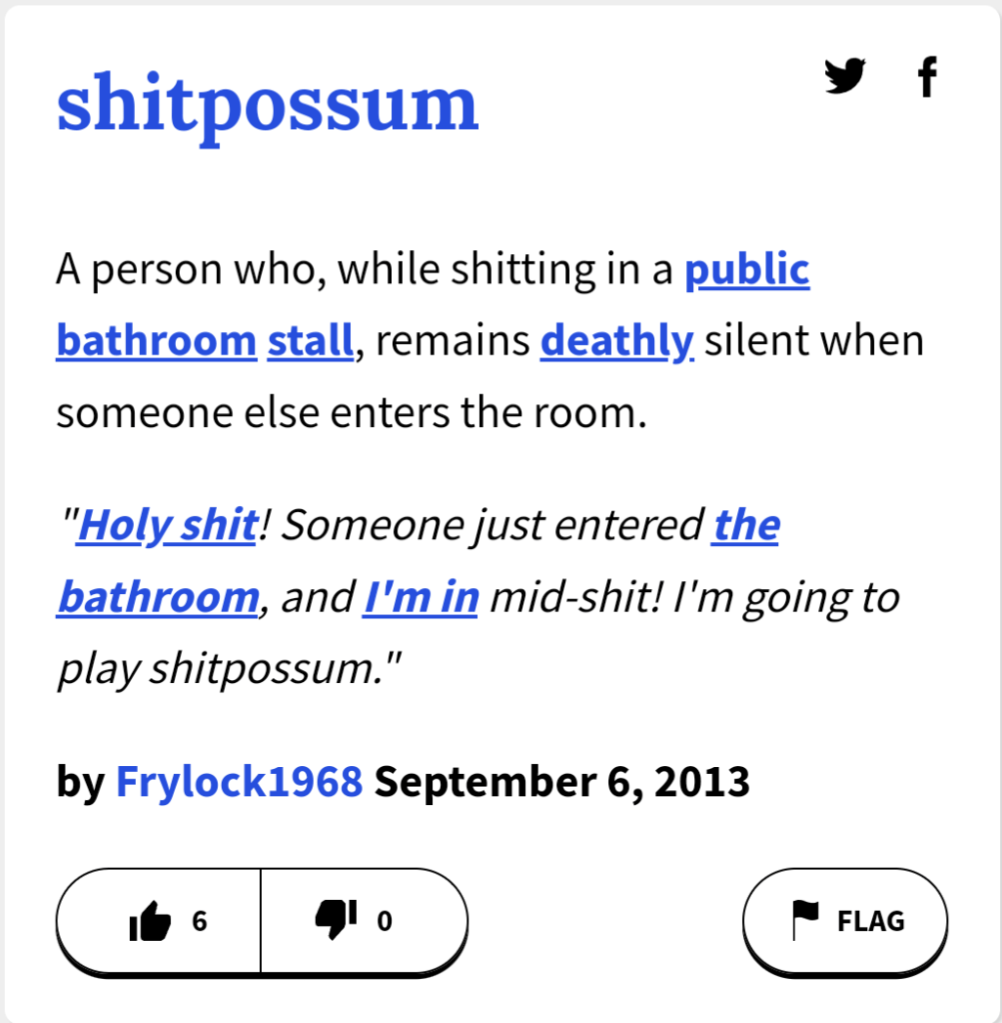
Today is the 10th anniversary of a terrible crime of theft and my first and only entry in Urban Dictionary: Shitpossum. This requires some explanation.
I was at Erik’s house for the weekly, Friday-night game, and (for whatever reason) he was lamenting about how he was unable to add an entry to Urban Dictionary for a word he coined, shitpossum. I was curious as to why he was having a problem, so I visited the site and, well, one thing led to another, and I entered it in myself.
Classy, huh?
In fairness, I did come up with my own synonym, chickenshitter, but at some point that synonym disappeared from the entry. What’s up with that, Urban Dictionary? I have the usage quote for that one. “Hey, who’s in that stall? Why don’t you answer? Are you some sort of chickenshitter?”
My buddy, Vic, and I are getting ready to share dungeon master responsibilities on a new 4th Edition Dungeons & Dragons (“4e”) campaign set in a game world of our own creation. The subject of my Dungeon Crawl System (“DCS”) came up, and it had me thinking about a change I should have made to it back when people were playing 4een masse.
For context, the DCS is a method of 4e encounter design that speeds up 4e’s notoriously slow combats and eliminates the need for the so-called “15-minute adventuring day.” The PDF can be found here.
There are two things you need to know to understand the change. First, in the DCS, NPCs were granted a +10 environment bonus to initiative assuring they’d almost always go first, and when they didn’t, the result would feel remarkably satisfying for the players. Second, there was a flaw in 4e’s math that didn’t manifest for most games because epic-level play was relatively rare. NPCs didn’t keep pace with PCs, such that by the time you reached epic level, the PCs were walking through NPCs as if they weren’t even there.
This, of course, assumes that you built your epic encounters as instructed. Sly Flourish provided some excellent (and free) advice on how to design your encounters so that they could keep pace with the PCs’ power curve. The short answer was cheat. Pull out all sorts of terrain, traps, and other tricks. “Gone are the days where monsters out of the book could threaten PCs.” If you’re completely unfair, the end result will be a reasonable challenge for the PCs. The long answer provides far more precise science than that.
The fact that the NPCs couldn’t keep pace with the PCs detracted from the game as written, but it fit nicely with my DCS. To put a point on it, epic level 4e as written in the sourcebooks was the DCS. Build encounters as written, don’t allow short rests more often than every other encounter, and epic level was fast and furious and reasonably balanced.
The Change
Put another way, as the PCs approach epic level, there’s less of a need for the DCS. 4e itself slowly morphs into the DCS, so the DCS needs to slowly eliminate itself. There was one easy way to do that requiring an insignificant conceptual leap.
For the NPCs’ environment bonus to initiative, the bonus shouldn’t be a flat +10. Instead, use this formula: ((30-[PC level])/3)+1 always rounding down. In Excel, use column A to list the levels from 1 to 30, then populate column B with =MAXA((ROUNDDOWN((30-A#)/3,0)+1),0), where A# is a placeholder for cells A1, A2, A3, etc. In English, it’s this: For levels 1-3, the bonus is +10; levels 4-6, it’s +9; 7-0, it’s +8; etc. Each set of three continuous levels has the same bonus, and it’s one less than the previous (i.e., lower) set of three levels. For those who work best with charts, it’s this:
Level
Bonus
1-3
+10
4-6
+9
7-9
+8
10-12
+7
13-15
+6
16-18
+5
19-21
+4
22-24
+3
25-27
+2
28-30
+1
This creates enough of an improvement that no further tweaks are strictly necessary. So, as for the rest of the numbers, until you hear otherwise, use my system as written for levels 1-20, but when you hit 21st level, build encounters the way the Dungeon Master’s Guide instructs you. That’s probably precise enough because, if you’ve bought in to running the game, you’re already committed to the notion that you’re bound to tweak your encounters anyway. My system’s precision is close enough for dungeon master work, even at high paragon and epic.
I will definitely be using this system quite a bit when I running this campaign.
My buddy, Vic, and I are starting a new 4th Edition Dungeons & Dragons (“4e”) campaign for which we’ll be alternating as dungeon masters. The campaign will be set in a game world of our own creation called Baledaar (BA-leh-dar). I spent all weekend entering the cosmology into Masterplan. Doing so required that I fill in some (not all) of the gaps in our, well, master plan for the campaign setting. I’m really happy about where were taking this.
We created several Twitter/X handles for many of the deities and locations of the campaign world. To keep them active, I posted some goofy, soap opera-like back and forth, but going forward, a lot of the tweets/exes(?) will represent updates for the progress, as well as some in-character interaction that isn’t necessarily as goofy. The idea will be to give people a feel for the setting elements in case we ever publish it.
In light of the direction in which Elon is going, I’ll probably create a few of these on Mastodon as well.
Here’s a war story from last Thursday night. I was working in Charles Town, WV across the street from the casino. I can see it from my office window. I was commuting back and forth from home (55 minutes each way) all week. I finally broke down, got a hotel room, and spent Thursday evening at the casino. In 3-1/2 hours, I made $465, and the casino paid for my dinner through comps. After work on Friday, I went back, and in 2 hours and 40 minutes, I won another $265 (and had another free dinner). As always, everything worked out for me.
But Not for Everyone
On Thursday night, someone who certainly should not be gambling was at my table. This is hard to describe in writing, but here you go: He was sitting in the first seat with a $15 bet and was dealt two 8s. After everyone’s initial hands were dealt, the dealer is showing a 5 (i.e., absolute crap), and of course he split the 8s (“always split aces and 8s!”) such that he had two $15 hands to play.
So, the guy indicates he wants a hit on the first hand. The dealer accidentally drew two cards at once, a 10 and a 9, and gave him the 10 on the first hand (total 18), then the 9 on the second (total 17). The next card drawn to the next player was a 4, and the one after that was a face card (10).
The dealer winds up getting a 20, which is not at all what you’d expect considering he was showing a 5, so the dealer’s 20 beat both the 18 and the 17. This is the guy’s beef: He claimed that he never indicated “stay” for either hand and therefore should be given a victory on both hands.
Now, if you’re not following the details, here’s the bottom line: You’d have to be incredibly stupid to hit either hand against the dealer’s 5. There’s no way he would have done that. Because he didn’t, he lost. But even if he were daring and had hit on the first hand, his 18 would have become a 27 — a bust — and his second hand would have been a 22 — another bust. No matter how they explained it to him, he couldn’t get it. When we (the players) did, he accused us of working for the house. I finally raised my voice and said “I just want to play, and your attempt to cheat yourself to a win $30 is getting in the way of that.”
Is this me or him?
But hey, if he had hit, the dealer wouldn’t have gotten a 20, so maybe the rest of us would have won, but he would definitely have lost either way. That’s the important part. Nevertheless, the pit boss gave him two options, both of which had the same effect. Either take a win on one hand and a loss on the other (effectively a tie), or take a push on both hands (neither win nor lose, also a tie). That’s the best he could offer, and it was the right thing to do because in fact he wasn’t given the opportunity to wave off his 18. But this guy was stubborn. He demanded they review the video to see what happened.
And here’s the twist. He did wave off the hand to indicate a stay. I saw that and was trying to help him avoid the loss, which is why I lost my temper when he gave me shit. When they reviewed the video, they saw that, so they had legal grounds to take his money on both hands. He stubbornly tried to cheat his way to winning under circumstances in which he couldn’t theoretically win either hand, refused to take the draw as compromise, and as a direct result, lost both hands. Of course, his explanation was that they were liars.
The Point
All of this is to say that there’s a very sad side to gambling. Losing isn’t a bad thing if you’re having fun. There’s no difference between losing $1,000 on the blackjack table and spending $1,000 to go scuba diving. The cost is the same, so if you’re having fun with whichever you choose, neither is a problem. But I’d bet good money 🙂 that this guy lost his phone payment last night, and maybe more. He made an incredible stink over two $15 bets. The table minimum was $15, so you can consider those as “small.” He should not be gambling, and neither should you unless you’re willing and able to lose everything you bring to the table. The first (but not only!) requirement is to assure you’re not playing for the wrong reasons; you must have a legitimate enjoyment of the game. It should never be seen as a source of income unless, like me, your victories far exceed you losses. Put another way, if you’re declaring gambling victories on your tax returns, then it’s (by definition) income, so you can treat it that way. But even I can lose, and I have. I’m prepared for that every time I sit down at the table.
I posted this goofy meme across social media this past week.
I received a not-so-goofy response. Long story short, Zephyr the Dream Dragon on Mastodon responded that he’d never want to use wand-wielding conductors as models because he’s worried he’d get sued by J.K. Rowling. Now, I think Zephyr gets it. I think Zephyr realizes that any such lawsuit would be frivolous. But not everyone does, and that’s a huge problem. It also pisses me off.
I’ve had too many conversations with too many people that think the WotC’s open gaming license (“OGL”) and its clones are legitimate licenses. WotC’s OGL is most certainly not, failing on multiplefundamental points, some of which you learn about in the first week or so of Contracts Law class. (Even when they get something right, it’s a potential disaster.) My posts on the ORC raise some doubts, but certainly leave open the possibility that the ORC is a legitimate license (albeit an unnecessary one) under very narrow set of circumstances and making some huge assumptions as to how courts will rule. However, even if enforceable, the ORC misstates the law and contains clearly unenforceable language designed to do nothing else but make you think they’re doing something better than WotC. That dishonesty is the symptom of a larger disease.
All of these gaming companies that are producing OGLs knowing full well that they’re probably not enforceable, and in any event can be done in a better way (public domain).
So, when (for example) both Paizo and WotC claim, implicitly or expressly, that single words can be copyrighted, or even that short phrases can be copyrighted, it’s no small matter. Too many people, whether they understand the ridiculousness of the claim or not, abide by their wishes and self-censor, as do the multitude of those that do believe that to be true.*** That’s utter horseshit. The purpose of copyright isn’t to reward artists for their hard work; that’s just a mechanism to achieve the true goal. The true goal is to give us, the public in general, an environment rich in art. But if copyright is used to suppress the creativity of artists, why have it? In fact, doing so is copyright misuse, but how often is that punished?
*** My point is that, while I can’t fix economic issues that cause your self-censorship, I can certainly fix legal misunderstandings that cause it, but you have to be willing to accept that you’ve been fooled all these years.
What we really need is a cheap tribunal (think small claims court of copyright infringement) that’s not as narrowly useful as what we currently have. People should be able to fight frivolous claims of copyright infringement regardless of their financial means or legal sophistication, and they should be able to do so relatively quickly. That’s far easier said than done, but our system doesn’t even try, and as much as it pains me to say this, if the copyright (or any) system runs contrary to its own purpose for existing, it shouldn’t exist. I don’t want that, because a properly constructed copyright system can be extremely beneficial to society. So, I’d desperately like to see us fix it, and the RPG industry’s misstatements of the law are an unnecessary barrier to that goal.
I mentioned in my last post that I’d be writing this one. It took a little longer than I expected, but here it is. “Failing” may be a strong word here, but bear with me. It’s all relative.
During or soon after the quarantine, Russ Burlingame and I had a conversation about the MCU. Getting to the point, he felt that the Infinity War Saga was “lightning in a bottle” and suspected that they wouldn’t enjoy the same success later down the road. In hindsight, his prediction came true. The current phase is not as popular as the others, but I think Russ’s prediction should be seen not as an indication of accidental or unsustainable success, but rather as an indication of complacency and failure to evolve. The difference between the two explanations is that, if the latter is the proper one, then it didn’t have to be like this.
Sure, Ms. Marvel was geared towards a specific (and thus limited) demographic, and Secret Invasion had some weak writing, but let’s look beyond that. After all, sooner or later, they had to do a show geared more towards kids, and Secret Invasion could still have been well-received because it serves the larger storyline, so neither were necessarily disasters, but it’s Secret Invasion that holds the key as to why the current phase is failing.
To start, we had Iron Man. In it, there was no real connection to the larger storyline, the Infinity War Saga, but there didn’t need to be. We were just starting out. We didn’t even know that there was and Infinity War Saga at that point. I don’t think Marvel Studios had any idea whether Iron Man would be a success and allow them to continue. Put another way, as viewers, we didn’t know what we were missing, and the post-credit scene hinted only at the Avengers as a team. As far as we knew, we would be getting a couple of sequels, and that’s it. Eventually, that changed. One of the more maligned Infinity War Saga shows, Thor: The Dark World, introduced the reality stone, so even if you didn’t like that movie – shame on you; Thor is awesome – you could more easily brush it aside as setting up what was to come in the remainder of the saga.
Eventually, the Infinity War Saga fostered within us an expectation that each show, good or bad, is part of an important and grandiose larger whole. That is, each movie is analogous to an episode of an entire season of a television show. You don’t throw the baby out with the bathwater and abandon a show simply because one episode is weak. In fact, if you’re being fair, you understand that, sooner or later, there has to be a bad episode because its function is to advance the larger story, and sometimes that means dealing with the boring set up.
Now that we’re spoiled by that, we now need to see that in the early movies, not just the newer ones, but have we? Do you have any idea how Shang Chi, the Eternals, Moon Knight, or Ms. Marvel connect to Secret Wars/Kang Dynasty (if at all)? We didn’t need a direct connection from Iron Man to Avengers: Endgame, but now that we know it’s coming, we need to see that now, and I don’t mean just post-credit scenes. I expect Loki, season 2 to be the first time we start to see a coherent grand plan for the Secret Wars/Kang Dynasty, but that’s too late, and will possibly be too little as well. After all, the TV series are supposed to be optional viewing. Many people aren’t going to watch Loki at all, so even if it’s a masterpiece, how are those viewers going to view the current MCU phases? I’ll tell you how. They’ll see them as inadequate.
It may already be too late, but if the next movie doesn’t give us a clear sense of where the larger storyline is going, it certainly will be.
Jonathan Major’s legal troubles appear to be requiring a massive change in course, and that won’t help.
It’s been a while since I wrote about the MCU, in no small part because the current phase hasn’t lived up to the last ones. I have my own idea as to how to fix that, but I’ll save that for another post.
I recently read this article, which prompted me to write this post.
Umm, Spoiler Alert?
It’s a TV show, and the episode in question is over a week old. Your grace period has ended.
Sexy.
Secret Invasion revealed that Rhodey has been a skrull for quite some time, though exactly how long is unknown. The only thing we’ve gotten out of the MCU powers-that-be is that he was replaced at some point prior to Avengers: Endgame. The suggestion in the article is that it occurred in or after Captain America: Civil War. Sure, maybe. As a hobbled guy, he was easier to subdue. But I don’t care. Here’s my point.
Rhodey being a Skrull after Captain America: Civil War changes how fans see every interaction he’s had since. His reunion with Team Captain America and tense conversation with Thunderbolt Ross suddenly don’t have the same emotional impact anymore. The same goes for his fun banters with his fellow heroes while they gear up for the time heist in Avengers: Endgame.
Umm, no. At least to that last sentence. Rhodey’s “fun banters” in Avengers: Endgame were actually Rhodey being an asshole. I explain how that’s the case in a prior post, so I won’t repeat that argument here (other than to link to this video). However, the fact that he was a skrull at that point is is a great explanation as to why he was being such an asshole to everyone. He wasn’t their friend and didn’t care about them. Sure, he kept up appearances with Tony Stark, but only because he knew that would be the relationship that couldn’t suffer. Any distance between those two would have been a red flag.
On the flip side, he seemed to get along with Sam Wilson, a.k.a. Falcon, in Infinity War, even showing concern that he couldn’t find him while he was being dusted. Why no animosity? Because Sam Wilson didn’t paralyze him. I mean her. It was a female skrull, Raava (mislabled Varra in the article), that stole Rhodey’s identity. We all just assumed they buried the hatchet in the downtime, but the truth is that Raava didn’t have a grudge against Sam.
But I digress. I think we can all see things that can be rationalized to justify that the switch occurred. All of this is to say that, especially in hindsight, we can easily make sense of the fact that Rhodey has been a skrull, but the “fun banters” don’t take away from that. They’re very much a part of that. They weren’t fun. He was being an asshole.
Side Note #1: I want to say one good thing about Rhodey/Raava. It makes sense that the two personae are played by different actors. They did that only because of the sex-swap, but they should have done that with everyone. What are the odds that Nick’s love interest, Priscilla, had a similar face to her alter-ego, Varra? Every skrull should have been played by a different actor than the one they appeared as in human form because their forms would have been completely different. Instead, Varra just looks like Priscilla in makeup.
Fourth wall break!
Side Note #2: On the other hand, what are the odds that two of the major characters had the names Raava and Varra. Why wasn’t there a Cink Rufy as a counter to Nick Fury? Stupid.
— Rob Bodine, also gsllc@chirp.enworld.org (@GSLLC) July 15, 2023
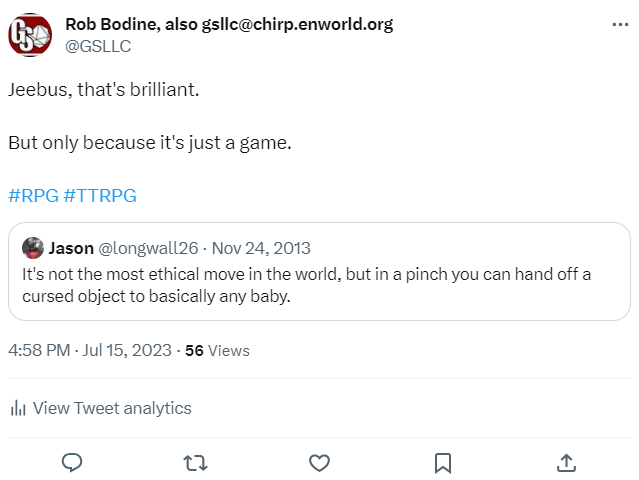
Screenshot below in case either tweet is ever deleted.
I shared a screenshot of Jason’s tweet to other social media, including Facebook, and most who responded agreed that it was funny, sometimes rolling with the joke and adding more. Sure enough, I found the one rotten apple in the bunch.
It went on further, but why burden you with that?
I guess “girls” need to avoid this guy, because he just refuses to have fun. The funny thing is, Mike was one of the people that reacted to the post with a laughter emoji. Go figure.
This is the second of my two planned videos about Paizo’s ORC license. This one summarizes the issues I raised in the last video, follows up on one of those issues, then discusses an entirely different topic. I take a side trek towards shrink wrap licenses, but as long as this video is (41:00), I tried to keep it as brief as possible, so I didn’t mention the mild circuit split on shrink wrap licenses. Basically, sometimes the courts uphold them, and sometimes their skepticism has them strike them down. In other words, the concerns I expressed aren’t merely speculation, but rather based on actual disagreement between different courts. But hey; just watch the video. I wasn’t nearly as fired up in this one.
EDIT: After you watch the video, come back here for point of clarification. I say that shrink wrap licenses are being used in a weird way with respect to RPGs. Here’s another way to phrase it. With software, the licensor places a unilateral contract on their product and says, “This product is paired with this license. Use the product, and you accept the license.” With RPGs, the licensor (e.g., Paizo) isn’t putting their license on their own product, but even if they do, it’s not capable of being accepted at that point anyway, so it means nothing so far. Instead, the licensee (e.g., you) are putting Paizo’s unilateral contract on your own product, and in doing so effective saying, “Yeah, I accept this.” But you never actually say that to the licensor. Moreover, if Paizo accidentally figures out that you used the license on the product, they’re never going to contact you. Everyone is in a contractual relationship with everyone else, but most of us don’t actually know it. That’s weird.
Remember, shrink wrap licenses are unproven where it counts, and there are legitimate reasons not to trust them, not the least of which is that they’re unilateral. Now you’re using them in a way unique to an industry that’s rarely subject to litigation of this sort. That’s even more suspect.
This is the first of my two videos about Paizo’s ORC license. This one rehashes (far more than it should have) the idea v. expression dichotomy, and then discusses problems with consideration within the license. I did it off the top of my head, which is never a good idea (over 40 minutes of ums and ahs), so watch it at at least 1.25 speed and expect to take breaks.
This is just the tip of the iceberg as far as how animated I get.
My second video on acceptance was just recorded, so that will go up tomorrow. It summarizes the issues I raise in this video, follows up on one of those issues, then discusses an entirely different topic. If you have any other questions on either what I’ve discussed in these two videos or what I haven’t, please let me know. I know there are other issues people are contemplating.








 Play What You Want