Let's roll some dice, watch some movies, or generally just geek out. New posts at 6:30 pm ET but only if I have something to say. Menu at the top. gsllc@chirp.enworld.org on Mastodon and @gsllc on Twitter.
Author: Frylock
Robert E. Bodine, Esq. is an attorney in Virginia focusing his practice on real estate and intellectual property law. He is one of the founding members of the Gamers’ Syndicate, a Washington, DC-based gaming club. He was the author of the Loremaster.org article series, Protection from Chaos, dealing with intellectual property law matters as they relate to the gaming industry, and has represented several game designers on intellectual property matters. You can follow him on Twitter @RobertEBodine for politics, @PropertyAtty for legal matters, @GSLLC for gaming matters, and if you’re a sports fan, @MMADork.
A little over a year ago, I wrote a post about my glory days of Dungeons & Dragons (“D&D“) living campaigns. I left D&D in 1982 due to the Satanic Panic and didn’t return until 2005. When I came back, Living Greyhawk was ongoing, and the TTRPG culture surrounding it was great. A little later, Living Forgotten Realms came along, and not only did Wizards of the Coast (“WotC“) up their game, but so did my friends and I, running weekly games at up to six Washington, DC area sites for 250+ RPG Gamers’ Syndicate members, plus weeknight stuff (i.e., D&D Encounters), and for two years, a convention. The entire experience was robust, which I think is a perfect word to describe it. Because I quickly grew tired of 5th Edition D&D, all of that fell off the radar for me.
Fast forward to this past week. A new coworker saw a d20 on my desk and asked if I play D&D. The conversation turned to those glory days, and she asked if that stuff was still going on. I told her I’d look into it. I asked around my old channels and got no reply. I went to the WotC store locator, and long story short, there were no official D&D Adventure League retailers in Northen Virginia. Huzzah Hobbies still exists, but there are no D&D games on their events schedule. Everything I came back to in 2005, and last dealt with in maybe 2019, is gone. The only infrastructure is online through social media sites in which my coworker isn’t interested (e.g., Facebook), and as I mentioned above, reaching out to Facebook groups resulted in no responses. She and her husband are in a single online game via Discord but want to sit around a table and throw dice. When I explained how living campaigns worked, she found that incredibly intriguing.
Something wonderful is missing. The community seems disjointed because more than just the game itself has been relegated to technology. TTRPGs have always been social in nature.
You’re probably prone to think this is a function of my age; however, before I was an attorney, I was a database geek. Not only do I not fear technology; I love it. After all, I’m currently creating digital character builders for various games. Applying technology to game play itself is a great thing. I don’t like playing games without digital character builders (hence, my projects). Moreover, my coworker is probably 25 years younger than I (maybe more) and has been playing D&D for less than a year. She has no nostalgic ties to the early 2000s culture. She simply knows that she wants what I used to take for granted, but it’s no longer available in Northern Virginia. Despite not personally needing this real sense of community, I find that sad. Maybe there’s a timely lesson in this that applies to more than just TTRPGs.
I returned to Dungeons and Dragons in 2005 after 23 years away due to the Satanic Panic, then starting a new career, then law school. When I came back, Living Greyhawk was my way in, and before you knew it, I was running gamedays all across the DC area, and even ran a convention, synDCon, for a couple of years. I went to my first Gen Con during those times, and like most of you went to plenty of smaller cons. As much as 3rd Edition Dungeons & Dragons (“3e“) turns me off now (which is a lot), I still enjoy thumbing through the books for nostalgia, and of course I’ve played it in somewhat recent history to connect with friends that remained with it. More importantly, whatever my criticism of the crunch, the flavor was as good as any edition.
Damn right.
Nothing demonstrated the disparity between crunch and flavor better than the Truenamer from Tome of Magic.
Prepare to vanish.
Because it’s primary abilities were based on skills (cool idea in theory, Rob Schwalb), the character’s power slowly diminished for three levels before it suddenly got a boost on the fourth that overcame that diminishment. Other players would be frustrated by the truenamer’s impotence. Eventually, that boost wouldn’t be enough, and the only way to keep pace was a single, specific, magic item, the Amulet of the Silver Tongue, that the DM had no choice but to give you (unless the DM hated you). No one else could make use of it. Unfortunately, there were only two versions of that item (i.e., lesser and greater), so after 12th(?) level, the character never could keep pace with the rest of the party’s power curve. Sure, a DM could just create a “superior” version of the Amulet of the Silver Tongue, but considering two more were were necessary to keep the character relevant through 20th level, they should have been included.
But I’ll be damned if that class didn’t have the greatest built-in flavor of any class I’ve played. The class used spooky words of power known as utterances to rearrange reality to suit its needs. At the highest level, there was an utterance, Unname, that could erase a creature from existence. It did so by warping reality and removing the creature’s truename from existence. Neither resurrection nor reincarnation could bring them back. It cost a ton more than that, which was a cost far more than anyone would ever want to pay. Bringing a class like this into other editions should have been a priority. It’s just too damn cool.
Rob Schwalb is one of the best writers in the industry. He had a really cool idea, but the system was convoluted that breaking away from the standard led to disaster. In this case, the disaster was an underpowered class. But enough with this digression.
In preparation for starting a new 1st Edition (“1e“) campaign a few years ago, I replenished my RPG stash, but not just 1e. There were quite a few books I wanted to get back from my 3e days, and with a little help from my friends, I did. These included the Book of Exalted Deeds, Deities & Demigods, the Fiendish Codex: Tyrant of the Nine Hells; and Drow of the Underdark:
Everything else I wanted I already had, but that was still a lot for a game I don’t play. Why? Flavor. I loved what the Fiendish Codexes did. I loved expanding on the Drow even though it has since been done to death. And I became a Dungeons & Dragons fan because I was a mythology nut, not the other way around. Without leaning in so heavily to mythology, I’d have never been interested in it.
Whatever its strengths and weaknesses, 3e will always hold a special place in my heart.
Okay, I know I promised to get my FASA Star Trek RPG character builder up and running over the weekend, but I ran into a serious snafu, and it needed to be addressed. In any event, it’s up now. You can find it in this GitHub repository: https://github.com/Frylock1968/FASAStarTrekRPG. There’s a long-winded read me file that you really should read before you use it. Because none of you will, here’s a summary:
It’s written using Access 365, which is a limited programming tool.
It’s written using Access 365, which means Apple users are out of luck without some extra steps I don’t understand myself, and even PC users without an MS Office subscription won’t be able to run it. This software requires a preexisting installation of Access on your machine. The good news is that, to my knowledge, Access is included with even the most basic Office subscription.
It’s a beta version, which means I’m relying on your help in uncovering errors.
If something doesn’t work, I’m going to fix it, but if there’s a feature missing, it’s unlikely I’ll add it. I plan to make a web-based version of it, and that will include everything.
More features will be added, but only really simple ones. I’ll save all features for my intended web-based application.
A feature I said I’d like to add to this application is the ability to create Orion PCs. Yeah, that ain’t gonna happen. After reading through it, I learned that such a feature requires four different methods, and arguably five. Ruddies, greens, Green slave women, greys, and half-breeds among the bunch are all handled differently, and those differences are non-negligible. That’ll have to wait for the web application.
One issue I can’t seem to figure out is a data lock issue. When you load a previously saved character and edit it, and it results in Chinese characters saved to some of your fields, don’t save it. Something’s corrupted. Instead, reload the character from your hard drive and start again.
One clean up task on my list is to remove excess options from lists. For example, Klingon culture is Klingon culture. It shouldn’t be divided into separate cultures for Imperials, human-fusions, and romulan-fusions.
There’s no user manual. Instructions appear on the user interface itself in red, italicized text.
I’ve previously discussed my FASA Star Trek RPG character builder. I updated you by stating that I had made quite a bit of progress. Well, I was going to publish it after adding the component for creating Romulan player characters but decided to wait until I added the Klingon component. I can easily say that it should be uploaded to GitHub by the end of this weekend (let’s say, Sunday, 7/13).
I’ve already uploaded my first beta version of my Gamma World 7e character builder to GitHub (here). I’ll create a new repository for the Star Trek stuff and publish the link as soon as I do. I plan to add a component for creating Orion player characters and merge other components from my prior work into this character builder. That prior work has the means to instantly create solar systems, NPCs of all races, animals, and balanced starship battle groups. Eventually, I’ll replace all of these with web-based versions when I begin producing character builders for other games. Those other games will be contemporary ones still in print, so those will be subscription-based if I can work out a deal with the publishers.
FYI, the Gamma World and FASA Star Trek applications will always be free.
I finally posted my Gamma World 7e Character Builder to GitHub. This is a beta version, which means I need the community feedback to address any hidden bugs. It’s also nothing more than an MS Access database, which means the user interface isn’t exactly perfect, and it won’t run on Apple products. Still, this is, at this moment, pretty damn useful. You can find it here, or you can download it directly from here.
Here’s something that in part is completely uncontroversial, but I still want to say it because I think some of it might encourage disagreement.
Old Guard was released 5 years ago. The sequel was released recently. I have zero recollection of the original beyond the basics, so I don’t fully appreciate the context, and I didn’t enjoy it. Releasing the sequel 5 years later is just fucking stupid. There’s far too much content we absorb to expect us to clearly remember the detailed context from a prior film that isn’t worthy of multiple rewatches over the years, and I’m not going to rewatch the original just to make sure I appreciate all the subtleties of the sequel that make it worth watching. And that’s for a movie. For a TV show, this is even dumber.
I saw a meme recently that I didn’t save, so I can’t reproduce it here. It pointed out that in the old days, there were 20-something episodes per season, with only a summer break between each season. Now it’s 10 episodes (or fewer) separated by at least a couple of years. In the age of the internet and streaming where release schedules should be more relaxed, this represents a massive failure by the creatives. I’m sure they, along with the suits in control, win with this arrangement: less work for more pay. In the meantime, people can be distracted by all the other content available.
I get the notion of Abe Simpson yelling at clouds. I’m very much self-aware of how I’m not part of the new culture when it comes to a lot of things. Unlike many people my age (57), I’m 100% fine with that. All of you do you, and don’t worry about the guy that isn’t in the most important demographic. But this is fucking stupid, and on this, I don’t know why the currently generation tolerates it. Maybe they don’t feel they have a choice, or perhaps ignorance is bliss, but if they’ve given this any thought and still think this is a reasonable option, then I really don’t get what the kids are thinking these days. In this narrow regard, it was much better in the old days. Considering we had only three viable channels, that’s crazy.
Note well that I’m not criticizing the content itself. Most people my age do, but that’s not what this is about. To the extent that I don’t like the creative direction of modern media, that’s generational, and my opinion should be ignored. I’m talking about something far more objective than personal taste. This is about structure, and the structure is shit.
The application does not currently support creating Klingon or Romulan PCs for campaigns centered on those empires, and honestly, that’s not a priority. At this point, I have only three things I need to do immediately: Create the capacity to save the character to an external file; create the capacity to advance to the character as it competes adventures, and the customary clean up of bugs and such that are inevitably found during the use of the application. The first two will be relatively quick, and the third one is always an ongoing process.
I have to spend the next couple weeks focusing on a Response to a Motion for Summary Judgment. After that, I’ll finish this up and start my next project. Or so I hope. The next project will involve a modern game system still in print. I know the author of the game and need to discuss it with him before starting the project. If he gives me the thumbs up, that one will be a bear.
By the time I’m finished, I will be known as the “Character Builder Guy.”
Last weekend, my 1st Edition Dungeons & Dragons (“1e“) gaming group discussed expanding our horizons. To some extent, 1e has run its course for us, so after the other Rob takes over as DM and runs us through the Village of Hommlet, we’ll probably be trying out new game systems. (Technically, we haven’t heard from Rob on the matter, so there’s more to discuss.) This discussion was prompted by a discussion I had with another member of the group a couple of weeks prior, and that prompted me to create my Gamma World 7e character builder (which is complete and should be on GitHub soon). This latest conversation with the group discussed different game systems we may run. One of my favorite is the FASA Star Trek Role-Playing Game (“FASA ST“) from the 1980s. When I was no longer allowed to play D&D, I shifted over to FASA ST for as long as I could. Surprisingly, I still have absolutely everything I bought related to that game except for the ship models that my older brother destroyed. (He’s an asshole.) I couldn’t possibly tell you how I managed to retain all of those items, but I have them.
Anyway, since Saturday, I was inspired to start another character builder, this time for FASA ST (2nd edition). I already created and published a Gamemaster’s application to manage various aspects of a FASA ST campaign, but I never got around to putting a character builder into it. Because I didn’t want to relearn my old code, I left that GM’s application be and started a new one. I imported a lot of the underlying data, then started building. In just four days, I’ve made an incredible amount of progress considering three of those days were workdays. 🙂
Like with the Gamma World character builder, I offer you some screenshots. For those of you with at least a vague recollection of the game system, I offer commentary to explain what’s going on. Most of you might want to ignore that commentary.
In the first screen, you choose your heritages (called “race” in the game). The red arrow points out a house rule I created. Each race has a specific set of bonuses and penalties to certain abilities. For characters of mixed heritage, those bonuses and penalties are averaged. My house rule is that, much like me, a typical American mutt of European ancestry, I allow characters to have as many as four distinct lines. My primary lineages are Scottish, Irish, German, and Italian, with a little Dutch sprinkled into the first three. Your character can be Vulcan, Romulan, Klingon, and Human. Star Trek canon seems to contemplate a mixing of the races, so my game does as well.
This next screen shows what you learned growing up. There are limited options, but they’re all useful for different types of characters. Another red arrow means something to point out. As you’re going through the character-building process, the same skills can be chosen multiple times to jack up a chosen specialty, but to make sure you can audit your work (and my software), I keep all the skill rolls separate. That creates a problem. In no event can a score exceed 99, but you might accidentally do so. In the end, I’ll force a cap of 99 on the final scores, but then you’re throwing away points you could have used elsewhere. Moreover, if you ever go backwards in the process, it erases everything that comes after it. It must because later steps are often dependent on the decisions you make in earlier steps. If your Computer Operation score gets too high, you may lose a lot of your work when you go back to fix it. The button at the top allows you to see your character’s current status (as far as points allocation) without taking the time to add up individual rolls. You’ll see a screen shot of this a little later in this post.
Nothing to discuss here. This is just the basic curriculum that all PCs learn at Star Fleet Academy.
This is also basic information you learn at Star Fleet Academy, but it couldn’t fit on the prior screen, so I gave it its own. Pay no attention to the fact that all the skills seem to be the same. I was running some testing.
Now you get to Branch School, which is where you start to really specialize. Navigators go to navigation school, medical professionals go to medical school, etc. Above, you see the helm Branch School, which is the simplest of all of them. There are no electives. You simply get what you see above.
If, however, you choose any other school, you get a pop-up window that allows you make your elective choices. For communications, you get to spend 30 points in various languages any way you want, whether 30 points in one language or 3 points in ten languages. The rest of your skills are non-elective, so when you push the Accept button, it loads not only the choices you made here, but also the choices that are set by your choice of Branch School.
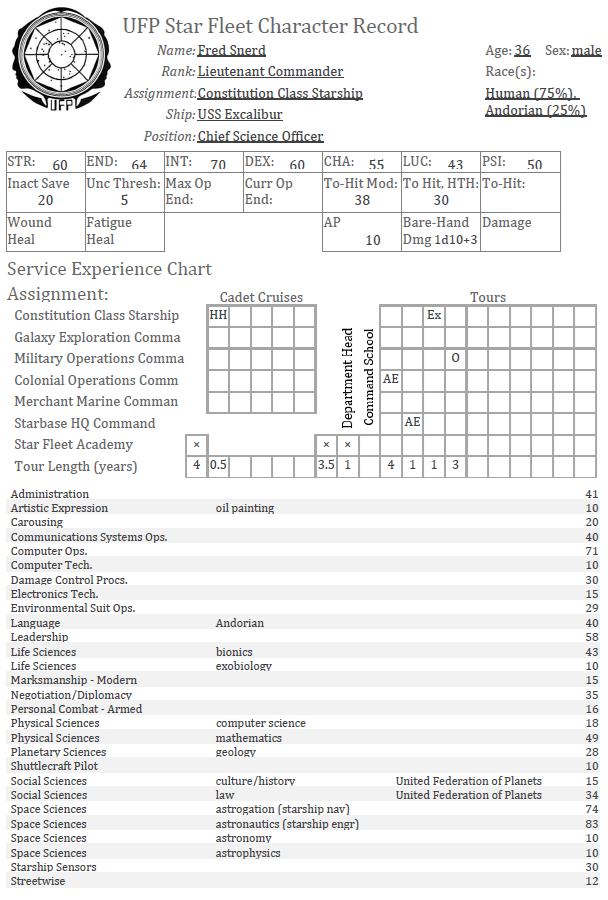
As promised, here’s what happens when you hit the Current Status button at the top right. You get an alphabetized and consolidated list of your skills so far. This image was taken for a different set of data than the others, so these numbers don’t correspond to what you saw in the images above. But this is, for example, all of your Carousing scores added together and listed just once. At this point, there’s no danger of wasting points by assigning scores above 99, but for the data in the prior images, I had a Carousing score of 115 just getting to this point. That’s why this exists.
That’s it for now. I’ve got only one more pop-up screen to create (Medical), and then it’s on to the characters’ past duty assignments on starships (or wherever they were assigned before the campaign begins).
Side Note: I’m Getting Better
The 1e character builder took years to create. I’m not relying on a technicality to say “years.” It’s more than just two. I think it’s been at least five years because I started it before I bought my current home in 2022. If you go through my posts, you might find and exact number, but I’m too lazy to figure it out. Even now, the damn thing has very little of a user interface, and I’m only part way through the Monster Manual II data entry. I haven’t even started Oriental Adventures or Deities and Demigods, and the latter would require some new data structure to implement. More importantly, because it was developed over years without any formal requirements analysis, it’s not put together very well. (Requirements analysis is important. Think about building a mutlistory building and halfway through the process being told it needed a basement.) Some of this can be explained by the fact that I included a campaign management tool, with the massive monster data entry that required. Moreover, I can blame this to some extent on the fact that it’s difficult to produce software for a game system that’s so convoluted.
Grognards are going to get angry with that statement, but it’s absolutely true. Every 1e rule is an exception to every other one. There’s no consistency at all. I’ve written extensively on how some of what’s in 1e should never have been abandoned by modern game designers. But be realistic. Taken as a whole, it’s exactly what you’d expect from a first-of-its-kind effort undertaken by a cobbler/insurance salesman. There was plenty of room for improvement. That doesn’t in any way condemn the efforts of the old gods of RPGs. We as a community owe them everything.
I was able to finish the Gamma World character builder in under three weeks. and it looks like I won’t even need that much time to finish this one (at least for the Federation PCs; Klingons and Romulans will take longer). I say all of this to make the point that I’m getting better as I relearn the skill of software development. In fact, I have an extra week of vacation time I’m taking in August, and I’ll be using that time to take a course towards C# certification. (C# is a programming language.) I may be able to launch these character builders via the web, opening them up to Mac users as well, though if that’s in my future, it’s a little ways off. There’s at least one more game for which I’d like to produce a character builder, and if the designer gives me his permission, a desktop application would be my next priority.
How Can I Get a Hold of This?
Gamma World should hit GitHub as soon as I figure that out. The FASA ST character builder will follow suit.
Maybe I’ll be known as the “Character Builder Guy.”
Over the past week or so, I created a character builder for 4th edition Gamma World. Well, really, 7th edition, but because it was based on the 4e Dungeons & Dragons system, it’s often referred to as 4th edition by non-enthusiasts like me. I’ve never played any other editions, though I owned some books at some point.
Anyway, you might be asking, “One week?” Well, yeah. I get that. My 1e Dungeons & Dragons campaign manager took years to create. The data entry was a royal pain in the ass, and the system is so loaded with exceptions to the rules (rules that themselves weren’t “clean”) that without formal requirements analysis, I made some regrettable design decisions for which I’m still paying. Moreover, there’s no way I could distribute it to the general public even though it creates wonderful character sheets. Only a software engineer could hope to make sense of it. The general public would be lost. None of this should surprise you considering I have a job.
So how the hell did I (essentially) finish the Gamma World project in one week? Well, for one, I ignored my cats.
Here’s Tezcaatlipoca giving me the evil eye.
Second, it’s not like I have anything else going on. Moving on, it’s not a campaign manager. I’ve entered no monsters (yet), and there are no tools to help run the campaign. Also, the game system is really simple. There are no choices to be made. If you’re a radioactive hawkoid, you’re assigned powers, and you don’t get much of a choice in the matter. The only choices you make are, at certain levels, which are very limited. For example, the aforementioned character has two origins, hawkoid and radioactive. Each grants a single utility power, one option per origin. If you choose the hawkoid one at level 3, then you must choose the radioactive one at level 7. This is true of critical hit effects and expert powers at different level pairs. it’s not like 4e where at X level you have several powers from which to choose. There’s only one or two options, and where there are two, choosing one forces you to choose the second later on. That’s great for software designers, especially ones 25 years removed from the industry and forced to use MS Access for the whole thing. It’s almost like automating tic-tac-toe, and even Access can facilitate that. (Access has way too many issues to use commercially, the absolute worst of which is the fact that you can’t embed commas or semicolons in text fields that will ever get loaded into a listbox. WTF?!)
Other than little tweaks here and there, the only thing I need to do is give the ability to save and load characters to and from the hard drive. You might think that’s a fairly important feature, but no, it’s not. Gamma World character creation is so easy that rebuilding the character from scratch is trivial as long as you saved your prior character sheet showing the gear you found. That’s the whole “great for software designers” thing in action. I can say I’m finished even if I’m not really finished. In fact, I don’t ever need to finish and would still be able to publish this. (I will finish, but that’s not the point.)
I don’t have to, and you can’t make me.
Prove It!
Okay, so you want proof? Here are some screenshots.
Just ignore that red text. That should have turned invisible.
What you can see is that the builder allows you to limit your sources to the Gamma World rulebook, Famine in Far-go, or both. Also, if there are any supplements I missed, or if you have homebrew content, you could create it and restrict it. For example, there’s some chatter about GW needing errata. So, if you want to change an origin to suit your needs, you can create it within your own source.
This page is pretty straightforward. I added a “roll 4d6 and drop the lowest” just for the hell of it. It’s not an option in the official rules, but it’s easy to program and just as easy for the user to ignore.
Here you can simply select the type of weapon you have as an abstract concept, or you can add a label for it giving the weapons more concrete descriptions. A lot of this is intended to be abstracted, but one of my favorite Gamma World images comes from a prior addition. A guy using a speed limit sign as a shield perfectly encapsulates the campaign setting. <Googles>
Ok, I misremembered a little bit, but I got the gist of it, and so did you.
That’s from the 3e GM’s screen. While I haven’t given you that option — as you’ll see, it would have no place on the character sheet — I thought it would be a neat idea to do so for the weapons.
Next up, you randomly roll starting gear, move it into the gear you own, then double-click on any gear or ancient junk you find during adventuring. I had to make a command decision on this one. It bugs me a bit, but it really won’t affect anyone’s lives. Sometimes you roll such that the result is, “Roll twice on this table.” So, you essentially get a bonus item. Technically, under the rules, one or both of those rolls could have the same result, however unlikely, allowing you third, fourth, or twentieth bonus item. For programming reasons, I decided not to allow this cascade. If you get to roll twice, neither of those rolls can give you the result of rolling twice. Similarly, there’s a result that says you can roll twice on the ancient junk table instead. If you do that, you can get a result for either or both rolls allowing you to roll twice, and that’s supported. However, when making your bonus rolls on ancient junk, I block the result of rolling twice. I’m sure everyone will get over it.
Here, you select your basic personality characteristics, choose your portrait, and enter in any notes. Going back to the prior screen, you can add as many items as you want, but they may not fit on the character sheet. The notes field is good for making sure you can see all your gear and junk on the character sheet. On the character sheet, the notes field will expand forever. Not sure what I mean? Here’s the character sheet for Jake.
How Can I Get a Hold of This?
I don’t know exactly when I’ll distribute the character builder, but it’s taken almost no time to put this together, so a good, working copy should hit GitHub in the near future. Every now I then, I spot an error, and its source can be programming logic or data entry error. Things look pretty clean, but since producing the character sheet, I noticed AC wasn’t taking the Int/Dex bonus into account for Jake, who was wearing light armor.
This post is for me, not you. It’s a convenient place to keep a list of enhancements I’d like to see to Masterplan. Consequently, I won’t be promoting this post via social media. It’s simply here so that I can add to it no matter where I am, and if Andy ever agrees to apply them to Masterplan, he can come to one place with all my thoughts organized neatly.
Magic Items
In the library window, allow a user to filter the list.
Adding Price as a built-in field for magic items so that it doesn’t need to be added as a section.
A button allowing you to assign the default cost to a magic item based on its type (e.g., ammunition, armor, weapon). (Most magic items have the same cost at the same level. Ammunition uses it’s own formula. I’m not certain if there are any other exceptions, but in case future work creates exceptions, or an item is assigned no cost, it would be easier to be able to just hit a button to assign the cost rather than set it automatically.)
Add “Consumable (Other)” and “Consumable (Elixir)” each as a type of magic item.
Add “Alchemical Item (Oil),” “Alchemical Item (Poison),” and “Alchemical Item (Volatile)” as a type of magic item, while leaving “Alchemical Item” (without a subtype) for ones without a designation.
Add “Critical” as a magic item section header in the drop down list box.
Artifacts
When a new section is created, it can’t be removed. See, Jacinth of Inestimable Beauty, in Mordenkainen’s Magnificent Emporium. Do not delete the built-in sections (e.g., “Pleased (16-20),” “Moving On”).
Add “Critical” as a magic item section header in the drop down list box.
Projects
PC data should be exportable so that a PC doesn’t have to be imported multiple times to be used in multiple projects.
If a PC is imported from a *.4ednd file, import its portrait along with it.
Combat
If a token represents a swarm or tiny creature, or a creature currently subject to the prone condition, or a creature at a different altitude, allow that token to occupy the same space as another token.
Monsters
Increase the list of available, stock choices for range in the Power Range drop down list to include Melee N (one creature), Ranged N (one creature), Area Burst N within Y (creatures in burst), Area Burst N within N (enemies in burst), Close Blast N (creatures in blast), and Close Blast N (enemies in blast). These could replace some of the ones already in there.
Libraries
Allow an option for larger text in, for example, the Libraries window.