Let's roll some dice, watch some movies, or generally just geek out. New posts at 6:30 pm ET but only if I have something to say. Menu at the top. gsllc@chirp.enworld.org on Mastodon and @gsllc on Twitter.
And now for something completely off topic for this blog.
The Supreme Court of the United States (“SCOTUS”) allowed the so-called ban on TikTok to go through. I refer to it as “so-called” because, as the holding states, it’s not a true ban; it’s a conditional ban. Political rhetoric always clouds the truth, so despite this being a unanimous decision of the Court, I still feel the need to preface this discussion with a brief discussion of the role of appellate courts.
Some Pontificating
The reason most of you are so angry at SCOTUS, or particular justices, is at least in part because you don’t understand (or care about) its role. Appellate courts, including SCOTUS, aren’t there to make policy decisions. They don’t make law. That would be a violation of the Separation of Powers principle, a violation of their individual oaths of office, and anti-democratic. In other words, SCOTUS doesn’t ask what the law should be; they ask what it actually is, for better or worse. What the law is, whether statutory or constitutional, is determined by Congress (and state legislatures). All the appellate courts do (that’s relevant to this conversation) is interpret that law, resolving ambiguities in the language or in how it might apply to a particular set of facts. So, you may absolutely be upset that TikTok is banned if you want, but the blame for that doesn’t lie on SCOTUS, and it would be horribly inappropriate if the justices sitting on that bench changed the law because they didn’t like it either. Stop shooting the messenger. That includes me. Much like SCOTUS just tells you what Congress says, I’m just telling you what SCOTUS said.
Enough of that. Let’s talk about what they said.
The Facts and the Law
In the interests of brevity and clarity, I’m just going to get right to the point, simplifying everything and leaving out a lot of fluff (and perhaps some important nuance).
TikTok, Inc. (“TikTok”) is an American company, but it’s owned by ByteDance, Ltd. (“ByteDance”), which means, like ByteDance, TikTok is subject to Chinese laws. This means that TikTok must “assist and cooperate” with the Chinese government, granting them “the power to access and control private data.” In other words, not a single piece of information you put on TikTok, even data indirectly coming from other connected social media platforms, is truly private. The Chinese government has access to all of it.
Important: This information includes age, phone number, precise location, internet address, device used, phone contacts, social network connections, the content of private messages, videos watched, and behavioral data (e.g., keystroke patterns and rhythms). Remember this list or come back to review it if necessary.
Trump tried to shut down TikTok, but the appellate courts stopped that, seeing that as outside the scope of executive power. Biden took office and tried to negotiate with ByteDance, but that went nowhere. In the meantime, Congress than passed the Protecting Americans from Foreign Adversary Controlled Applications Act (the “Act”). Under the Act, entities may not “distribute, maintain, or update a foreign adversary-controlled application” in the USA. There were some other details, including exceptions, but the point, of course, is that TikTok fit the definition.
I mentioned “conditional ban” above. TikTok could continue to operate under the Act if it underwent a “qualified divestiture.” That means that ByteDance would have to sever its control over TikTok, which would prevent ByteDance, and thus the Chinese government, from accessing your data on TikTok.
Applying the Law to the Facts
This gets complicated for the non-lawyer, so I’m going to leave it up to you to ask questions if you want a more detailed analysis. Here’s the short version. The first issue was whether the First Amendment applied to the Act, and SCOTUS said yes. The second issue was whether the Act’s constitutionality was subject to strict scrutiny or intermediate scrutiny. The Court said intermediate scrutiny, which is an easier test to pass, in part because the Act didn’t impose restrictions based on the content of any speech. In fact, the Act doesn’t care what was being said at all. In legalese, it was “content neutral” as opposed to “content based,” so it would be easier for the Court to find the Act constitutional (though not “easy”).
Applying intermediate scrutiny, the Court asked whether the Act 1) “advances important governmental interests”; that 2) don’t “burden substantially more speech than necessary”; 3) “to further those interests.” In other words, the goal must be important, and there must be a causal connection between the restriction and achieving the goal.
The Entire Point
I’ve been discussing this case with a coworker, and I know what she’s going to want to know. It isn’t going to be all the details on how all the conclusions above were reached. I imagine you want the same thing. Here it is. Congress passed the Act to prevent China from “track[ing] the locations of Federal employees and contractors, build[ing] dossiers of personal information for blackmail, and conduct[ing] corporate espionage.” This isn’t unreasonable. The Free Speech clause could certainly interfere with legislative acts that prevent such employees and contractors from using the TikTok app, so prohibiting the app’s availability is the only way to protect national security.
Or is it? Well, no, there are indeed other ways to do so, but under SCOTUS precedent, Congress is under no obligation to select those other ways. Congress made this choice after extensive hearings and other fact-finding processes and determined that all the evidence suggested that this is the best way, all while doing so in a way that satisfies intermediate scrutiny.
You may also want to know whether other platforms are next. It should be obvious that US companies are clearly outside the scope of this law, so Facebook, the platform formerly known as Twitter, and MeWe are safe. As for other foreign entities, SCOTUS points out that TikTok has “special characteristics” (i.e., foreign control over large amounts of private data) that have always justified a different analysis. This is why SCOTUS chose to “emphasize the inherent narrowness of [the] holding. . . . A law targeting another speaker would by necessity ential a distinct inquiry and separate considerations.” This case won’t immediately affect any other social media platform.
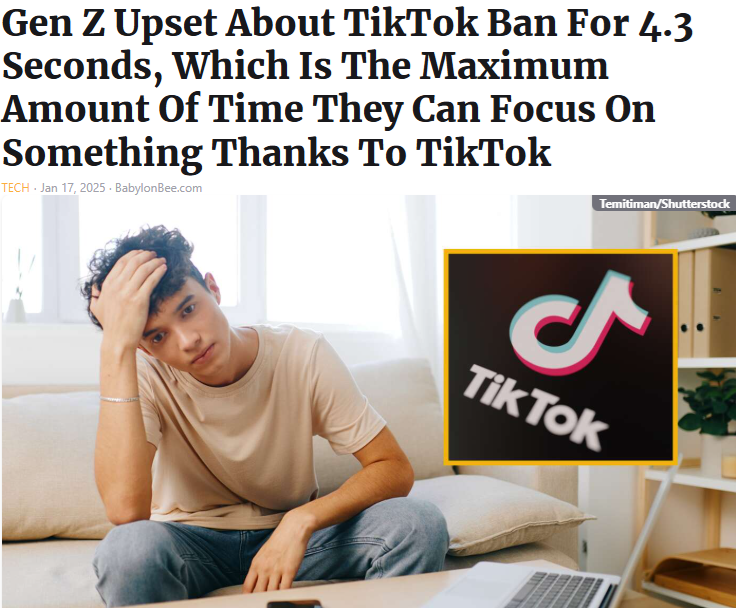
c/o The Babylon Bee
Is This a Good Idea?
As I said, SCOTUS doesn’t ask what the law should be, but we certainly can. I read somewhere (but didn’t verify) that a content creator can make 10 times on TikTok what they can make on Facebook, and YouTube is even less generous than that. This will certainly hurt content creators, but is your profit more important to you than your own privacy? What about the names and phone numbers of your friends that will also be exposed without realizing it? With everyone complaining about Facebook tracking confidential information, you’d think you’d be even more concerned with a foreign adversary doing so. All that considered, and putting aside matters of censorship, is this a good idea?
This is a decision you must make for yourself, and you can let your congressperson know how you feel about it. SCOTUS did not tell Congress it had to keep the Act; it just said it could. There is nothing stopping Congress from repealing or amending the law. That said, please keep in mind that Congress made its decision based on extensive research I’m sure you haven’t done, and arguments without specifics will fall on deaf ears. The nature of a republic is that you elect people you trust to do that research and make those decisions, because you don’t have time for a proper analysis. But they still must answer to you.
Final Note: I’ve left out a lot of details. However, I’ve uploaded a PDF of the decision with highlighted text and commentary from me. If you want to dive into the detail and have all your “Why?” questions answered, download it here. I’m happy to discuss the Court’s reasoning in greater detail. As long as you’re polite. 🙂
There are a ton of movies I’ve never seen, and I try to watch as many of them as possible. This means not watching movies I’ve already seen. Of course, like all of you, there are still some movies I like to rewatch. One of them I’m watched again tonight: The Devil’s Own.
This is the first I’ve seen it since quite some time before everything switched from DVDs to streaming (well over a decade). I saw it was available on Hulu/Disney+, so I figure it was about time to give it another watch. Brad Pitt stars as a member of the IRA beside Harrison Ford’s Irish-American New York City cop. Ford’s wife was played by Margaret Colin just off her breakout role in Independence Day, and his eldest daughter was played by a young Julia Stiles. Treat Williams, Ruben Blades, and (of all people) Rob McElhenney round out the lead cast. I love the movie, and I love the soundtrack even more. James Horner is probably my favorite musical writer of the 90s. His soundtracks are more valuable to me than any of the popular music that came out in that decade.
A Weird Connection
Right before law school, I moved to Westchester County, NY and worked in the Wall Street district of Manhattan. I was intending to attend the New York Law School, but the more prestigious Chicago-Kent College of Law accepted me two weeks before class started. I changed gears and moved to Chicago the day classes started. However, during the four months I was working in Manhattan, there was an area blocked off for the filming of a “new Brad Pitt movie.” I never saw Pitt because I never had the desire to hang out and watch filming, but I saw the set up for the scene when (spoiler alert!) Diaz was killed. It was filmed right outside my office, and whenever I watch the scene, it reminds me of the lead in to what was probably the best time in my life.
I spent a lot of time here.
In any event, it didn’t have very good reviews, but I thought it was great.
I recently came across an article about 10 songs that wouldn’t work in today’s social climate. Sure, I’m kind of old (56), so for the most part, those songs didn’t bother me, but culture revolves around the young, so my opinions don’t matter. However, I never understood the stupidity of the objections to one song in particular that appeared in the article: Suicide Solution by Ozzy Osbourne.
I post this with no fear any of you will kill yourselves after listening.
Ozzy was famously sued for causing the suicide of one of his fans by releasing the song. (That was the dumbest sentence I’ve ever written.) The article seemed apologetic to those from the 80s and today who objected to the release of the song. The idea is that Ozzy is trying to advertise suicide as the solution to your problems. Moreover, there’s a part of the song where Ozzy stutters over the word suicide, saying, “Su, su, su . . . .” I remember the attorney representing the plaintiffs saying that it sounded too close to “Shoot, shoot, shoot,” which, of course, is how the fan committed suicide. Ozzy fought back saying that the song was about the dangers of alcoholism, which is a sort of slow suicide by way of the chemical solution of alcohol. (I know there’s some disagreement on whether alcoholic beverages are “solutions” or “mixtures,” but that’s not a concern of this post.)
So, who’s right? (I am right.) Well, form your own opinion. (Your opinion will be stupid unless you admit I am right.) Here’s the opening lyric to the song.
Wine is fine, but whiskey’s quicker. Suicide is slow with liquor.
Do I really need to post the rest of the lyrics for you to understand what this song is about? Well, just in case . . . .
Take a bottle, drown your sorrows. Then it floods away tomorrows. . . . Now you live inside a bottle. The reaper’s traveling at full throttle.
Seriously, may I stop? While the other lyrics can be interpreted in a multitude of ways, they should be interpreted within the context of what you just read. Clearly, this song is about the dangers of alcohol excess. It’s actually a fucking public service announcement, but because a couple of parents couldn’t accept that the life they provided their child with a life he felt wasn’t worth living, they needed a scapegoat. That’s some serious cognitive dissonance, but their personal failings carried potential consequences for society at large, and ideas like this still swirl around in people’s insecure brains.
Of course, there could be even more to this argument. Suicide requires a complex combination of circumstances and emotions. No song could be causally linked to a suicide. Free fucking speech. But none of that should matter because the song itself is telling you not to commit suicide through irresponsible alcohol use. Ozzy knew something about this, as a fellow musician he knew had recently drank himself to death (so to speak). This song was absolutely the wrong target to attack.
I’m probably preaching to the choir among my few readers, but apparently there are still plenty of people who cling to this incredibly stupid position. Even my YouTube search warned me about what’s coming.
I don’t mind the phone number going viral, but I really don’t need the warning at the very bottom. Duh.




 Play What You Want