Let's roll some dice, watch some movies, or generally just geek out. New posts at 6:30 pm ET but only if I have something to say. Menu at the top. gsllc@chirp.enworld.org on Mastodon and @gsllc on Twitter.
Many of my contacts are flocking to Mastodon, so I decided I’d give it a try. That was a waste of time, and I’ll waste no more time on it.
First, let’s discuss what it is to the extent of my understanding.
Which ain’t much.
Mastodon is a group of servers each acting as its own Twitter. You can create your own server with your own rules, which can cover content or speech moderation. In other words, you can say, “No naughty language,” or “This server is for discussing race cars and nothing else.”
So, I decided to create a login. The first thing it asked me is what kind of server I wanted to join. This is similar to what Twitter does (i.e., asking your interests), but in the case of Mastodon, it’s non-optional. You have to pick one. The choices I was given were about 10 in number. If I attempted to search for others, it would search from among those 10 options. I sighed and picked the one that was closest to what I was interested in, then hit “Next.”
Here, I tried to create my account. No matter what I chose as a username or how I modified my password, I received a “forbidden” message. I went to Google to see if I could find answers (Mastodon help is useless) and found this tweet and an interesting reply.
I've googled for a solution. This thread is the top relevant search result. 😐
Image pasted below in case the tweets are later deleted.
I can’t find anything backing up the reply’s claim, but I did find several other complaints posted over the past week (among other issues), so it’s not just me. No matter how idiotically I’m behaving, if your system isn’t idiot proof, it’s not going to be popular.
But I’m no idiot, which is why I’ve stopped trying.
EDIT: It turns out that I am an idiot. I kept trying and succeeded.
On Sunday, I promised a post explaining my abstracted combat system. This came in handy when my 1st Edition Dungeons & Dragons PCs took over an orc tribe and sent them in to clean out a kobold gang and some bugbears. However, I built it on the fly based in part on how Risk handles combats, so I never ran it quite as I wanted it to go.
Add up the number of hit dice on both sides, treating any “+” as 0.5 HD (e.g., HD 2+1), giving a total hit dice for each side (always rounding up so that no character is rendered useless). (If using a different system, perhaps CR or level would be more appropriate.)
If it’s practical to roll a number of dice for each side equal to their number of hit dice, then do that, but otherwise divide those total hit dice values by the least common devisor between them (using at least 2 to avoid a 1 unless absolutely necessary), giving each side a modified number of dice to be rolled (rounded as suggested below).
Roll a number of d6s for each side equal to their number of dice (which could differ for each side).
Starting from the highest roll for each side, compare the rolls, giving each side a win when they roll higher than the other side, giving a side an automatic win for each extra die they roll, and if one side can be deemed to be on their home turf, awarding a win to such a defender on a tie.
Optional: To speed up combat, multiply the number of wins for each side by the greatest common devisor.
Subtract a number of characters from a side with hit dice equal to the number of wins its opponent received (rounded as suggested below), starting with the lowest hit dice creatures available, but always modifying your selections if it avoids having to round fractions.
Rinse and repeat.
As for rounding, as a physics major, I was told to round down for decimals below 0.5, round up for decimals above 0.5, and round to an even number for decimals of exactly 0.5. Thus, 4.5 would be rounded down to 4, but 5.5 would be rounded up to 6.
As always, examples help to explain the rules.
Combat 1
Side 1: 12, 1-hit dice (“HD”) orcs
Side 2: 6, 1/2 HD kobolds defending their home turf.
The orcs have 12 HD (= 12 x 1), and the kobolds have 3 HD (= 6 x 1/2).
The least common devisor between sides is 3 such that the orcs will roll 4d6 (= 12/3) and the kobolds will roll 1d6 (= 3/3).
The orcs roll a 1, 2, 3, and 6, and the kobolds roll a 6.
As defenders, the kobolds get one win on the tie against the orcs’ 6, but the orcs get three wins because of their unopposed dice.
Optional: The wins are multiplied by least common devisor, which is 9 (= 3 x 3) wins for the orcs and 3 (= 1 x 3) wins for the kobolds.
The orcs lose 3 characters (3 wins for the kobolds costs the orc side 3, 1-HD characters) and all the kobolds are killed because their total hit dice (3) are less than how many they lost (9).
There are no kobolds left, so the combat is over.
Combat 2
Side 1: 9, 1- HD orcs
Side 2: 19, 1/2 HD giant rats defending their home turf.
The orcs have 9 HD (= 9 x 1), and the giant rats have 10 HD (= 19 x 1/2, rounding 9.5 up to 10).
The least common devisor between sides is 2 such that the orcs will roll 4d6 (= 9/5, rounding 4.5 down to 4) and the giant rats will roll 5d6 (= 10/5 = 2).
The orcs roll a 6, 5, 1, and 1, and the giant rats roll 5, 3, 1, 1, and 1.
The orcs get two wins (6 v. 5 and 5 v. 3), and the giant rats get three wins (the tied 1s go to the defender, plus the one unopposed die).
The orcs lose 3 characters (left with 6 characters), and the giant rats lose 4 characters (2 x 1/2 HD, left with 15 characters).
The orcs now have 6 HD (= 6 x 1 HD each), and the giant rats have 6 HD (= 15 1/2-HD each, rounding 7.5 up to 8).
The least common devisor between sides is 2 such that the orcs will roll 3d6 (= 6/2) and the giant rats will roll 3d6 (= 6/2).
The orcs roll 5 and 4, and the giant rats roll 3, 2, and 1.
The orcs get two wins, and the giant rats get 1 win.
The orcs lose one character (left with 5 characters), and the giant rats lose four characters (2 HD lost = 4 1/2 HD characters lost, left with 7).
The orcs have 5 HD (= 5 x 1 HD each), and the giant rats have 4 HD (= 7 x 1/2, rounding 3.5 up to 4).
At this point, it makes sense to simply roll 5d6 for the orcs and 4d6 for the giant rats.
The orcs roll 6, 5, 4, 3, and 1, and the giant rats roll 5, 4, 4, and 3.
The orcs get wins for 6 v. 5, 5 v. 4, and the extra 1, but the giant rats get victories for the ties with 4 and 3.
The orcs lose two characters (left with 3 characters), and the giant rats lose six characters (3 HD lost = 6 1/2 HD characters lost, left with 1).
At this point, the orcs can’t lose. They’ll roll three dice, and the lone remaining giant rat will roll one. At best, the giant rat will take out one orc (leaving two remaining) but may just be skewered without accomplishing anything.
Let’s try one more.
Combat 3
Side 1: 10, 1- HD orcs
Side 2: 2, 1+1 HD hobgoblin guards and 1 4 HD hobgoblin chief defending their home turf.
The orcs have 10 HD (= 9 x 1 HD each), and the hobgoblins have 10 HD (= 4 for the chief + 3 for the two, 1+1 HD guards, each treated as 1.5 HD).
The least common devisor between sides is 2 such that each side will roll 5d6 (= 10 HD / 2).
The orcs roll a 6, 6, 5, 4, and 2, and the hobgoblins roll 6, 3, 2, 2, and 1.
The orcs get four wins, and the hobgoblins only one win (the tied 6s go to the defender).
The orcs lose 1 character (left with 9 characters), and the hobgoblins lose 4 HD worth of characters. They can’t lose both guards because that would be a loss of only 3 HD. Therefore, they must lose the 4-HD chief. Only the two guards remain.
The orcs now have 9 HD (= 9 x 1 HD each), and hobgoblins have 3 HD (= 3 1-1/2-HD guards).
The least common devisor between sides is 3 such that the orcs will roll 3d6 (= 9 HD/3) and the hobgoblins will roll 1d6 (3 HD/ 3).
The orcs roll a 5, 4, and 2, and the hobgoblins roll a 6.
The orcs lose 1 character (left with 8 characters) and the hobgoblins lose 2 HD worth of characters. Because each hobgoblin is treated as having 1-1/2, they lose 1 guard, leaving 1/2 HD left. That rounds down to 0 HD, so the other guard survives (though not for long).
As with the giant rats from Combat 2, the lone remaining hobgoblin will at best take out one orc before the uncontested die takes him out. If you’re trying to apply this to mass battle but don’t want to take all day doing it, you can fairly and intuitively adjust the system as follows. Choose a common devisor greater than the least common devisor. After rolling the dice to determine the number of wins, multiply the number of wins by that common devisor. Here’s an example.
Combat 4
Side 1: 100, 1- HD orcs.
Side 2: 30, 2 HD hobgoblins.
The orcs have 100 HD (= 100 x 1 HD each), and the hobgoblins have 60 HD (= 30 x 2 HD).
The least common devisor between sides is 2 such that the orcs will roll 50d6, and the hobgoblins will roll 30d6. No thanks. Instead, we’ll divide by 20, so that the orcs will roll 5d6, and the hobgoblins will roll 3d6
The orcs roll a 4, 3, 3, 3, and 2, and the hobgoblins roll 5, 5, and 4.
The orcs get two wins, and the hobgoblins get three wins. Now remultiply the devisor you chose (20) and multiply the wins by that. That means the orcs have 40 wins, and the hobgoblins have 60 wins.
The orcs lose 60 characters (left with 40 characters), and the hobgoblins lose 20 HD worth of characters, which amounts to 10, 2-HD characters (left with 50 characters).
Now we proceed to round 2 with 40 orcs v. 50 hobgoblins. Using 10 as a new multiplier, the orcs will roll 4 dice, and the hobgoblins will roll 5 dice.
The orcs roll 6, 5, 5, and 1, and the hobgoblins roll 5, 5, 3, 1, and 1. Because neither team is defending their home turf, the orcs earn two wins, two dice are ties (and thus ignored), and the hobgoblins earn one win from the unopposed die.
Multiplying these wins by 10, the orcs gain 20 wins, and the hobgoblins gain 10 wins.
The orcs lose 10 characters (left with 30 characters), and the hobgoblins lose 10 characters (20 HD worth of 2-HD characters), leaving them with 40 characters.
In round 3, the orcs have 30 characters, and the hobgoblins have 40 characters, so we can again use a common devisor of 10, giving the orcs 3 dice and the hobgoblins 4 dice.
With rolls of 5 and 4 for the orcs and 6, 5, and 4 for the hobgoblins, the orcs lose all three rolls, and thus 30 from their ranks, with no losses to the other side.
There are no more orcs left, which is good because I don’t want you to think I like orcs. So, the 40 remaining hobgoblins can now loot the bodies and drink themselves silly. Wait, does this mean I like hobgoblins?
Wrong hobgoblin.
If you’re comfortable with the system, this will go more quickly than it looks. However, I know plenty of game systems have created mass battle rules, and I wouldn’t be surprised if those rules are far better than this ad hoc one for dealing with small scale, abstracted battles. If you have any you prefer, send me a link, but you can see for yourself whether this works for you by getting out your d6s.
No, not those d6s.
FOOTNOTE: I’ve made a few changes and additions to the system. You can find them here.
Dungeons & Dragons is a trademark of Wizards of the Coast, LLC, who neither contributed to, nor endorsed, the contents of this post. (Okay, jackasses?)
I don’t like discussing politics (or any serious matters) on this blog, so I rarely do. That said, as I’ve told you before, Election Night is as exciting for me as the Super Bowl, so I’m going to discuss it today. All I’m going to say is this: Not matter who wins . . . .
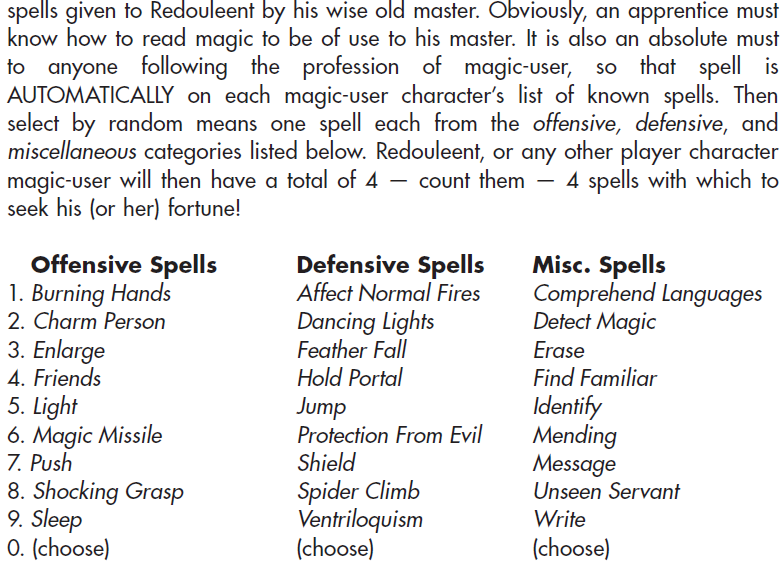
Last night was session 5 or 6 (I don’t remember) of module B2: The Keep on the Borderlands, my first 1st Edition AD&D (“1e“) game in 40 years. It was by far our best session yet. Everyone is more familiar with the combat system, so it went far more smoothly. We had two new players join: Vic and his 23-year-old son, Nicholas. For someone so young, Nicholas certainly got into the 1e spirit. He played a neutral evil wizard because . . . well, why not? He also chose to randomly select his spells, which I don’t require. Wizards get Read Magic at 1st level, but rather than randomly roll for one offensive spell, one defensive spell, and one miscellaneous spell (see Dungeon Masters Guide, p. 39), I allow them to choose one from each, and then choose another spell from either the defensive spell list or miscellaneous spell list. If they get to memorize only 1 spell at first level, they might as well have options.
As this post will show, this may come back to bite me in the ass.
So, Nicholas randomly rolled and learned Charm Person for his offensive spell. I noted at one point is a spell I’d never choose over Magic Missile or Sleep, but holy crap did that work out. Not only did his two uses of the spell have every bit as good a mechanical benefit as Sleep ever did, but it made the session memorable. In short, he charmed an orc, which (SPOILER ALERT!!!) greatly assisted towards taking over the remaining orcs in the tribe, which they then led to take out the kobold tribe. Next, they decided to clean up some unfinished business with the bugbear tribe, where the remaining orc minions lost their lives, but not before softening up the area. Nicholas’s second Charm Person was used on a prisoner that himself was evil and is supposed to wreak havoc on the party as soon as he could. That crisis was averted. Now Nicholas has two new allies that don’t get an automatic save against the charm for an entire month (in game time). The combats with the orcs were abstracted, which forced me to create a mass battle system on the fly. This session represented growing pains for that system, but with some help from the players, I think I have a good system in hand that allows for abstracted combat. I’ll discuss that system later this week.
While interesting, the anecdote above is also presented for context relevant in small part to this post’s theme.
Segments
As recently as last night’s session, I had a player (Erik) comment in passing on how stupid he thought segments were. I’ve discussed why I like segments, but here’s the short version: They replace material components that no one actually tracks (in 5th Edition at least), as a means to encourage variety among casters. That is, when you’re selecting a spell, you have to decide whether you want to take a strong spell that takes long to cast and risks being dispelled before it takes effect or a weak spell that you know will almost always take effect. Well, different players have different personalities, so that should result in different spell selection among players. A risk-averse player will choose a weaker spell rather than an uber-powerful spell that takes 8 or 9 segments to cast, while a risky player will accept the risk in favor of the reward something like Time Stop provides. Someone who’s mildly risk-averse may choose something in the middle. The same can be said for fighters. Which is better: a dagger that does only 1d4 (or 1d3) damage but has a weapon speed factor of 2, or a two-handed sword that does 1d10 (or 3d6) damage but has a weapon speed factor of 10? Well, a two-handed sword, but there are tougher choices than that.
But none of this becomes apparent at low levels. Sleep has a casting time of only 1 segment, and it’s uber-powerful for a 1st-level spell. Get to higher levels, and these decisions become far more interesting, and identically-classed, identically-raced characters will play out very differently. That’s a good thing that’s been inadequately replaced in modern versions of the game by relying on material components or, for example, increasing the number of races from which you can choose, but that can get a bit ridiculous at times (anthropomorphized hamster PCs?). Segments represent a far better way to encourage diverse character builds because they not only allow for player agency but actively encourage it. You get to build your character to suit your personality rather than according to pre-built build packages for classes.
Experience Points
Here’s another example that received far more grief last night than segments. If a DM awards experience points (“XP”) for gold found (as I do), then by definition your characters will always have more experience than they can afford to use. That’s weird, so let me explain by example. A first level thief needs 2,251 XP to level to second level, but let’s assume that the thief earns 1,000 gold pieces (“gp”) during the course of earning those XP from combat. For the sake of argument, we’re going to assume that you earn 1 XP for each gp you find adventuring, so in fact this thief is sitting on 3,251 XP (= 2,251 XP earned from killing monsters + 1,000 XP from the gold acquired). In the best case scenario, a thief must spend 1,500 gp to afford the training necessary to advance in level, so at this point, the thief is sitting on 3,251 XP he can’t use. That’s okay. He heads out to do some more adventuring. He finds another 500 gp while killing 1,000 XP worth of creatures. Now he has 1,500 gp, so he can spend it to move to level 2.
But wait a second. He just earned another 1,000 XP from killing monsters, and 500 XP from the 500 gp he found, so now he has 4,751 XP. That qualifies him for 3rd level with room to spare, but after leveling to level 2, he now has literally no gold left to pay the 3,000 gp necessary to level to third level. No, you’re going to have to go back out there and earn some coin, and that’s just going to exaggerate the problem.
I’d pull mine out too, but . . . .
Again, this is an issue at lower levels, but as the spread in required XP for leveling increases, this is less of an issue. I also noted to Erik that, “Hey, why are you complaining that you’re getting ‘too much’ gold. Just be happy you’re wealthy.” But let’s face it: That’s frustrating, so Erik has a point. You know you’re sitting on enough XP to level one or two times, but you don’t have the money to do so. It drives you nuts. That’s why I’m saying that this game requires patience. In the end, it all works out as you gain higher levels, and at that point you’re going to be very happy that you’re earning XP for wealth found, especially if you’re a fighter wanting to build a castle or a wizard wanting to build an ivory tower.
I knew plenty of wizards in law school.
Just be patient, and it’ll all work out.
So, let’s bring this full circle with a simple statement so you can all go home: As these wizards increase in level, I may regret having given these characters an extra spell at 1st level. Remember, all spells scale with level, so a 1st level spell cast by a 12th level wizards is a lot more powerful than it was when the wizards was 1st level.
Dungeons & Dragons is a trademark of Wizards of the Coast, LLC, who neither contributed to, nor endorsed, the contents of this post. (Okay, jackasses?)
A Facebook friend posted about his meeting with Derek Riggs, the creator of Eddie, the character gracing the covers of Iron Maiden’s albums. Despite my efforts to soil that character, Eddie is iconic, as are the album covers generally. Among those covers, Number of the Beast is my favorite, and probably my favorite album cover of all time. Somewhere in Time is more impressive, and (one of my favorite 5 albums) Powerslave is more interesting, but Number of the Beast wins. My reasoning is less about the display and more about the message.
“That particular idea I stole from a comic book that I’d read in the 70s, then I adapted it. I wasn’t trying to create a mood. I was just trying to get the job done in the short time I had.”
I inferred a clear message from it, and it raises a pet peeve of mine. When someone gets admonished for doing something bad, rather than say, “I will be a better person going forward,” they sometimes say something like, “That’s not who I am. That’s not me.”
Well, who the hell was it? It was your body doing that crazy stuff. Is there a gremlin living in your head controlling your every move? This excuse is appropriately along the lines of “the devil made me do it,” and it’s a subtle way to avoid properly owning up for the mistake. No, you did the bad thing. You’re responsible. It is you. We hope it’s not who you want to be, and we hope that you’ll grow out of it, but right now, you’re the asshole, not some unidentified, supernatural manipulator. The album exemplifies this by showing that, while the devil is pulling Eddie’s strings, Eddie is pulling the devil’s strings. The smaller Eddie is what people see, the devil is who Eddie blames, but ultimately Eddie is in control. That’s true for all of us.
Is my interpretation correct? Well, yes, because it’s a subjective perspective. Good art encourages you to think and feel on your own. It doesn’t matter what the artist intended; I read into it what I do, and you read into it what you do. Both of us can like it even if our interpretations are in direct opposition to each other or even to the artist.
In this case, I’m sure most of you took the same message from the art, so there really isn’t much of a dispute. So, I guess the real message of this post is, “Leave your gatekeeping at the door.”
On Tuesday of this week, I hinted at an interesting story pertaining to my visit to La Cruces, New Mexico.
I was visiting El Paso, Texas for — if you can believe it — the second of three times total. (Who wants to go to El Paso more than once?) At someone’s suggestion, we headed over to La Cruces for a bull riding event. It wasn’t a full rodeo. All of the competitions were bull riding. I didn’t expect to enjoy this show at all, but I’d absolutely see another one if it were ever convenient. Moreover, rodeo clowns are amazing. That’s not sarcasm. They’re remarkably good at what they do and save riders from serious bodily injury and/or death multiple times a night.
In an of itself, that would be interesting (though nothing to wake the kids over), but there’s more to this story. During the event, they held a customary game of “cowboy poker” or “suicide poker.” Everyone’s sitting around a table pretending to play poker, then they let the bull in. The last one remaining in their seat wins. The bull hung out for a few seconds. It appeared he wasn’t going to do anything. Suddenly, he charged the table. The one woman at the table was caught beneath him, and her life was saved not just by the rodeo clowns, but also by the other player who was “scalped” by the bull. Everyone survived. The scalped guy was on the radio later that week telling everyone that was complaining about the event to calm down. He knew the risks and accepted them. Whether he eventually changed his mind and sued, I don’t know. He really was a hero for jumping in and saving that woman. On the other hand, the two cowardly New Mexico University football players at the table bailed on her as quickly as they could.
The video of it made a bunch of “events gone horribly wrong” compilations over the years. Here’s an example video with a story on the event (embedding not permitted by YouTube due to age restrictions). It gets a little gory, so you may not want to watch.
Google chrome is my browser of choice, and it has several plug-ins that allow you to control the playback speed of certain streaming services, which are Amazon Prime Video, Disney+, and Hulu for me. Netflix requires no such plug-in because it has the feature built into its platform. Apple TV is my only platform that doesn’t have an associated Chrome plug-in, though I get the impression that, like Netflix, its proprietary streaming software includes it. I wouldn’t know because I’m a PC guy. MACs are for people that to use computers without knowing how to use computers.
PC users are so cool.
Enough insults. My observation is that the speed at which TV shows and movies are presented is too slow for me. I often use 1.25x speed when watching a show even if I’m not in a hurry to get through it (though sometimes I bump it to 1.5x). My mind wanders if I watch them at normal speeds, and there are some shows that I would never have finished if it weren’t for being able to watch them at a higher speed. Maybe I have undiagnosed ADD. I don’t know. I’m not going to diagnose myself.
I don’t have this problem with my Paramount+ shows, which right now are Star Trek: Lower Decks and the new Beavis and Butthead. I have no idea if there’s a plug-in for Paramount+ because I have yet to need one. I also haven’t had the need to use the plug-in for Disney+. I’ve watched all the MCU and Star Wars series that have come out and not once noticed a problem with their pace. Maybe those shows are just better written. Or maybe I’m weird (maybe?!), and these plug-ins exist because people’s time to watch shows are limited.
An internet rabbit hole led me to an article on the nine types of intelligence: naturalistic, musical, logical/mathematical, existential, interpersonal, linguistic, bodily/kinaesthetic, intrapersonal, and spatial. Some other articles claim only eight, leaving out existential intelligence, while another claimed there are twelve, adding emotional, creative, and collaborative intelligence. I bet if I search long enough, I could find articles claiming anywhere between eight and twenty forms of intelligence – I seem to remember hearing a claim of 27 once – but I don’t want to work too hard at this. It doesn’t matter which model I use because I’m not addressing all forms in this post.
This will be nowhere near as important as an evaluation of me by others, but it seems like an appropriate post to follow the debacle that was Inktober. Here it goes.
Intrapersonal Intelligence
“An understanding of oneself and the human condition as a whole.”
“Sensitivity to one’s own feelings, goals and anxieties, and the capacity to plan and act in light of one’s own traits.”
I think I have exceptionally high intrapersonal intelligence. This should surprise no one considering the existence of this post. I’m brutally honest with myself about my strengths and weaknesses and act accordingly. Anyone involved in competition develops skills in this area regardless of whether their intrapersonal IQ is high. Part (not all) of winning a fight is evaluating your opponents’ strengths and weaknesses, comparing them to your own, and then making the fight a contest relying on the things you do better than that opponent. Over my life, competition has taken the form of martial arts and lawyering, both of which involve “fights.”
This is an intelligence I use often, as it can span areas that we’d generally associate with other forms of intellect. For example, I’ve trained in martial arts since I was 14, but I wouldn’t say my bodily/kinaesthetic IQ is particularly high. And then there’s . . .
Musical Intelligence
“People with musical intelligence are generally more sensitive to sound and often pick up on noises that others would not normally be aware of. They have an excellent sense of rhythm and the ability to recognize tone and pitch.”
“Sensitivity to rhythm, pitch, meter, tone, melody and timbre.”
If I could have a higher intelligence in any of these forms, it would be musical intelligence. I played alto saxophone from 4th to 11th grade, moving onto guitar and (electric) base immediately after that. I dabbled on the keyboard every now and then since my undergraduate days and the University of Maryland (Go Terps!!!), and the keyboard my current focus. Beyond the saxophone, however, I’m entirely self-taught, and it shows in the terrible habits I developed on guitar and keyboard.
Despite my bad habits, I’m still “musical.” My musicianship is an example of how practice, persistence, and knowledge can overcome raw intellect. My knowledge of music theory is far above average, though there’s still a lot more to understand.
I’m looking at you, jazz.
I’ve used that knowledge to make myself better, but obviously Eddie Van Halen, who couldn’t read sheet music, was a better musician in his sleep than I was on my best day. Raw musical intellect served him far better than my study of music theory served me. I, on the other hand, can’t learn by ear; I need that sheet music. But that’s okay. Music has never been more than a hobby to me, so I can live with that. I just think anyone in earshot, as well as I, would appreciate me having a higher musical IQ, and not being high on that scale would always have held me back from a career. A career would otherwise have still been in play in my retirement.
Logical/Mathematical Intelligence
“People with this type of intelligence are excellent at maths and working with numbers. They can recognise patterns easily and work out processes in a logical manner. They have excellent reasoning skills and can often talk themselves out of trouble. People with high logical–mathematical intelligence are often drawn to games involving strategy and the solving of puzzles.”
“The ability to analyze problems logically, carry out mathematical operations and investigate issues scientifically.”
This is easily my highest form or intellect – I’ve forgotten forms of math that many people don’t know exist – but one I don’t use to any appreciable degree. When I was 15, I knew what I wanted to do for a living: Combining science and math with the law through the practice of patent law. Unfortunately, my experiences at a large law firm soured me to the practice of patent law. There’s nothing wrong with it; there’s just something wrong with that firm and the people who ran it. I can’t help but stay sharp in these areas, but patent law specifically gives me the shakes. It’s a behavioral thing, similar to a phobia but not nearly that bad. I associate anything patent related with a feeling of dread springing from how terrible my experiences were. I have little patience for people stupidly putting me through hell for no reason other than, “That’s just how we’ve always done it.” I’ve worked with both copyrights and trademarks professionally since leaving that firm, so this is specific to patents. It’s a shame. There’s serious money to be had there, and I have the background for it (i.e., a physics degree).
Interpersonal Intelligence
“People with this type of intelligence are often good at reading verbal and non-verbal cues as well as determining temperament and mood.”
“The ability to interact effectively with others. Sensitivity to other people’s moods, feelings, temperaments, and motivations.”
This is by far my lowest form of intelligence. I fully understand that humans are just apes flinging pooh, but that doesn’t mean I can predict your behavior. This comes from the fact that my childhood was rough, and in particular I was discouraged, and sometimes denied, close relationships that threatened my nuclear family’s control over me. As a result, I never developed a lot of the basic relationship skills that most of you take for granted. Being an attorney taught me to deal with people in some sense, but more in a ritualistic than intuitive way. Combined with a lack of interpersonal IQ, and viola! I’m middle-aged and have never been married despite that always being important to me.
Linguistic Intelligence
“People with high linguistic intelligence are very good at putting their feelings and thoughts into words in order to make others understand them.”
“[S]ensitivity to the meaning of words, the order among words, and the sound, rhythms, inflections and meter of words.”
As an attorney, this is the intelligence I use the most, but it’s exceptionally hard to evaluate myself in this regard. I have no sense of how high my linguistic IQ is. For example, I can write a mean legal brief, but I wouldn’t know how to start to write a work of fiction meant to entertain.
I would start every novel with this line just to spite all of you.
I think this fact reared its ugly head with my most viewed blog posts. Those posts were written for two different audiences, and I had a lot of trouble navigating between the two styles of writing. It negatively affected my clinical writing while doing little to grab people that don’t think that way. Perhaps my linguistic IQ is low, and I’m relying on other forms of intellect to compensate. Perhaps my linguistic IQ is high, and I would be an excellent creative writer if I put my mind to it and broke habits that make me a good technical writer. I certainly have an idea for characters that could be the basis of a series of novels, but I doubt I’ll ever even try to put that to paper. I may never know if I’m capable of it.
Existential Intelligence
“[P]eople with high levels of existential intelligence often think more deeply about daily occurrences.”
While I’m not sure what my existential IQ is, this definition certainly applies to me. A high existential IQ could be what I’m relying on to be a good lawyer. I have a passion for constitutional law, and there’s nothing concrete about that. That’s all philosophical. The average person’s inability to understand why the Supreme Court does what it does is often grounded in a misunderstanding of the nature of constitutional law itself. I’ve read (or re-read) easily over 1,000 pages of Supreme Court text within the past couple months. Here’s just a few: Apodaca v. Oregon, Edwards v. Vannoy, Ramos v. Louisiana, Johnson v. Louisiana, Carson v. Macon, Espinoza v. Montana, Kennedy v. Bremerton, Dobbs v. Jackson, Planned Parenthood v. Casey, Roe v. Wade, Citizen’s United v. FEC, Google v. Oracle, Craig v. Boren, Clark v. Jeter, United States v. Virginia (VMI case), Mississippi University for Women v. Hogan, Reed v. Reed, Romer v. Evans, Fourth Estate v. WallStreet.com, Loving v. Virginia, Matal v. Tam, Miller v. California, Paris Adult Theater v. Slaton, Walker v. SCV, McDonald v. Chicago, and District of Columbia v. Heller. Of all these cases, I’m willing to discuss only Google v. Oracle with people, and even that could get me in trouble. I don’t need the headaches you give me, but I do love reading landmark cases and those tangentially associated with them.
Collaborative Intelligence
“In the organizational and social media environment, has emerged a new type of intelligence that refers to the ability to work as a team to achieve a common goal.”
This is one of the additional 3 forms of intelligence, and I’m not sure what to make of it. First, collaboration precedes social media by millennia. Seriously, cave men collaborated to take down dinner. It’s who we are. This actually seems like a hybrid between interpersonal and intrapersonal intelligence. It combines your ability to work with others (interpersonal) with knowing where to place yourself within the team to maximize everyone’s strengths and minimize everyone’s weaknesses (intrapersonal). Oddly enough, despite my low interpersonal IQ, my high intrapersonal IQ always leads me to seek out a team to accomplish a goal. When I do so, I suggest placing people exactly where they belong without any consideration for how their placement insults them. 🙂 This is probably why I greatly prefer collaborative board games (e.g., Pandemic, Wizards of the Coast’s games based on the 4th Edition Dungeons & Dragons engine) to competitive ones).
I have nothing to say about the other forms of intelligence. Maybe I’d make the best gardener in the world, but I simply don’t care if I can grow tomatoes. And reading maps is far less important to me now that I have Google Maps to do it. I’m happy in my job, and if I weren’t, I’d probably go back to software engineering. I doubt I’ll ever “live with the chimps.”
A couple of weeks ago, a website tool started circulating social media. It produces a map of where you’ve lived, where you’ve stayed, where you’ve visited, etc. You can read the legend.
The question everyone asks is, “What’s the difference between stayed here and visited here?” My answer is that stayed here requires an overnight stay, whereas visited here requires that you went there to visit a particular place for the day, then returned home at the end of the day/evening. For example, I went to Wisconsin twice: Once for a day of paintball, and the second time to visit Lake Geneva, home of Dungeons & Dragons. When I was finished, I went home to Chicago. Likewise, I attended a bull riding competition in La Cruces, NM while visiting El Paso. Once the event was over, I went back to El Paso. The bull riding event was more entertaining than I expected, but there was an aspect to it that was even more interesting. That’s a story for another day.
For the record, stopped here means I stopped to use a rest area or eat, and passed here means I drove through without stopping. In no event am I including layovers at airports or flyovers on a commercial flight from one place to another. Otherwise, I could say that I passed here with one of the Dakotas, Wyoming and/or Montana, and Idaho when I flew between Minneapolis and Seattle. I don’t think that should add to my score.
I seem to have a higher score than most of my social media contacts, but the highest I’ve seen is 191. That guy’s been everywhere. My mission remains to stay (here) at the four purple places.
And for the record. . . .
Someone on Facebook asked me, “Why Germany but not Austria?” For the most part, I have no touristy reason for picking one country over the other. I’ve never been overseas. In fact, I’ve never been outside the continental United States except for Juarez (twice), Montreal, and Vancouver. My family tree has four distinct branches: German, Irish, Italian, and Scottish. All but the Italian portion has a nonnegligible amount of Dutch in it. Hence, I chose those five countries. I added Iceland because I hear it’s incredible.












 Play What You Want