Let's roll some dice, watch some movies, or generally just geek out. New posts at 6:30 pm ET but only if I have something to say. Menu at the top. gsllc@chirp.enworld.org on Mastodon and @gsllc on Twitter.
Recently, a friend and I started planning a 4th Edition Dungeons & Dragons (“4e”) game, so my Facebook, Twitter, Mewe, and now Mastodon(!) posts have brought up 4e. It resulted in a loose commitment from an old friend to join the game, which is great, and it has me thumbing through my old material searching for the unfinished business I have with 4e.
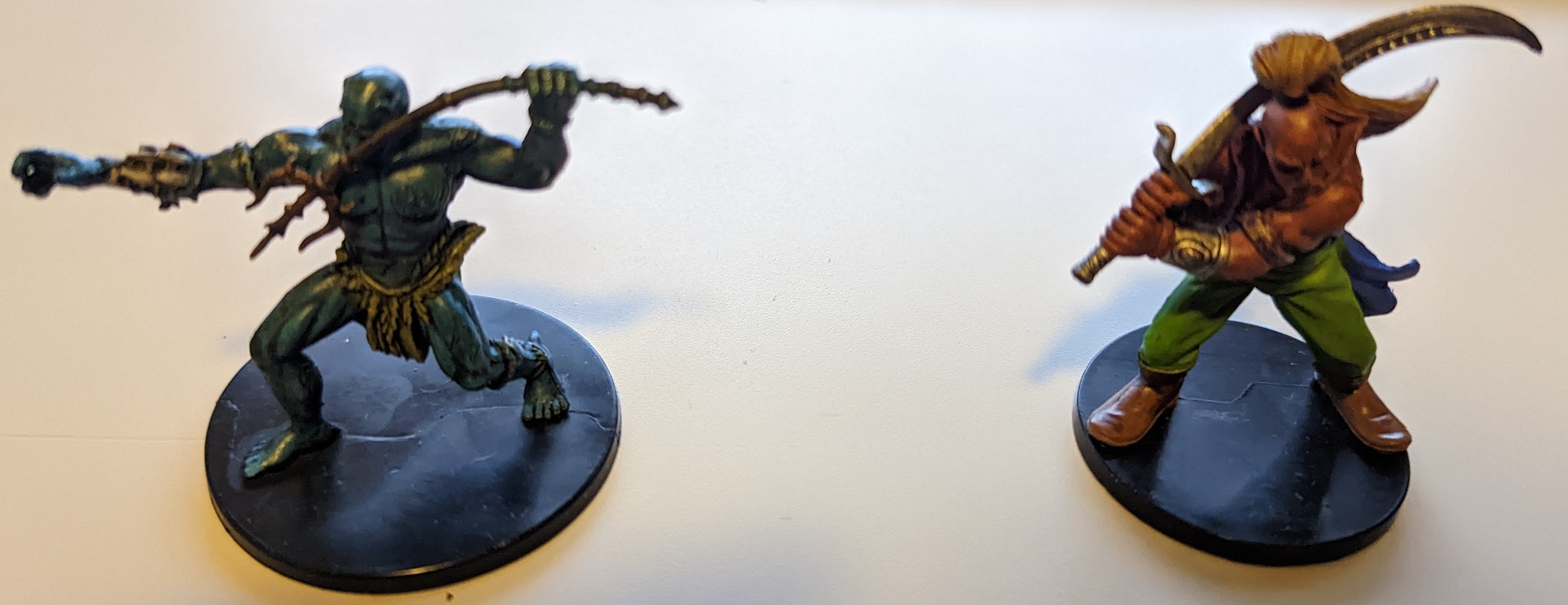
I always wanted to roleplay a jannisary, which is a character theme (read: background) from the Player’s Option: Heroes of the Elemental Chaos. This is a character whose backstory includes time in service to a genie. In my case, I’d choose a marid as my former master — probably Ajhuu — who might justify me taking a slight twist on the Prince of Genies paragon path when the time comes. All I’m saying, Vic, is that I have a maird mini if you ever want my benefactor to make an appearance.
Yeah, I see his trident. He’s still very powerful.
Mixing a jannisary theme with a melee bard (valorous bard, maybe?) could be fun, and mechanically wouldn’t be too underpowered. I have a tendency to create underpowered characters because I’m far more interested in building an intriguing character than a powerhouse.
Did someone say, “bard”?
I’m also eager to use my synDCon Dungeon Delves for side quests or when everyone’s just looking to pick some fights.
I’m extremely eager to add this game to my schedule. This shouldn’t be a big deal, but I’ve always been a slave to living campaigns, either directly or indirectly. When I returned to the game after a 23 year absence (due in large part to the Satanic Panic), I found games through the Living Greyhawk campaign, and from that formed relationships with people who were living campaign enthusiasts. As a result, most games I played were in living campaigns, but even my home games were populated with people that, because of their devotion to living campaigns, always wanted to play the current edition of the game. As a result, playing a past edition, and certainly an out-of-print game, was almost never an option.
Flash forward to today, and I’m running my first 1st Edition Dungeons & Dragons game in 40 years and am on the cusp of returning to 4th Edition. I’m actually getting to play what I want because my circumstances have changed. Not bad for someone who not too long ago left the game (willingly this time). Could the FASA Star Trek RPG be in my future?
I’ve also started working with the Masterplan application for running campaigns in 4e. If you play, check it out. I’m doing a lot of work on cleaning up the data.
By the way, this post has inspired me to change the name of my blog to Play What You Want.
A few days ago, I complained about how clunky Mastodon was. I stand by that. However, I managed to figure it out. So, let me tell you some things that, for some ridiculous reason, no one else seems willing to tell you.
First, if you go to Mastodon.com, you’re screwed. It won’t work. So, how do you do it? The best way to get on Mastodon is to know what server you want to join. In my case, I went with https://chirp.enworld.org/web/home. Another popular one for nerds is https://dice.camp/explore. I applied for membership 🙄, which was accepted. Mastadon.social appears to be the baseline, as a few celebrities are on there, but it doesn’t allow signups for some reason (maybe it’s just me). However, I learned that you don’t have to be on a server to follow someone on another server. As long as you see them appear in your server through a re-toot (yeah, their “tweets” were called “toots,” but now they’re called “posts”), you can follow them. I’m not sure how that works, but it does, so there you go.
Now, if I wanted to join a server that’s dedicated to sports, I wouldn’t know where to start. Someone had to give me the name of a server for me to find it. Again, going to Mastodon.com doesn’t help. You just have to know the URL of the server to find it, but for all I know, no such server exists. How could I possible find it?
I’m sure it can be done, but Mastodon is horribly clunky, so it’ll be a slow burn to get there. It’ll also take a while to get followers. To do so, I think I need to pepper my followers on other social media outlets to do so. In other words, the only way to even get on Mastodon in the first place, then to make it work for you, is to use other social media sites. Not a good business plan. Note, however, that there’s a setting in your profile that allows you to be found and promoted based on other members’ searches. It’s off by default, so I imagine you’ll want to turn it on.
So, join whatever server you want, then migrate to my profile and follow me. I’m at https://chirp.enworld.org/web/@gsllc and https://dice.camp/web/@gsllc. I believe these can also be found by searching for gsllc@chirp.enworld.org or gsllc@dice.camp once you’re in Mastodon.
My annoyance with the legal department at Wizards of the Coast led me to create a new law of the internet. You all know Godwin’s Law:
As an online discussion grows longer (regardless of topic or scope), the probability of a comparison to Nazis or Adolf Hitler approaches 1.
Put another way, if an internet argument goes long enough, someone’s going to call someone else a Nazi. Then, there’s Poe’s Law:
Without a clear indicator of the author’s intent, every parody of extreme views can be mistaken by some readers for a sincere expression of the views being parodied.
In other words, you can’t tell the difference between an idiot and a comedian unless they’re a comedian and they ruin their joke by explaining it. Well, Poe’s Law inspired the text of my own law, which unsurprisingly I call Bodine’s Law:
Without a clear indicator of the author’s intent, an arrogant author’s exploitation of another’s ignorance can be mistaken by some readers for a sincere, ignorant/incompetent expression of the views being expressed.
In other words, arrogant authors, thinking their dishonesty will never be exposed, tend to take advantage of the ignorance of others by knowingly making ignorant or incompetent statements, but if you understand the topic, you won’t know if the authors are actually ignorant themselves. The arrogant authors generally rely on an argument from authority, but not necessarily, so I think this rule is useful to keep in mind.
Henry, Sr. shouldn’t have slapped Indy. He should have used a baseball bat.
As you know (if you’ve ever read my blog), I’m running 1st Edition Dungeons & Dragons for the first time in 40 years, and I’m in talks with Luddite Vic about organizing a 4th Edition game. Moreover, in the back of my mind, I’m contemplating a FASA Star Trek RPG game. That one may never happen because I’d absolutely have to run that online to find any players, but it’s certainly something I’d like to do in theory.
The point is that all of that material has been sitting on my shelf for years (if not decades) collecting dust, but it’s still as good as it ever was. The potential is always there, and you never know how your circumstances will change. Hell, I even have 3rd Edition Dungeons & Dragonsmaterial on my shelves, and I can’t stand that edition. I’ve played it a couple of times in the past ten years just so I could hang out with some friends, and I’ve written not one, not two, but three posts on unfinished business I have with the edition, so even that has potential value (assuming the DM gets rid of confirmation of critical hits). Two editions of the Gamma World RPG, Star Wars Saga Edition RPG, Dragon Age RPG, Margaret Weiss’s Marvel Superheroes RPG, several board games (Demons!), and some games still in shrink wrap all litter my “man cave,” but I wouldn’t consider my collection huge. If yours is huge, that in my opinion you’re doing things better than I am. You never know what you might need to pull out for company. Hell, I’m even ready to host a night of blackjack or poker.
Where’s a roided-out Barry Bonds when you need him?
Dungeons & Dragons is a trademark of Wizards of the Coast, LLC, who neither contributed to, nor endorsed, the contents of this post. (Okay, jackasses?)
A while back, a Reddit post from three years ago began circulating again. It referenced that when the poster, and apparently everyone else, were little, they imagined a little guy that ran along fences, power lines, etc. while on a road trip. I did so as well, but my guy did something else that neither the tweet, nor the replies, discussed. My guy was a risk taker.
Passing Zones
On a long road, in addition to zones where no one may pass, lane dividers will occasionally create three zones in succession: 1.) one where only one side can pass, 2.) another where both sides can pass, and 3.) a third where only the other side can pass. In case it isn’t clear, I’ve edited an image I found to describe what I’m talking about, which I’m sure you’ve all encounters.
I’ve never seen lane dividing lines printed this way.
I’ve ridden across the country on many occasions and never seen the three zones painted in this order. I’ve always seen them in the order I presented them — 1, 2, then 3 — with no interrupting “nobody gets to pass” zone. YMMV, I guess, but my little guy always had to deal with them in this order.
My Little Guy’s Game
This is the additional game my little guy had to play. Like a passing car, he couldn’t switch lanes unless he had dashed lines. He’d switch from my lane to the other lane when he had the dashed lines on my side, then see how long he could last before switching back to my lane. The goal, as you might expect, was to make it all the way to the third passing zone, switching back to my lane at the last possible moment. However, if he got caught in the other lane because he couldn’t even make it to the second zone, he was killed. I also recall several instances where he’d bounce back and forth between lanes in the second zone. That was perfectly legal under the rules of the game.
My decision of when to move him over was dependent on how heavy traffic was and visibility. I had many instances where his ability to last was disappointing but remember only a couple where he died. Whenever that happened, I shivered.
I saw Black Panther: Wakanda Forever this afternoon. It was fun, but it was more about setting up Namor and his culture than it was about Wakanda itself. The first sequel is usually about the enemy, so this isn’t surprising or a bad thing. However, because they certainly intend to use that culture again in the MCU, it was more of an origin story than you usually get. When you have 2 hours and 41 minutes of movie, there’s time for that.
I’m glad they made the cultural shift for Atlantis to being Mesoamerican. I’ve commented on this blog before about this, and I know I’ve said this to friends: Because Marvel Studios is charting a cosmic direction for the MCU, I’m hoping they pull in more gods to match up with the likes of Thor. I’m a mythology nut, so I’d like to see those characters in their own stories. If they have Thor fighting enemies, why can’t they have Bast, Tezcatlipoca, Osiris, Shang-Ti, et al. being part of the MCU’s cosmic stories?
Follow me on Twitter at @gsllc Follow Chadwick Boseman @chadwickboseman (though I don’t know how often they tweet for him now) Follow Black Panther: Wakanda Forever @theblackpanther Follow Marvel Studios @MarvelStudios
My players wished their characters were this cool.
Two days ago, I published a system for abstracted combat that seemed appropriate for dealing with the (wonderful) circumstances the players created for themselves in my run of B2: The Keep on the Borderlands.
In short, the evil wizard (PC) charmed an orc while invading their lair, killed the orc boss, and then convinced the remaining orcs (12 warriors and 19 non-combatants) that they were taking over the tribe. The wizard was assisted by his charmed victim as well as the half-orc rogue PC. Their first mission was to use the orcs to clear out the kobold lair. Rather than play it out as a combat involving over 30 characters, I decided to come up with a d6 system on the fly. One of the players said, “Do it like in the game, Risk,” and to the best of my recollection I did. Each combat required an evolution of the system, as its shortcomings kept revealing themselves. This evolution continued as I created example combats on that last blog post. Here’s are the only corrections I need to make to that last system:
When determining how many dice to roll, use your gut, but try to get to 3-5 dice for each side.
To avoid difficult fractions, allow one or two characters from a side to sit out a round of combat.
You have to read the last post for context, but here’s how this would play out. As to #1, let’s say each side has 16 hit dice (“HD”). I could roll 8 dice for each side, with a “loss” resulting in 2 HD lost for the side. I could also roll 2 dice on each side, with a loss resulting in 8 HD lost for each side. The first way is rolling far too many dice, and the second way is far too swingy (i.e., the combat is likely to be resolved after only one round). So, you should instead have each side roll 4 dice with each loss resulting in 4 HD lost for each side. Of course, the multiplier is optional, so even if you roll 4 dice, you could choose for each loss to result in either 1 or 2 HD lost for each side depending on how long you want the combat to run. However, I’d think you’d want to go more quickly than that considering that this entire system is meant to provide a relatively quick resolution to combats you don’t want to play out meticulously.
As to #2, let’s say one side has 16 characters and another has 15 characters. The only common divisor (that produces an integer) is 1, so that means you’re rolling 16 dice for one side and 15 for the other. That’s fine if you have that many d6s (who doesn’t?) and you want to roll that many dice (who does?), but I’d rather roll between 3-5 dice. So, what do I do? I have one of the characters on the first side sit out that round. Maybe he tripped while attempting to close into melee. Maybe he pulled out a broken arrow and needed to grab another one. Whatever the explanation, now it’s 15 v. 15, and I can roll 3 dice, each representing 5 HD of characters, or I can roll 5 dice, each representing 3 HD of characters. The 16th character doesn’t get an automatic win but is also immune from getting killed. You may not like this solution. You may be thinking that having more characters should result in a tactical advantage, so you should give the side with the extra character an extra die to represent that advantage. However, that already occurs only when the advantage is significant (i.e., 15 v. 9 with one side rolling 5 dice – two uncontested – and the other 3). Adding a die here would be quite an advantage (i.e., mathematically, it’s always rounding up no matter how small the fraction), but to each their own. I’m not the boss of you.
An Addition to the Rule
Now I have to break new ground. What if the PCs want to get involved? A PC could join one of the groups as a leader, adding their own level (HD) to the mix. For that to make sense, there must be both a risk and a reward attached to it. Here’s what I’m thinking:
On a loss, that loss must be shared by a PC such that every other round each PC involved must share in the loss suffered. This loss is expressed in hit points, not HD, such that if a PC takes a loss of 4 HD, the PC actually loses only 4 hps. Otherwise, a 1st or 2nd level PC would never survive past the 2nd round.
One PC should also be able to use what’s on their character sheet to influence the combat beyond simply adding their HD to the equation.
I think #1 is self-explanatory, but we clearly need guidelines for #2. Remember, this is being written for 1st Edition Dungeons & Dragons, so you’ll have to translate these ideas into to your own system. Imagine a larger combat where each PC leads a small group of NPCs in their fight against a group of enemy NPCs. Only one PC should be permitted to lead a given group to avoid these benefits being cumulative, though a second PC could certainly be permitted to join a group led by another PC so as to increase the number of HD in that group and share the PC hit point damage from #1.
Cleric: Can subtract one HD from the HD lost by the PC’s side for a single die rolled in a round OR add one HD to the HD lost from the other side in a round if the other side has at least one undead creature on it.
Druid: Can subtract one HD from the HD lost by the PC’s side for a single die rolled in a round OR use terrain such that the druid’s side is considered the defender for the purposes of ties.
Fighter (Barbarian, Ranger), Cavalier, Thief (Assassin, Thief-Acrobat), or Monk: Can add one HD to the HD lost from the other side in a round, but every even numbered round can add two HD to the HD lost from the other side in a round.
Ranger: Can add one HD to the HD lost from the other side in a round OR use terrain such that the PC’s side is considered the defender for the purposes of ties.
Illusionist, Paladin, or Wizard : Can add one HD to the HD lost from the other side in a round OR subtract one HD from the HD lost by the PC’s side for a single die rolled in a round.
Bard: Can add one HD to the HD lost from the other side in a round OR can subtract one HD from the HD lost by the PC’s side for a single die rolled in a round OR use terrain such that the bard’s side is considered the defender for the purposes of ties.
Example #1: Five d6s are rolled, each representing 2 HD, and a cleric’s team loses 3 times. Rather than losing 6 HD, that team loses 5 HD because one of those loses is reduced from 2 HD to 1 HD.
Example #2: Five d6s are rolled, each representing 2 HD, and a fighter’s team wins 3 times. Rather than inflict 6 HD of loss to the other side, that team inflicts 7 HD of loss because one of those wins is increased from 1 HD to 2 HD.
Note: PCs should be permitted to choose which effect they want to deliver after they see the results of the rolls.
There isn’t much variation here because the system isn’t complex enough to support it. Each class should have the same degree of impact on the combat, but if the system is simple (as it should be), that precludes significant variation in class abilities. That said, players should be able to suggest how they can appropriately contribute to their groups, even if based on alignment, race, or a specific spell in their arsenal. I suggest being careful not to allow an imbalance. Remember, NPCs often have those abilities as well, and what’s good for the goose is good for the gander. The NPCs should often be able to introduce such complexities. Don’t overcomplicate this system and place yourself in a position where you might as well play out combat meticulously.
I’m also considering adding a morale shortcut for cutting off combats when it’s clear the other side should be routed, which would in turn allow me to give the fighter and ranger a means to boost their team’s morale in light of their ability to attract followers. Even a small group could do some damage, and that may prove useful in the big picture.
You might see another sequel to this series of posts with better ideas.
Mass Battles?
I have this urge to somehow distinguish between melee and ranged attackers in this system, and to make the benefits level-dependent, but no matter how I imagine it, it makes the system far more complex than it should be for combats involving 10s of characters rather than 100s of characters. The former is my focus, so it wouldn’t surprise me if this system didn’t work as well for battles between armies (if at all). If that’s the case, so be it. I can always look up how others have handled those situations if needed.
My Ending to the Keep on the Borderlands
I have an idea for how to end this adventure mod. Though it’s easy to guess what it would be, I won’t post it here because my players may read it. I posted it to my D&D MeWe groups because none of the players are members, so if you want to read about it, head over there. This idea would allow me to use this rules system as modified, but it would also allow the characters to gain reputation points. As I’ve written, I have a reputation system that’s important to how I run this game. By being involved, the players aren’t just crossing their fingers and watching the DM roll dice, and they can increase their reputation in the process.
Clearly this system needs tweaking, so your constructive comments are appreciated.
Dungeons & Dragons is a trademark of Wizards of the Coast, LLC, who neither contributed to, nor endorsed, the contents of this post. (Okay, jackasses?)






 Play What You Want