Let's roll some dice, watch some movies, or generally just geek out. New posts at 6:30 pm ET but only if I have something to say. Menu at the top. gsllc@chirp.enworld.org on Mastodon and @gsllc on Twitter.
The Renaissance Faire was a major part of my young adulthood. My family used to go to the one in Crownsville, MD every year. The impetus was my father, who was a well-read student of history. He’d go there and discuss “current events” with the actors. To their credit, they did fairly well, though they couldn’t out-history him.
I haven’t been there in a long time, but I consider it every year. a It’s ironic that we went as a family considering that I was a victim of the Satanic Panic, and here we were doing something reminiscent of the source of that panic. Well, if I do go again, and the opportunity presents itself (c’mon nerds!), I’ll be ready to add to the irony by adding my favorite intellectual property to the mix (something for which I was similarly ridiculed).
I really wish names weren’t obscured. Everyone deserves to receive credit for their ideas.
Follow me on Twitter @gsllc Follow William Shatner @StarTrek Follow the Maryland Renaissance Faire @mdrenfest
Sundays now are lazy days for me. I either post something silly or other people’s work. Usually both. Today, it’s proof that claymation can produce drama.
Sorry, but it’s time for another serious and long post.
I came across an article from the Stanford Graduate School of Business last week. It cites a study that demonstrates the importance of humor to the human psyche, which in turn correlates (and presumably is the cause of) health benefits. This doesn’t surprise me at all. The subject of this post is something that wasn’t the immediate concern of the author but is quite important and was lurking in his own text.
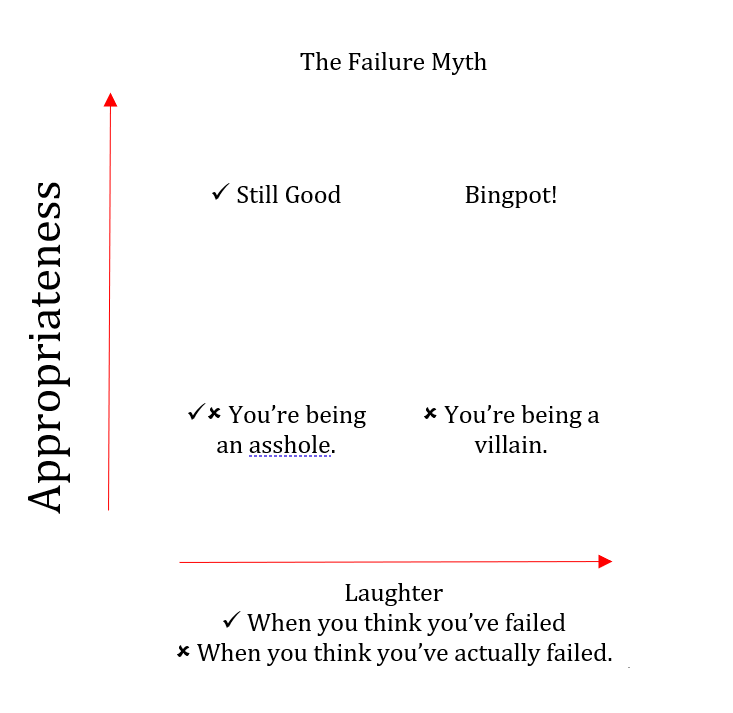
Scrolling down a bit, you’ll find a graphic containing four quadrants. I’ve recreated the graphic here using the advanced graphic techniques of MS Word.
This chart sums up the arguments of the author. It says a few things that are relevant. First, it claims that making jokes is a good thing even if you bomb. Everyone bombs, but people respect the effort. As I’ve stated before, I have no disagreement with this. You can and should bomb as long as you learn from the mistake. Second, it states that the degree to which you generate laughter is irrelevant if the joke itself is inappropriate. In theory, I agree with this, but I have a real problem with the direction Americans are going in labeling everything as offensive. Case and point:
Microsoft feels the need to warn you about naughty language.
Clearly, if your audience is a room full of Klansmen, then you can bring down the house and still be a villain as the chart states. However, most audiences aren’t 90% or better Klansmen, yet there’s a horrible trend towards labeling everything as offensive. To justify the position, the habitually-offended simply label anyone that laughs at anything they don’t like as a Klansman, Nazi, or anything else that allows them to mask their unreasonable offense as reasonable. This, of course, leads to real harm to people’s lives, but I’m not going to dive into that. I’m instead going to point out two other consequences that concern me: Killing comedy by limiting its subject matter, and a more general problem (beyond comedy) of reasonableness transforming from a community standard to an individual standard. As to the first issue, no where was this more apparent than the show, Brooklyn 99.
Limiting Subject Matter
After seeing tons of YouTube videos containing various characters’ best moments, I decided Brooklyn 99 was probably my kind of show, so it became the latest binge watch for me. It’s clear that the writers were very talented. There were funny jokes, many characters were endearing, and there were some recurring themes (e.g., the Halloween heists) and wonderful catchphrases that these writers wisely knew not to overdo (a common error among their colleagues).
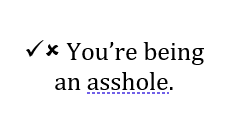
That’s great, but after five seasons, Fox cancelled it. Many were incensed, but it was cancelled because the ratings were poor. After a Star Trek-esque fan campaign, it was then picked up by NBC, but the coming 8th season will be its last. This despite the network change inevitably drawing in at least some viewers that had never seen it when it was on Fox. Despite the vocal minority of diehard fans, the show clearly couldn’t keep anyone’s attention for long. Why not? Because, contrary to the assertion of the linked article (citing writer Michael Lewis), writing jokes today absolutely carries a risk, and the writers didn’t want to bear that risk. It was clear that they were going out of their way to walk the tightrope of avoiding outrage at the hands of this vocal, minority (some of whom wouldn’t necessarily be fans of the show), but ultimately that small audience can’t support the show. When the habitually-outraged tie the hands of comedy writers, we get a modified chart.
Very little is considered appropriate by the habitually-outraged, and that small sliver of acceptable comedy that’s left can’t maintain anyone’s interest for very long. I finished it only because I can’t help myself. Once I start a task, whether business or personal, I have to complete it, which is why I generally don’t binge-watch TV shows if I see they have that many seasons. I took a chance on this one and was ultimately disappointed in the last few seasons. Despite its several strengths, it became a chore to finish it, and not because it jumped the shark. It never reached such a height. Rather, it simply grew into a tedious retread of boring, unchallenging stories because the jokes had almost no chance of offending anyone. Even where it comes to non-comedic material, it was predictable. If you didn’t know “whodunnit?” as soon as the bad guy first hit the screen, you’re an idiot. The villains were all telegraphed because the formula was always the same. Moreover, I wanted to throw Charles, Hitchcock, and Scully out a window 30 stories up, though that started within a couple of seasons. They were frustrating characters.
But killing comedy is merely a symptom of an insidious disease.
The Standard of Reasonableness
Everyone is offended by something, and that’s fine, but too often I hear the line, “You have no right to tell me whether I’m offended.” The fact that people say that means they’re missing the point. Absolutely no one is doubting you taking offense. What we’re saying is that you’re being ridiculous for doing so. But even that isn’t the problem. It would be utterly ridiculous for you to be offended by me wearing a blue shirt simply because your dad died while wearing an orange shirt (the other end of the color wheel), but it’s okay if you are. You can’t help that. Humans are emotional creatures, and certain associations will always result in illogical reactions. However, you shouldn’t impose that offense on me by demanding I always wear an orange shirt for the rest of my life.
And that’s the crux of problem. Any one element that’s deemed offensive by the online mob is composed of a miniscule percentage of people (some of whom aren’t tied to the subject matter at hand), but everyone is afraid to incur the wrath of that mob. Moreover, because these internet tough guys aren’t content with just changing the channel, but rather insist everyone get in line with their sensibilities, far too much content is labeled taboo for everyone, and we’re left with the modified chart similar to the one above for all areas of life, not just comedy. If you disobey, you’re given a horrible label that, without being questions, can cause you to lose your job, friends, and even family. This isn’t imposing accountability; it’s imposing the insecurity-driven whims of the individual on all of us. Throughout history, vigilante mobs have always swept up more innocents than the guilty because there are no protections from false accusations.
This is a troubling trend that those currently on that side are blind to. Rather than “reasonableness” being defined by the community, it’s being defined by each person on an individual basis. Going back to my crass example, if Mary’s dad died wearing a blue shirt, and Mary gets to define for me what’s reasonable, then I always have to wear an orange shirt. However, Joe’s dad died while wearing an orange shirt, so Joe demands I always wear a blue shirt. Then there’s Sally, who’s dad died while trying to break the Guinness Book of World Records record for wearing the most shirts at once (it’s 260, and as far as I know, Ted is fine), and she demands I wear no shirt at all. Finally, there’s Aloysius, and he demands I always wear a shirt with both blue and orange in it because of some other insanity I’m too lazy to invent. So, no matter what choice I make, I’m always going to offend three (a majority) of these four people, even though the majority (three) of all five of us aren’t offended by whatever choice I make. This places me in an impossible position, even though I’m not addressing the demands of 7.5 billion humans, 325 million Americans, 8.5 million Virginians, 1.1 million . . . Fairfax Countyans(?), or even 47,000 McLeananites (copyright 2021, me [not really]). Use any of those numbers, and seemingly ordinary actions or words will result in the same sort of no-win scenario. This is precisely why reasonableness must remain a community standard. We, not a few habitually-outraged, internet tough guys, should set that standard.
As bad as tyranny by the majority is, tyranny by the minority is much, much worse. We strike that balance legally by having a Constitutional democracy where a supermajority (still democratic!) creates fundamental rights that supersede the passing whims of the cops or even the legislature, protecting the individual, but still ultimately subjecting us all to the broader strokes of the majority. Your right to impose your insecurities upon the rest of us by suppressing speech is not the sort of fundamental right that’s necessary to preserve your individual dignity. Or at least it shouldn’t be, because it in fact suppresses an actual fundamental right in the internet age, where Town Square is now in the hands of the private sector. But if we can’t enjoy even jokes, there’s no hope for finding compromise on more difficult issues.
If you were looking for a miracle cure for what ails us, you’ve come to the wrong blog, but apparently our lives depend on it.
Two movies recently hit Paramount+. Yesterday, I wrote about A Quiet Place 2. Today, I’m really sad to report that Bill & Ted failed me.
I don’t think this is a case of growing out of the material. I’ve grown out of professional wrestling. I know what it feels like to just not care anymore because of who I am now. On the other hand, I haven’t grown out of Star Trek or Star Wars. Weirdly, I’ve absolutely grown out of the old Godzilla movies but love the new ones because I loved the old ones. I’m not sure that makes sense, but there it is.
This movie was atrocious. The pacing was terrible. The new characters were stupid. We all thought Station was stupid, but we didn’t throw the baby out with the bath water. We sucked it up and enjoyed Bogus Journey anyway. But here, I couldn’t do that. There were too may actors/characters added that were a second rate versions of the actors/characters they were replacing. What’s worse, the android was replacing Death even though Death was still in the movie. Death was a watered down version of his character in Bogus Journey, but my nostalgia kicked in and I was okay with that. But nostalgia couldn’t save this movie. Probably worst of all is that the heroes aren’t even Bill and Ted. Why did they name the movie Bill & Ted [anything] if Bill and Ted aren’t really the heroes.
It’s rare for me to be this disappointed in a movie that I want to love so much.
Two movies recently hit Paramount+, and I’ve been dying to see them both. First up is A Quiet Place 2. I’m not a fan of horror movies, so when a few of the typical horror tropes reared their ugly heads, it took quite a bit away from my enjoyment of the movie. As with all horror movies, people make stupid decisions just to advance the plot (lazy writing), and are then saved because logic always gives ground to the needs of the script. If that doesn’t bother you as much as it did me, then you may like this movie a lot more than I did.
That’s important, because I still liked (not loved) it despite these flaws. As much as I wanted to punch the main characters in the face, I found myself really caring for them. I wanted them to win. The opening act was also very tense, and while it didn’t answer all the questions we have, it gave us some more with which to work.
I should warn you that the movie doesn’t really have an ending. I guess that’s to make sure there’s A Quiet Place 3.
This is a link to a sad story for me, care of Den of Geek. It celebrates the birthday of the special effects pioneer, Ray Harryhausen. As I’ve written, I love Clash of the Titans. It was a huge part of my childhood. It’s a shame that it represents the end of an era. TL;DR: A brutal review of Clash of the Titans by a dense, visionless critic (not my favorite group of people) writing for Variety drowned out the positive reviews and disheartened Harryhausen. This was the proverbial straw that broke the camel’s back, causing him to retire from filmmaking. While his techniques had largely (not completely!) become antiquated at that point, my guess is that he would have adapted if he had stayed. We’ll never know. Even if that’s not the case, the article points out that he was more than just a special effects guy.
For the average person, social media isn’t as focused as a movie review. That is, as a non-celebrity, I don’t wake up every morning expecting an attack on my character, but the volume of commentary is so large that you’d be a fool not to think it’ll come your way eventually. Don’t let it bum you out, especially when it comes from people that don’t know you that are saying things that aren’t true.
Ray left for Olympus in 2013. Rest in peace, good sir.
Wouldn’t it be cool if he were buried on Mt. Olympus?







 Play What You Want