Pinned Post: Looking at My Stats and Revisiting My #RPG #Copyright Posts

If you enjoy this post, please retweet it.

The quarantine has me doing a bit of blogging lately, which means I’m also looking at my stats. With respect to my posts regarding copyright and RPGs:

The posts are broken into two separate issues. Part 1 and part 2 are about the copyrightability of RPG stat blocks, and part 3 (not relevant here) is about the OGL. As to the first issue, to date, part 1 represents ~30% of text by page count and has 17,037 hits (edit 10/20/2020: 17,667 hits), whereas part 2 (70%) has only 704 hits (edit 10/20/2020: 802 hits). Moreover, part 1 spends much of its text on going over basic copyright principles that don’t represent the actual argument. It’s clear by the stats and the basis of the criticism itself (often peppered with personal insults) that the vast majority of (non-lawyer) criticism I’ve received is from people that have read only 30% (at most) of that argument. I know it’s long, convoluted, and at times poorly written (mostly because it targets two very different audiences); and you’re under no obligation to read it (or even care about it). However, it’s all connected, and if you’re going to criticize it, you should probably understand it first.

Or not. Free speech and all that.

Endnotes:

Follow me on Twitter @gsllc
Follow me on Mastodon @gsllc

Dungeons & Dragons is a trademark of Wizards of the Coast, LLC, who neither contributed to nor endorsed the contents of this post. (Okay, jackasses?)

Good Watch: Binging of #Community Finished! @CommunityTV @Russo_Brothers @theofficenbc @parksandrecnbc

If you enjoy this post, please retweet it. Other posts in this series can be accessed by clicking here.

I recently binged the entire series, Community, via Hulu. I started on Netflix and then was informed that the Netflix version was based on a syndication license, meaning it had a little bit cut out of each episode. If you’ve never seen the show, go with Hulu over Netflix.

Going into it, all I knew was that it took place at a community college, it starred Joel McHale and Chevy Chase, and there was a Dungeons & Dragons episode (the first one with “Fat Neil”). I didn’t realize that the Russo brothers were involved in it, and having finished the series, I now appreciate the relevant cameos in the MCU. The best part about the show was how it often parodied other shows. For example, there was an episode based on Law and Order, another animated as a GI Joe cartoon, and another mimicking a civil war documentary (brilliantly casting Keith David as the narrator).

The series followed along the same life-cycle as most good TV comedies. It started a little slow in order to establish the characters, was largely funny throughout, but by season five, the scripts got stale, some key actors moved on to other projects, and the replacement/rearranged characters felt forced and/or substandard to me.

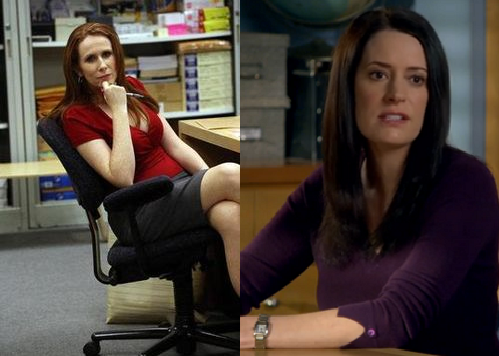
Nellie and Francesca: Same Thing
Nellie and Francesca: Occupying the Same Space

The series finale showed that the writers were self-aware in this regard, but another paintball episode in season 6? That could work if you weren’t binging, but binging is the new normal. I wonder if the shift to binge-watching series will discourage creators from allowing their shows to recycle tropes and, in general, overstay their welcome. Time will tell.

Fonzie Jumps The Shark GIF | Gfycat
Has this reference jumped the shark yet? c/o Gfycat

Verdict: If you’re not a completionist like me, then I wouldn’t bother with season six unless someone with your tastes strongly suggests a specific episode. (Episode 12: Wedding Videography had me laughing out loud, and the series finale was also very good.) Enough of the core group was there to keep it funny, but the magic was clearly gone by then. It was then just a decent show. However, while never as good as the Office or Parks and Recreation, Community seasons one through five were certainly worth my time.

Other posts in this series can be accessed by clicking here.

Follow me on Twitter @gsllc
Follow Community @CommunityTV
Follow the Russo Brothers @Russo_Brothers
Follow the Office @theofficenbc
Follow Parks and Recreation @parksandrecnbc

Disclaimer: Dungeons and Dragons is a registered trademark of Wizards of the Coast, LLC, whose attorneys are overzealous in their enforcement efforts and did not contribute, endorse, or request any of the content in this post or references to their work appearing herein.

🙂

We’re Living in the #Thanos Snap (Sort Of) #MCU @Russo_Brothers @MarvelStudios

If you enjoy this post, please retweet it.

Someone posted a question to Facebook recently: Are we getting baseball soon? This instantly made me think of the scene in Endgame where director Joe Russo played a member of Steve Rogers’ support group. He was recalling a recent date. During the date, one of the topics of conversation was, “How much we miss the Mets.”

Side note: The Mets can rot. Go Nats!

My first thought was to write a lighthearted, very short post – a stub, really – about how many of us feel that way. However, the connections between the aftermath of Thanos’s snap and our quarantine have quite a few more similarities. (Don’t worry. This will still be short.) While the reasoning for our predicament, and some of its effects, are very different, there are some effects where I find strong similarities. With 50% of the population suddenly and unexpectedly wiped out, storefronts were emptied and services like professional sports ground to a halt. Everyone missed their friends and family, but for some that loss would be tragically permanent (e.g., whoever was riding in the helicopter that crashed when its pilot was dusted). Does any of this sound familiar?

When the Hulk’s snap was an attempt to return everything to normal, it took only one movie, Spiderman: Far from Home, before we realized that wasn’t entirely so. Then attorneys like me started pointing out all sorts of legal issues that would arise. (My observations, including sports contracts, are buried in my Facebook stream, so enjoy this example article instead.) My understanding is that a serious legal issue will be addressed in Black Panther 2: Is T’Challa still king?

In the real world, what are the long-term effects of COVID-19 besides, obviously, the permanent loss of life? What will we be facing when the stay-at-home orders are lifted? It won’t be that simple. The practice of hand-shaking is under assault. Some long-standing, extremely popular restaurants just won’t be able to reopen. They’ll be replaced eventually. In fact, for many aspiring entrepreneurs, this will be the opportunity of a lifetime – demand will be high – but it still sucks.

When journalist Joni Balter suggested that, when the state’s stay-at-home order is lifted, many may welcome him and other restaurants back in the Downtown area, Douglas pushed back. “I’m not sure you really get it, Joni,” he said. “You don’t just come back from this. This cost $3 million just to close my businesses down. We are broke … the reality is that it’s going to be tough for 50 percent of our restaurants to come back.”

Staying in the real world, we’re already contemplating (if not seeing) the legal battles that will ensue over missed payments and such. Some of it is being held off by, for example, government moratoriums on foreclosures and evictions, but without forgiveness of debt, we’re just delaying the inevitable.

The streets are empty, friends and family are missing, and things will never quite be the same despite eventually getting our own version of the Hulk Snap. Some of that may be good in ways that don’t synchronize with the Thanos Snap. For example, some people have learned that they can work from their homes, and their bosses will realize how much money that will save them in overhead. Less traffic and lower fuel costs will make the world more efficient and less costly. I’ll have more time to write blog posts. 🙂 But humans are social creatures, and we’re going to lose some of that permanently.

Art imitates life. Sometimes it predicts it.

Follow me on Twitter @gsllc (and please retweet!)
Follow the Russo brothers @Russo_Brothers
Follow Marvel Studios @MarvelStudios

No Small Parts: Bereet in Guardians of the Galaxy @Melia_Kreiling @comicbook @BrandonDavisBD @JamesGunn @seangunn #QuarantineWatchParty #GotG #MCU #NoSmallParts

If you enjoy this post, please retweet it. Other posts in this series can be accessed by clicking here.

Tuesday night was the Guardians of the Galaxy quarantine watch party hosted again by Brandon Davis of ComicBook.com. We were joined by director James Gunn and actors Sean Gunn and Melia Kreiling. I love the GotG movies and have spoken about them many times, but with movies this good, there’s always something more to discuss after each viewing.

Melia Kreiling played Bereet in the 18-second clip below.

She had an additional one minute here.

This isn’t much screen time, but during my online interaction with Ms. Kreiling, I played the role of Captain Obvious and pointed out that there’s no such thing as a “small part.”

Actors with quick appearances, even if they have no lines and are relegated to the background, provide necessary color to scenes. I’m sure most actors want lead roles in blockbuster films, but if that isn’t available, their contribution can still be important. Let’s consider the scenes in the videos. Like most of the primary and secondary MCU characters, Peter Quill (you might know him by another name, Star Lord) had a lot of growing to do. He started as an irreverent, silly, narcissistic, selfish criminal, but by the end of Endgame had become an . . .  irreverent, silly, savior of the universe. Old habits die hard, and you can’t fix stupid, but it’s the thought that counts, and his intentions became noble.

But how can you appreciate that growth if you don’t experience its full progression? Bereet provided the necessary context. The first time we got a glimpse into what made Peter tick was his interaction with Bereet. She was, as Ms. Kreiling puts it,

Peter and Bereet had clearly spent a non-negligible amount of time together, most of which we assume was sexual, and he didn’t even remember her being there. How self-absorbed can one get? He then refuses to honor his word by betraying Yondu (admittedly, not the nicest guy either). Bereet provided the means to display that betrayal by unwittingly answering the “phone call,” something Peter would just have ignored without the audience knowing it had happened. This was good acting and good writing, and was as important as any other moment in that movie.

“Small parts” are often critical. Sometimes we just don’t think about the roles they play.

Other posts in this series can be accessed by clicking here.

Side note: As I was pulling up the YouTube videos, this gem auto-played. For your viewing and listening pleasure. Seriously, listen to that music.

Follow me on Twitter @gsllc (and please retweet!)
Follow Melia Kreiling @Melia_Kreiling
Follow ComicBook.com @comicbook
Follow Brandon Davis @BrandonDavisBD
Follow James Gunn @JamesGunn
Follow Sean Gunn @seangunn

#Shazam v. Guardians of the Galaxy @ponysmasher @martamilans @smugorange @russburlingame @comicbook @BrandonDavisBD @janellwheeler @tylacinee @SunSoar25 @ZacharyLevi @karengillan #GotG #mcu #decu

If you enjoy this post, please retweet it.

On April Fool’s Day, I enjoyed yet another quarantine watch party. This one was for Shazam, which I love. We were joined by the director, David Sandberg, and the actors that played Billy’s foster parents, Marta Milans and Cooper Andrews. The party was hosted by Brandon Davis of Comicbook.com, and Russ Burlingame joined in as well. We may have been joined by some other people involved in the film, but I wouldn’t know. I was clearly confused. For a moment I though Russ was the producer or something. Awkward.

Anyway, comic book movies are well-loved, but it seems most people love them solely for their action and fantasy elements. I feel that they don’t get the respect they deserve for the acting and screenwriting, which at times is top notch. After all, the Marvel Cinematic Universe (“MCU”) and DC Extended Universe (“DCEU”) have a few former Oscar winners in them. There are several themes that came up in our collective commentary that I wanted to discuss, some of which are shared with the Guardians of the Galaxy. Shazam occupies the same space in the DCEU as GotG. When I initially made that observation, my thoughts were narrow. I was referring to the fact that both were expected to lighten the mood of their respective cinematic universes by focusing a lot more on comedy than the others. All these movies have some comedic one-liners, and both Shazam and GotG were still very much action-oriented, but we all can see that the balance between those two genres were tipped a little further comedy for Shazam and GotG. But there were other reasons to make this connection that I didn’t initially appreciate.

Everyone Was Pretty Selfish

As with most stories, the primary characters in these films were flawed; to-wit: their motivations selfish. In GotG, Peter was a thief, Gamora was an assassin, Rocket and Groot were mercenaries, and Drax was motivated solely by hatred and loss. Each of those attitudes led to risks not only to their own well-beings, but to the well-beings of the entire galaxy. The same selfishness was common among the main characters in Shazam, and not just the villain. These flaws were normal for children their ages, and thus the stakes were initially lower, but when these kids were forced to deal with fantastic circumstances that don’t exist in the real world, they had no choice but to grow up quickly. It didn’t go so well. Billy stole from Freddy, and when they worked together, they willingly took $73 from the mugging “victim” knowing full well that Shazam was scaring her into handing over the money. They stole far more money from an ATM.

Eventually, Billy started to play the role of a hero, but only because his reckless behavior created the danger in the first place. Though he saved the day … well …

Billy’s still all about himself. Freddy had his own problems. He “understood this whole superhero thing” better than anyone, but he quickly broke his own rules.

Family Takes Many Forms

That second tweet isn’t strictly correct. The Vasquez family wasn’t an “adoptive” family; they were a foster family. That’s a slightly different dynamic. I’m not familiar with the details of the process, but in an adoptive family, at least the parents get to choose the children they adopt. In a foster family, that choice is made by the foster care system. Foster familes are forced on one another, and in GotG, that’s true as well. The Guardians were forced on one another by circumstance. This isn’t to say that freewill didn’t play any part; the Vasquez family chose to be a foster family to someone, and the Guardians could have split up as soon as they escaped prison (or at any other time). I’m just saying that there were far more severe limits placed on their respective choices, and that makes their coming together as a family more impressive.

And those families worked. By working together, the characters in desperate need of personal growth became better. They focused on more than just themselves. On the extreme end of the spectrum, Nebula’s realized relationship with Gamora, and then the other Guardians, led to her rhetoric shifting from “I’m killing Thanos because I hate him” to “I’m killing Thanos because he’s going to kill half the universe.” In a similar way, despite all the superpowers he had, Billy was still just a dopey kid who’s sense of family was an unattainable ideal, and like Starlord, that caused him initially to miss the family that was right in front of his face. Billy didn’t really evolve until he accepted his new family, and then he learned not only their importance, but everyone’s importance. The sense of family led to a sense of community.

The Stakes Were Still High

These are still action movies. The Guardians saved a planet from a villain who would eventually become a threat to the entire galaxy. That threat needed to be extreme in order to keep the movie from getting too lighthearted. Shazam was written to be even far more family-friendly, yet the boardroom scene was so dark that it received quite a bit of criticism. I don’t think that’s fair. A movie so lighthearted can cause the viewer to lose sight of the stakes. Doctor Sivana murdered several people, including his brother and father. Sound familiar, Ego? What about you, Thanos?

The Acting Was Solid

I won’t beat the dead horse any more than I must, but here’s a quick summary of my feelings on the actors of GotG. The actors in GotG represented the best acting ensemble in the MCU, and Karen Gillan’s performance was so good in the MCU and elsewhere (for example, no spoilers and spoilers) that I’m convinced that there’s an Oscar in her future if she’s given the right script. Similarly, the cast of Shazam! is probably my favorite ensemble from the DCEU. All the themes above required solid acting to pull off.

Zachary Levi did a fantastic job playing a kid in a man’s body. He had the same insecurities as any kid and tried to hide them by acting as a kid would assume an adult would act. Billy’s lack of a father figure added to the awkwardness, which Levi captured well. A lot of that is scriptwriting, but someone must act it out.

One thing that stood out to me was that Billy never showed a fear of the dark as Tom Hanks’s character in Big did.

This made sense because he had superpowers, but when he met Dr. Sivana, he had that moment of fear. Once he experienced Sivana’s superpowers and intimidating personality, that childish fear rose to the surface. He assumed (inaccurately) that his powers were no match for Sivana’s.

Later in the movie, Meagan Good had a similar but funny moment.

For context, she was an adult actress acting giddy around a guy playing Santa.

Marta and Cooper did a great job as foster parents, which was critical to advancing the main theme of the movie.

Perhaps they showed a little too much patience for Billy’s antics than they should in the real world, but this is a movie, so the script did what it had to do. The point is that foster parents should be patient, and that’s something to which I can relate. When push came to shove, they mixed the right amount of good cop/bad cop in how they dealt with Billy. That gave Billy the push he needed, leading to his catchphrase, “If a superhero can’t save his family, he’s not much of a hero.”

The child actors did a really good job as well. I don’t have much to say about them because they were kids playing kids, so nothing floored me there. However, having a script that takes advantage of a bunch of cute kids is always going to make some people happy.

Conclusion

I’ve never really read comics. I don’t know how faithful this movie was to the comics, and I understand that’s important to some of you, but I just don’t care. I’m taking this movie at face value, and I was impressed with both the acting and script. It was a lot of fun and may be my favorite DCEU film to date (though I really liked Wonder Woman too).

Postscript

There are some people included on my cc: that weren’t involved in the film and (to my knowledge) aren’t professional journalists. They were people that I “met” for the first time through this quarantine watch party, and they’re as important to it as the celebrities. It was a lot of fun. You may want to join us sometime.

Follow me @gsllc (and please retweet!)
Follow Zachary Levi @ZacharyLevi
Follow David Sandberg @ponysmasher
Follow Marta Milans @martamilans
Follow Cooper Andrews @smugorange
Follow Russ Burlingame @russburlingame
Follow Comicbook.com @comicbook
Follow Brandon Davis @BrandonDavisBD
Follow Janell Wheeler @janellwheeler
Follow brooklyn @tylacinee
Follow Lauren Stoolfire @SunSoar25
Follow Karen Gillan @karengillan